
12 Things South Carolinians Grew Up Believing Were Normal Everywhere

Most kids assume everybody else lives the way their family does.
South Carolinians often find out otherwise the first time they mention a family tradition to someone from out of state.
Here’s what felt normal growing up that can puzzle everyone else.
Note: This is general information, not legal advice. School calendar rules and tax holiday dates are subject to change.
1. Hauling Trash Yourself
Anderson County alone runs 16 convenience centers, according to its solid waste department.
Colleton County’s convenience centers accept household garbage and recyclables from county citizens.
Many Anderson County centers are open 8 a.m. to 6 p.m., Monday through Saturday, so you can haul your bags on a Saturday.
Residential garbage collection is available in many areas through private hauling companies, so you can hire one instead of driving.
2. Starting School in August
South Carolina schools can’t open for students before the third Monday in August, under state law, unless they run a year-round calendar.
Lawmakers set that rule in 2006 and have amended it as recently as 2025.
In 2026, the third Monday fell on August 17.
If your kids started that Monday, you sent them back to class in the middle of August.
South Carolina School Make-Up Days
South Carolina law says school days missed to snow, extreme weather, or other closures must be made up.
Districts set aside at least three make-up days.
If those run out, boards can lengthen school hours by at least an hour a day for the total hours missed or hold class on a Saturday.
A local board can waive up to three days by majority vote, but only after three full days are made up that school year.
3. Tax-Free Weekend Shopping
South Carolina’s Tax-Free Weekend lets you skip the sales tax on school supplies, computers, clothing, and shoes.
The state legislature created it in 2000.
The 2026 weekend ran August 7 through 9.
If you shopped the weekend in 2025, you were part of more than $25 million in tax-free purchases, according to the Department of Revenue.
Those purchases saved shoppers more than $1.5 million in sales tax.
4. Collards in the Fall Garden
Collard greens are the official vegetable of South Carolina, a title lawmakers gave them in 2011.
Clemson‘s Home and Garden Information Center says mature plants will withstand frosts and light to medium freezes.
If you garden in the Piedmont, your fall planting window is August 1 through September 30.
If you’re on the coast, you have until October 30.
The coast gets three months.
5. Baiting Shrimp in the Fall
South Carolina’s shrimp baiting is a recreational fishery that targets white shrimp, according to the state Natural Resources department.
State law sets the season at 60 days.
It opens at noon on the last Friday on or before September 15.
The daily limit is 48 quarts with the heads on or 29 quarts with the heads off, per boat or seining party.
If you’re baiting from a boat, you and everyone aboard share that limit.
6. Chicken Bog for Supper
Traditionally, the only ingredients in chicken bog are chicken, rice, sausage, and onions, seasoned with salt and a generous amount of black pepper, according to the South Carolina Encyclopedia.
You poach the chicken and pull the meat off the bone instead of chopping it.
The culinary historian Damon Lee Fowler defines chicken bog as a highly localized form of pilau that, in the U.S., is found only in South Carolina.
If your bog came with snap beans, white rolls, and Pepsi, you ate it the traditional way.
Loris, north of Myrtle Beach, decided in 1979 to make chicken bog the theme of an annual October festival.
Attendance at the festival numbered about 20,000 in 2001.
7. Boykin Spaniels
The Boykin spaniel became South Carolina’s official dog in 1985, according to the South Carolina Encyclopedia.
Hunting fowl in the Wateree River swamps called for a compact, sturdy dog that could ride in a boat.
Whit Boykin, a planter and sportsman from the Boykin community near Camden, tested many dogs to answer those needs.
The breed’s precursor was reportedly a stray spaniel-type dog called Dumpy that befriended a Spartanburg banker around 1905.
In Boykin’s hands, that stray developed into a superb turkey dog and waterfowl retriever.
If you grew up around Boykin spaniels, you might have assumed many states had a dog bred like that.
In 2000, the breed’s registry, begun in 1979, listed 16,285 Boykins in forty-nine states.
8. Blenheim Ginger Ale
If you try Blenheim ginger ale, a 1998 New York Times article quoted in the South Carolina Encyclopedia says the first swallow brings on a four-sneeze fit.
The drink started in the late 1890s in the Marlboro County village of Blenheim.
That’s when Dr. C. R. May began adding Jamaican ginger to mineral water from a local artesian spring.
May prescribed the mixture as a digestive aid, then joined A. J. Matheson in the early 1900s to bottle it.
Until 1993, each bottle came off the production line and was shaken by hand to mix the granulated sugar into the ale.
Despite a marketing push in the late 1990s, Blenheim isn’t widely distributed outside the Carolinas.
If you go looking for a bottle in another state, you may come up empty.
9. Mill Village Neighborhoods
Mill villages were company-built neighborhoods around textile mills, according to the South Carolina Encyclopedia.
One estimate puts as much as one-sixth of South Carolina’s white population in them at their peak in the early 1900s.
The Piedmont boom began in the early 1880s with the Pelzer Manufacturing Company’s mill on the Saluda River in Anderson County.
In a mill village, you’d find workers housed in rows of identical single-family houses or, in some cases, duplexes.
In addition to housing, mills usually built churches and schools, and they sometimes provided electric lights.
Many mills kept company stores that sold on credit, and workers were sometimes paid in credits redeemable only at those stores.
You’d also have found baseball and softball teams providing a sense of community.
10. Frogmore Stew
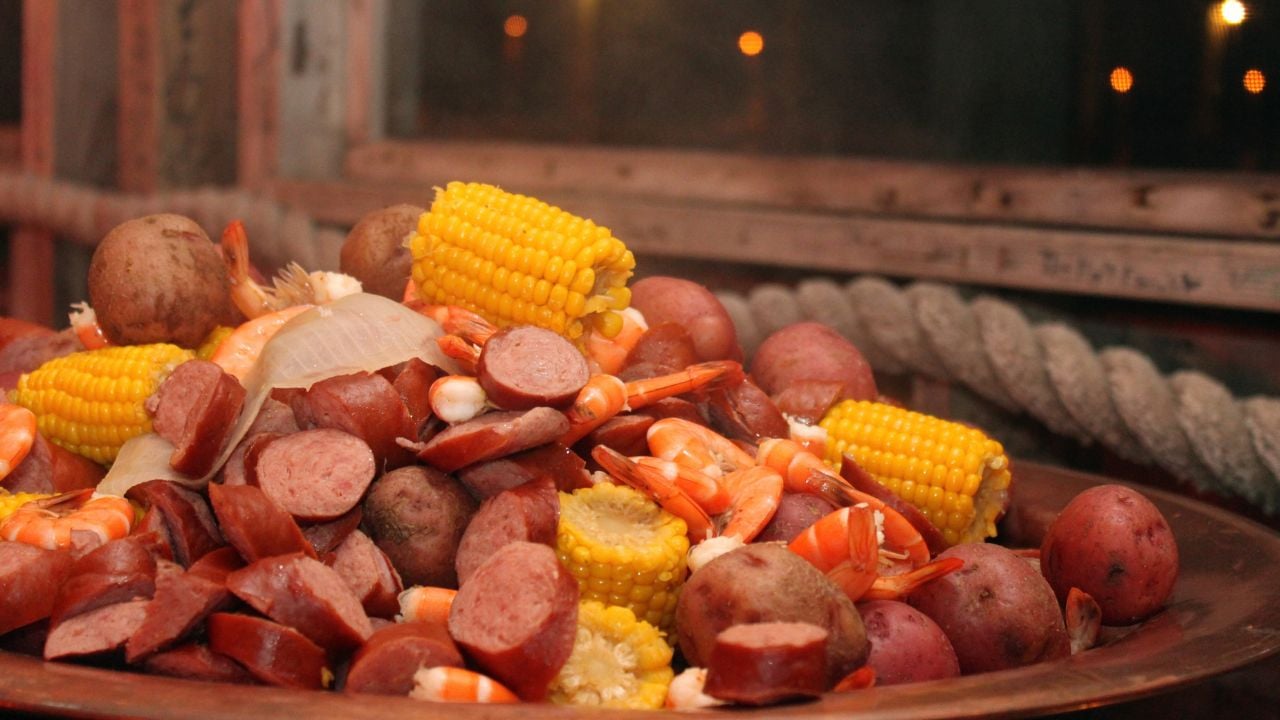
Frogmore stew is a one-pot boil built on fresh shrimp and newly shucked yellow corn, according to the South Carolina Encyclopedia.
In the recipe, you boil sliced spicy smoked sausage for five minutes, add the corn for five more, and finish with the shrimp for three.
If you cook it, two keys to success are to stagger the addition of the ingredients and not to overcook the shrimp.
Frogmore stew is a casual meal best eaten with the fingers and served on a picnic table covered with newspaper.
Some claim the dish started in the Frogmore community on St. Helena Island, near Beaufort.
It also goes by Beaufort stew and Louisiana boil, and the dish exists throughout the coastal regions of the South.
The recipe ends by telling you to serve it in a Carolina beach house surrounded by friends and family.
Psst! How much do you know about South Carolina’s symbols and history? Take our quiz and see how many you can get right.
Quiz
South Carolina Pop Quiz
Answer these questions on South Carolina’s symbols and history. Think you can get them all right? Prove it.
Which work is South Carolina’s official state opera?
11. Beach Trips to the Grand Strand
The South Carolina Encyclopedia says the Grand Strand hosts more than thirteen million visitors a year.
From its earliest days, the coast was promoted as a family resort.
The first visitors were middle-class and blue-collar families from the Carolinas seeking a summer getaway in their "backyard."
If your family drove to the beach every summer, you followed the pattern of those first visitors.
The Grand Strand officially stretches along 60 miles of Horry and Georgetown Counties.
Unofficially, the name has referred to the greater Myrtle Beach area since the early 1920s, after a promotional article titled "Myrtle Beach, South Carolina, America's Finest Strand."
12. Checking the Tide Chart
The City of Charleston tells residents to view tide tables to see predicted high tides and king tides in advance, according to its king tides page.
The TIDEeye tool is for keeping an eye on local weather and tides, as well as their impact on traffic and road closures.
The average high tide is about 5.5 feet above mean lower low water (MLLW), but during a king tide the high tide may reach 7 feet or higher above that datum.
Charleston Harbor had more than 50 sunny-day floods in 2025, the Post and Courier reported.
If you check a tide table, 7.0 feet at the Charleston Harbor gauge is the National Weather Service's minor flood threshold.
Moderate starts at 7.5 feet, and major starts at 8.0 feet.
If you're in Charleston in October, you're there in the month with the most 7.0-foot floods.
The tables count 272 of them since 1921 through September 2026.
The three highest months on record at that level were all Octobers: 22 events in 2015, then 18 each in 2019 and 2025.
7 South Carolina Porch Traditions That Are Slowly Disappearing

Front porches in South Carolina carry habits that are fading.
See how many of these porch traditions you remember from your front steps.
7 South Carolina Porch Traditions That Are Slowly Disappearing
8 Storm Season Habits Worth Copying From Longtime South Carolinians

Storm season in South Carolina teaches routines you can use anywhere.
Longtime residents have a few habits worth borrowing before the next forecast.
8 Storm Season Habits Worth Copying From Longtime South Carolinians
