
3 Nebraska Livestock Laws Drivers Learn After a Collision

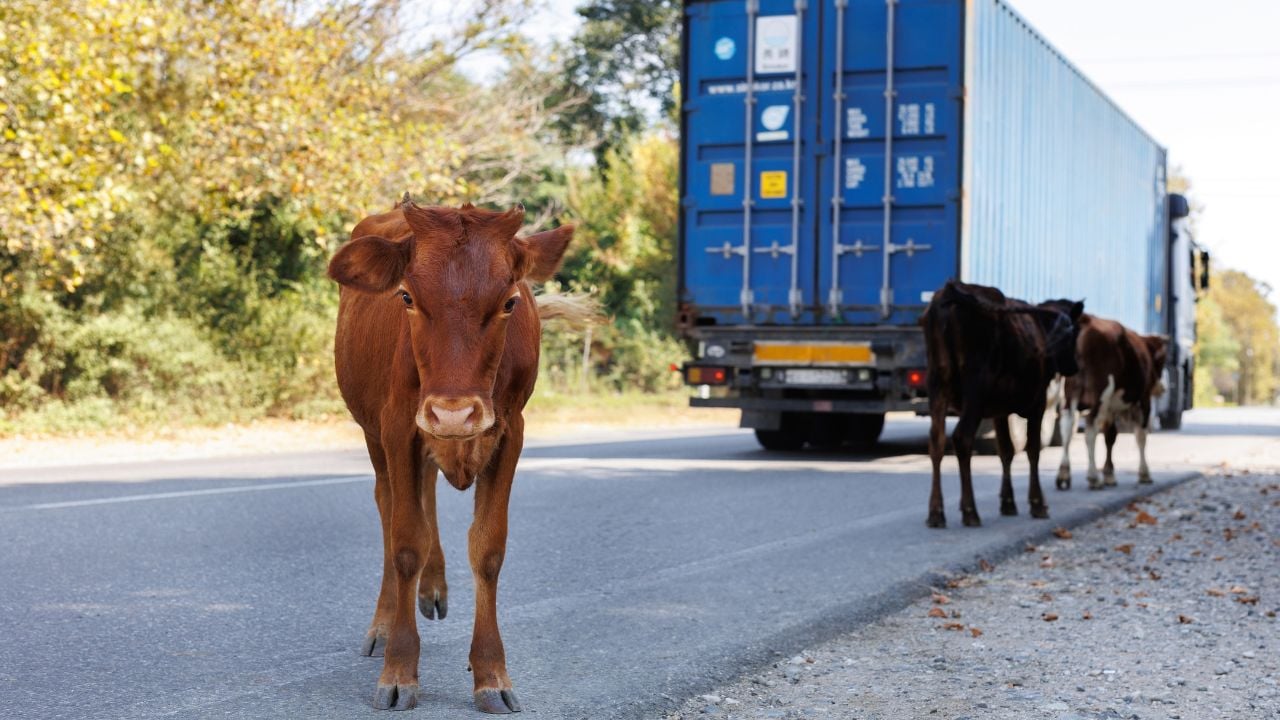
Coming around a bend to find cattle on the road is scary.
Nebraska law spells out who’s responsible when a car and a loose animal collide, and the answer isn’t always what drivers expect.
Here’s what to know before you ever need it.
Note: This is general information, not legal or insurance advice. Livestock and traffic laws are subject to change.
1. Negligence, Not Strict Liability
Livestock collisions fall under a civil-liability statute, Section 25-21,274, that covers any collision between a motor vehicle and a domestic animal on a public highway.
If you sue after a collision, the burden of proving your case stays with you.
The statute sets the standard of care at ordinary negligence, not strict or absolute liability.
Strict liability would hold a defendant liable for an action regardless of intent or mental state.
Escaped livestock isn’t, by itself, enough to raise an inference of negligence against the owner.
The statute applies to suits brought by a vehicle’s owner, operator, or occupant, and to suits brought by the livestock’s owner.
What Counts as Owner Negligence
University of Nebraska-Lincoln Extension’s 2014 guide to cattle collisions says the plaintiff has to show the owner was responsible for, or negligent in, letting cattle onto the roadway.
Examples of owner negligence are fences that weren’t being maintained, a gate left open, and a history of cattle continually getting onto public roads.
In McLaughlin Freight Lines v. Gentrup, a 2011 Nebraska Supreme Court case, the freight company offered other evidence in addition to the escape.
The court said the statute didn’t bar that claim, then reversed the judgment and sent the case back for further proceedings.
2. Right of Way for Herds
Section 60-6,378.02, in force since July 18, 2026, gives livestock on or along a highway the right-of-way over your vehicle.
The rule covers any person who is leading, herding, or driving livestock.
The statute defines livestock as any horse, mule, donkey, cattle, swine, sheep, or goat.
You have to use caution when you approach or pass those people.
If one of them raises a hand as a distress signal, you have to stop promptly.
You also have to yield the right-of-way to the livestock.
Those duties don’t apply if moving your vehicle is necessary to avoid an accident.
A first violation is a traffic infraction.
A second or later violation within five years after a conviction is a Class IIIA misdemeanor.
3. Roads Closed to Herds
Livestock can’t be led, herded, or driven onto a roadway with a posted minimum speed limit of 20 miles an hour or more, under Section 60-6,193.
The same subsection points to freeways, where the Rules of the Road already prohibit animal traffic.
A posted minimum speed limit doesn’t take effect until signs along the roadway tell you about it.
Lawmakers last amended the section in 2026.
Psst! How much do you know about backroads and ranch life? Take our quiz and see if you can ace it.
Quiz
Backroads and Ranch IQ
Answer these questions on Nebraska backroads, farms, and ranches. We bet you can’t get them all right. Prove us wrong?
How many hogs and pigs did Nebraska have on December 1, 2025?
Reporting the Crash
A collision with livestock can fall under Section 60-699, Nebraska's crash-report statute.
If an accident injures or kills someone, or apparently damages anyone's property by $2,000 or more, you have to send the Department of Transportation a report within ten days.
That total counts damage to the property of any one person, including the vehicle you drive.
You don't have to file a report if a peace officer investigates the accident.
The statute makes a failure to report an accident a Class V misdemeanor.
What Insurance Covers
For a livestock collision, the Nebraska Department of Insurance lists hitting animals under comprehensive coverage on an auto policy.
Theft, hail, windstorm, flood, and fire are in the same category.
Collision coverage pays for damage to your car from a collision with another car, an object, or a pothole.
Loose Bulls and Estrays
Livestock you find running loose can fall under a legal label, the estray.
Section 54-180 defines an estray to include livestock found running at large on public or private land whose owner is unknown in the area where it's found.
Section 54-415 requires anyone who takes up an estray inside a brand inspection area to report it to the Nebraska Brand Committee within seven days.
The statute makes a violation a Class II misdemeanor.
Section 54-304 tells the owner of any stallion, jack, bull, buck, or boar to restrain the animal.
The same statute lets any person take possession of such an animal running at large in the county where the person lives or uses real estate.
The statute then requires that person to notify the sheriff or a constable.
Hides on Dead Cattle
Cattle and sheep found dead fall under a livestock hide rule, Section 54-309.
If you find a dead cow or sheep, only the owner, or the owner's agent or employee, may lawfully skin it.
The statute doesn't mention vehicles, and the only exception it lists is for railroads, whose employees may remove the hides from stock killed by trains.
Division Fences
Livestock fencing starts with Section 34-115, which defines seven kinds of lawful fence, including a hog and sheep tight fence.
Section 34-116 sets the minimum height at four and one-half feet and caps the spaces between boards, rails, poles, and wires at one foot each.
If you own land next to a neighbor's, Section 34-102 makes each of you responsible for a just proportion of the division fence between you.
Unless the neighbors agree otherwise, that works out to an equal share of the construction and upkeep.
Stock on Another's Land
If a neighbor's livestock damage your land, Section 54-401 makes the owner liable.
The statute makes the owners of cattle, horses, mules, swine, sheep, and goats liable for all damages their stock does on another person's land.
An owner isn't liable when the landowner claiming damages caused negligent or willful harm to the division fence.
The statute's history traces to 1871, and lawmakers last amended it in 2008.
Under Section 54-402, a landowner whose property is damaged can claim a lien on the trespassing animals for the full amount of damages and costs.
A lien is a legal right to hold property as security for a debt, and the statute says the landowner can enforce it through a civil action.
9 Everyday Habits That Only Make Sense to Nebraskans
Nebraska's Natural Resources Districts put an unusual race on the ballot: A seat on the local water board.
These are the everyday habits that only make sense to Nebraskans.
9 Everyday Habits That Only Make Sense to Nebraskans
6 Nebraska Town Feuds That Go Back More Than a Century
Try explaining to someone from another state why Nebraska's athletic department cleared Memorial Stadium, the Huskers' home turf, for two high schools to settle a rivalry there.
Nobody explains it well.
