
7 Virginia Ham Facts Virginians Take More Seriously Than Out-of-Staters Expect

For a lot of Virginians, ham is more than something to slice for dinner.
There’s a long history and real pride behind it, and visitors don’t always see that coming.
Here are the ham facts that can start a friendly argument.
1. Dry-Salt Cure
Virginia ham starts with a dry cure, and Virginia Tech’s extension service publishes a step-by-step guide to doing it at home.
The U.S. Department of Agriculture’s ham guide lists Smithfield ham as an aged, dry-cured ham made exclusively in Smithfield, Virginia.
Dry curing is also the process used to make country ham.
One way to time the cure is one and a half days per pound of ham.
The cure mix calls for 8 pounds of salt for every 100 pounds of fresh meat.
You’d keep the hams at 36 to 40°F the whole stretch, since steady temperature control is essential to a good finished product.
If you’re curing Smithfield-style, smoke the hams for a long time at a low temperature, below 90°F.
2. Smithfield by Statute
Smithfield ham is a legal term in Virginia, not a flavor description.
Virginia law defines a genuine Smithfield ham as a ham cured by the long-cure, dry salt method and aged at least six months.
If you’re looking at a ham aged only five months, it doesn’t meet the definition.
The six months run from the day the raw pork cut first goes into the dry-salt cure.
The processing, smoking, curing and aging all have to happen inside the town limits of Smithfield.
What the Smithfield Label Covers
Genuine Smithfield ham is a protected label, and Virginia backs it with a criminal penalty.
The rule reaches anyone who knowingly labels, packs, advertises or sells a ham as genuine Smithfield without meeting the definition.
It covers a ham whether it’s wrapped or unwrapped, in a container or loose.
A violation is a Class 4 misdemeanor, and Virginia sets the fine for that class at $250 at most.
3. Peanut-Fed Hogs
Smithfield ham once had a diet rule for the hog written into the law.
The 1926 definition called for peanut-fed hogs raised in the peanut belt of Virginia or North Carolina.
Then the rule changed.
A peer-reviewed article in Animal Frontiers says the peanut-fed requirement was dropped by 1966.
If you read the current definition in the Code of Virginia, you won’t find a peanut in it.
4. Mold on the Outside
When you age a ham at home, Virginia Tech’s dry-curing guide tells you to use an exhaust fan controlled by a humidistat, a humidity-sensing control, to limit mold growth.
Mold often turns up on country cured ham, according to USDA’s ham guide.
Molds grow during the long curing and drying because the high salt and low temperatures don’t inhibit them.
Most of these molds are harmless, but some can produce mycotoxins, the toxic compounds certain molds make.
If you find mold on a country ham, don’t discard it.
Wash the ham with hot water and scrub off the mold with a stiff vegetable brush.
5. Early Export
Virginia ham was one of the first agricultural products exported from North America, according to Virginia Tech’s extension service.
Early clergymen praised the product, and the Reverend Andrew Burnaby reported that Virginia pork was better in flavor than any in the world.
Virginia ham has remained a high-quality product after more than three centuries.
If you’re curing a ham at home, the goal is to recapture the flavor those early clergymen praised.
6. Thin Slices
Virginia ham tastes best sliced thin, according to Virginia Tech’s extension service.
Slicing it that thin calls for a sharp knife, preferably long and narrow.
Calvin Schiemann, a retired extension agent, wrote a 2014 guide to cooking salt-cured hams that a Virginia Tech extension site hosts.
Slice thickness, not soaking time, is the main factor in how salty a ham tastes.
If you’re slicing a cooked ham, cool it completely first, since a hot or warm ham is difficult to slice thinly.
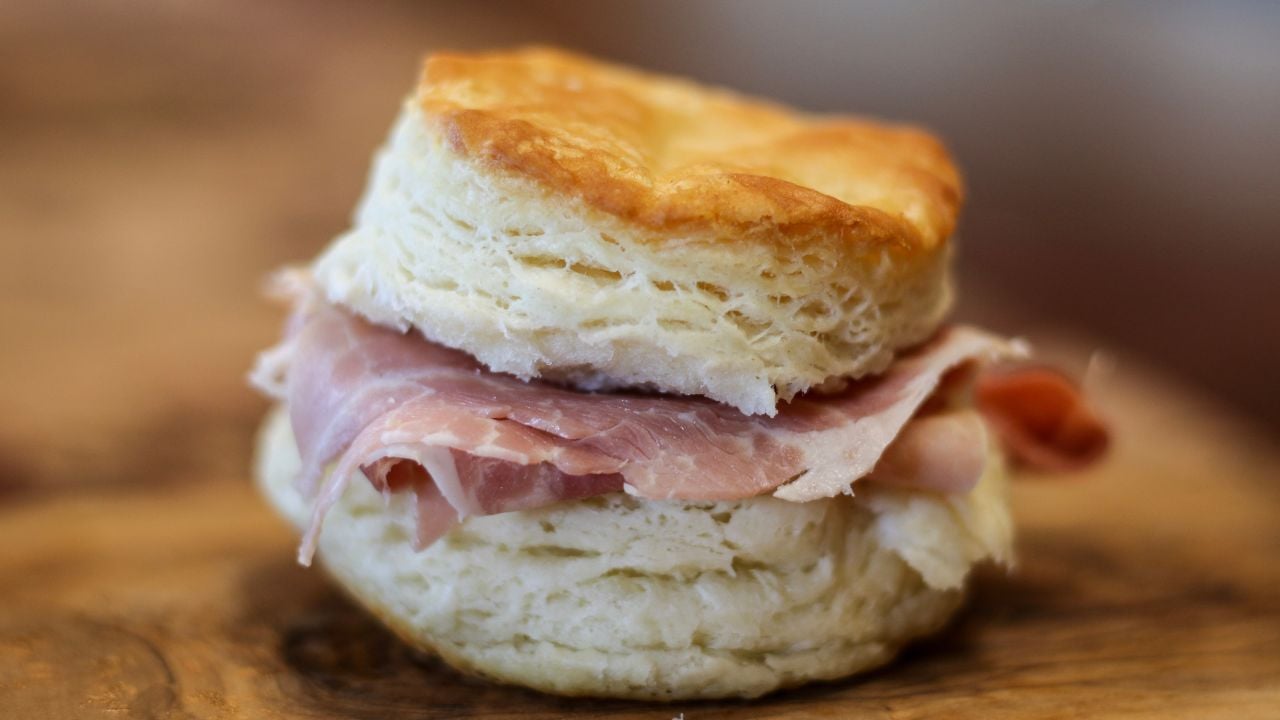
7. Ham Biscuits
Ham biscuits are on the menu at weddings and funerals, Christmas parties and football tailgates, according to Virginia Living.
Virginia’s tourism site goes a step further and calls them a staple at any Virginia gathering.
The ham itself predates the biscuits by several centuries.
If you’re making ham biscuits at home, Calvin Schiemann’s guide calls thinly sliced ham desirable for serving them.
An Animal Frontiers article on country ham says it’s most famous in small dishes like biscuits filled with thin slices of salty ham.
Psst! How much do you know about country ham and city ham? Take our quiz and see if you can ace it.
Quiz
Country vs. City Ham
Answer these questions on country ham, city ham and the Smithfield ham story. We bet you can’t get them all right. Prove us wrong?
True or false: A ham at the Isle of Wight County Museum in Smithfield, Virginia, has a 24-hour livestream.
Genuine Smithfield Ham After 2024
Virginia Commonwealth University's news service reported that Smithfield Foods announced in January 2024 it would discontinue its brand-name Genuine Smithfield Ham.
The company was the last such producer within the town limits.
If you were hoping for the same six-month ham, the company's replacement was a mild-cure country ham aged four months.
The Code of Virginia's page for the definition lists no amendment after 2008, so the six-month rule still stands.
A small ham-curing company could open a smokehouse inside the town limits and resurrect the town's legacy, wrote the publisher emeritus of the Smithfield Times in a February 2024 column.
In his view, perhaps only a lack of money and a marginal market stand in the way.
Dry-Cured Ham Storage
Dry-cured hams, the kind Smithfield ham is, are safe stored at room temperature, according to USDA's ham guide.
They contain so little water that bacteria can't multiply in them.
A whole, uncut country ham keeps safely at room temperature for up to 1 year.
Once you cut into a country ham, the uncooked ham keeps for 2 to 3 months in the refrigerator.
City Ham and Country Ham
University of Kentucky researchers say wet-cured ham, which you may know as city ham, is more common than country ham.
If you're comparing the two, dry-cured ham isn't injected with, or immersed in, a curing solution.
Country ham's flavor is complex and its texture is unlike that of other hams, the researchers write.
An Animal Frontiers article estimates the United States produces 2.5 million country hams a year.
9 Things Virginians Can't Legally Do to a Neighbor's Tree

Virginia has rules about what you can do to a neighbor's tree, and ignoring them can get expensive.
Tree trouble usually starts a lot smaller than that.
9 Things Virginians Can't Legally Do to a Neighbor's Tree
9 Conversations Virginia Families Put Off Until an Emergency Forces Them

Some of the hardest family talks in Virginia wait until an emergency forces them.
These are the talks many families put off.
9 Conversations Virginia Families Put Off Until an Emergency Forces Them
