
7 Things Arizona Homeowners Should Do Before the First Freeze

What do you do with your hose, your citrus tree and your potted plants when a freeze is on the way?
In Arizona, the answer is different for each one, and you’ll want to know it before the thermometer drops.
Here’s what to do ahead of time, what to leave alone afterward and what changes if you live in the high country.
1. Wrapping Your Backflow Preventer
A backflow preventer is the mechanical device that keeps water from being pulled backward into the water system.
In Phoenix, you can insulate yours with rubber or foam insulation.
For a short-term solution, you can cover it with a thick blanket and secure it.
Irrigation pipe can freeze and, depending on the type, break.
The best prevention is to bury the piping deep enough or wrap it with insulation.
Insulate your irrigation valves and every other household plumbing line outside your home, too.
Outside Phoenix, check your city’s guidance.
2. Covering Your Citrus Trees
Lemon, lime and citron trees suffer at least some damage when temperatures drop below 25 degrees Fahrenheit, the University of Arizona Cooperative Extension says.
Sour oranges, tangerines, tangelos, sweet and navel oranges and grapefruit are partially cold hardy and may survive temperatures as low as 20 degrees without significant damage.
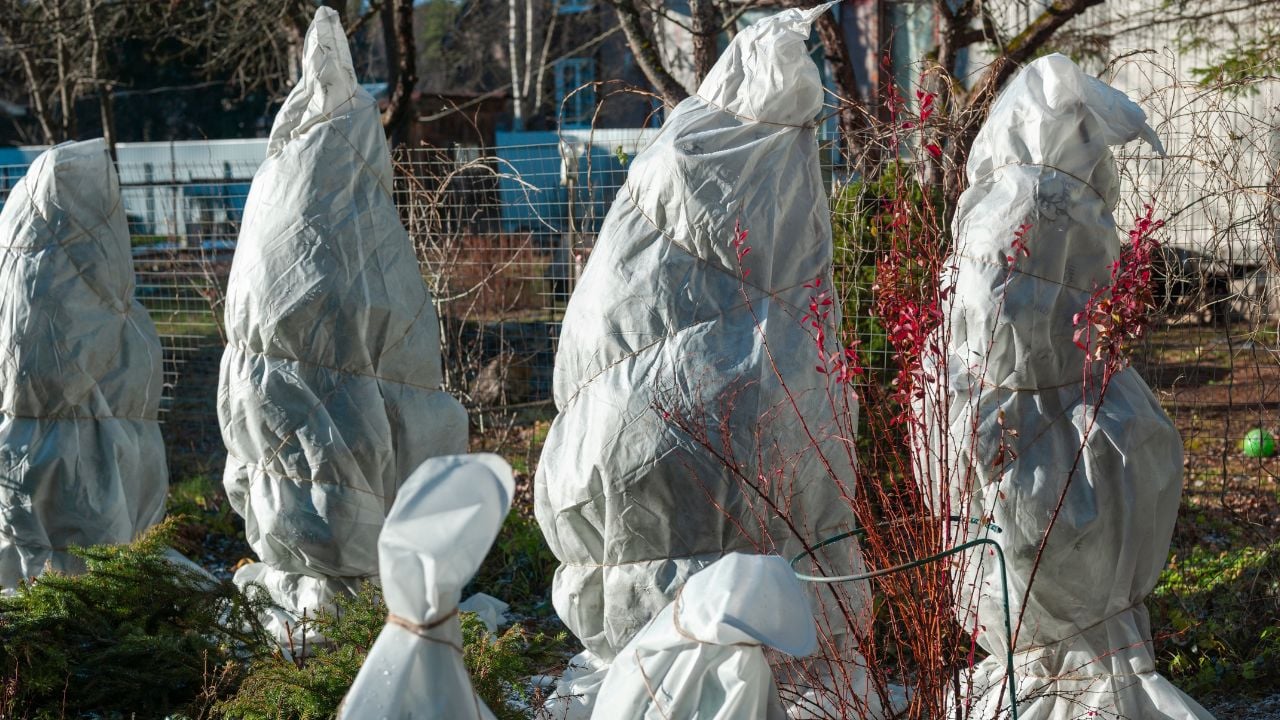
You can cover small trees with blankets, quilts or burlap sacks to conserve the heat they gathered during the day.
A string of old-style Christmas lights in the canopy adds heat for a small or medium tree.
The lights work best on a covered tree, and they must stay away from water.
Keep the soil around the tree moist, since moist soil radiates less heat to the air at night.
Moist soil works much better when the ground around the tree is bare.
Skip pruning ahead of the cold, since pruning may stimulate new, tender growth.
3. Checking Your Freeze Dates
Check the freeze history for the weather station nearest you because elevation, slope and the concrete and asphalt around a location change how many frost-free days it gets.
NWS Tucson’s table puts the average first freeze at 32 degrees or lower on Nov. 26 and the 1991-2020 normal a week later, on Dec. 3.
Phoenix averaged one day a year at 32 degrees or lower from 1991 to 2020, but 1964 had 35.
Then check a thermometer in your yard, which may read several degrees warmer or colder than the temperature the news reports.
What a Phoenix Freeze Watch Tells You
These are NWS Phoenix’s alert criteria, so if you live in Tucson, your alerts come from NWS Tucson instead.
NWS Phoenix normally issues a Freeze Watch 2 to 5 days before temperatures of 32 degrees or lower are expected for the first time of the winter season.
That means you may have only a few days to finish this list.
A Freeze Warning means those temperatures are occurring or imminent, and either alert can cover any occurrence in a major population area, not just the first of the season.
4. Wrapping Tree Trunks
Wrapping the trunk of a young citrus or other frost-sensitive tree is a practical way to prevent serious frost damage to its vital stem area.
Use multiple layers of weatherproof paper or cloth.
Looser wrapping insulates better.
Run the wrap completely to the ground and at least up to the lower branches.
Burlap, towels and even cardboard work as wrapping.
You can leave the wrap on all winter, from mid-November through mid-February.
5. Covering Potted Plants and Cacti
Bring your vulnerable potted plants indoors when frost or a freeze is predicted.
For a light frost, moving them under the porch and close to the house walls, which may hold some daytime warmth, will probably be enough.
Shrubs and other plants that stay outside need a cover that reaches the ground, and it goes on before dusk so the soil’s daytime warmth isn’t lost.
Sheets, blankets and towels all work.
White frost cloth, sold by the foot at most garden centers, can stay on during the day because it lets sunlight through.
Public radio station KJZZ reports that young plants and plants in containers are more vulnerable to the cold.
The Desert Botanical Garden in Phoenix recommends N-Sulate fabric, burlap or old sheets instead of plastic coverings.
Secure covers on spiny plants with twine or wooden clothes pins to avoid damage to spines.
Psst! How much do you know about Arizona weather? Take our quiz and see how many you can get right.
Quiz
Arizona Weather IQ
Answer these questions on Arizona weather. We bet you can’t get them all right. Prove us wrong?
In which year did Phoenix have its coldest January on record?
6. Draining Your Hoses
Take the garden hose off the outdoor spigot, drain it and store it somewhere warmer, like the garage, the city of Phoenix says.
Keep the garage door closed so colder air stays out.
Before temperatures drop below 32 degrees, open outdoor spigots to drain the water out and put faucet covers on.
Open the cabinet doors under your sinks so warmer air from inside the house can circulate around the pipes.
7. Finding Your Shutoff Valve
Learn where your main water shutoff valve is before temperatures drop below freezing.
It's usually where the water supply enters your home, commonly in the garage or in a concrete or metal box near the street.
In Phoenix, a burst pipe means turning off the water at the valve near where the service enters your home.
If that valve is broken, call the city to have the service turned off at the water meter.
Never try to turn off the water at the water meter yourself.
For an emergency water line problem in Phoenix, call 602-261-8000.
Freeze Warnings in High Terrain
If you live in the Mazatzal Mountains or in southeastern Gila County, including Globe and San Carlos, you're in one of NWS Phoenix's high terrain zones.
In those zones, NWS Phoenix typically issues a single Freeze Warning.
It can reissue the warning after the first freeze verifies if widespread impacts are possible.
Pruning After a Freeze
Leave your freeze-damaged plants alone until they start growing again in spring because pruning may stimulate new growth that late frosts can damage.
Damaged leaves and stems keep trapping warm air in the canopy, and new growth may come out of tissue that looked dead.
For citrus, prune out the dead wood after the spring growth flush shows the extent of the damage.
To find the dead wood, scrape the bark with a knife, since live wood is green just under the bark and dead wood is brown.
After pruning, paint any bark newly exposed to the sun with white water-based latex paint or whitewash to prevent sunburn and eventual disease.
8 Smart Home Myths Arizona Homeowners Still Believe
Smart devices can raise legal questions at home.
A doorbell camera is one place those questions start.
8 Smart Home Myths Arizona Homeowners Still Believe
8 Arizona Water Rights Rules Rural Property Owners Get Wrong

Water rules on rural land can surprise a buyer.
A well on the property can be one place the surprises start.
8 Arizona Water Rights Rules Rural Property Owners Get Wrong
