
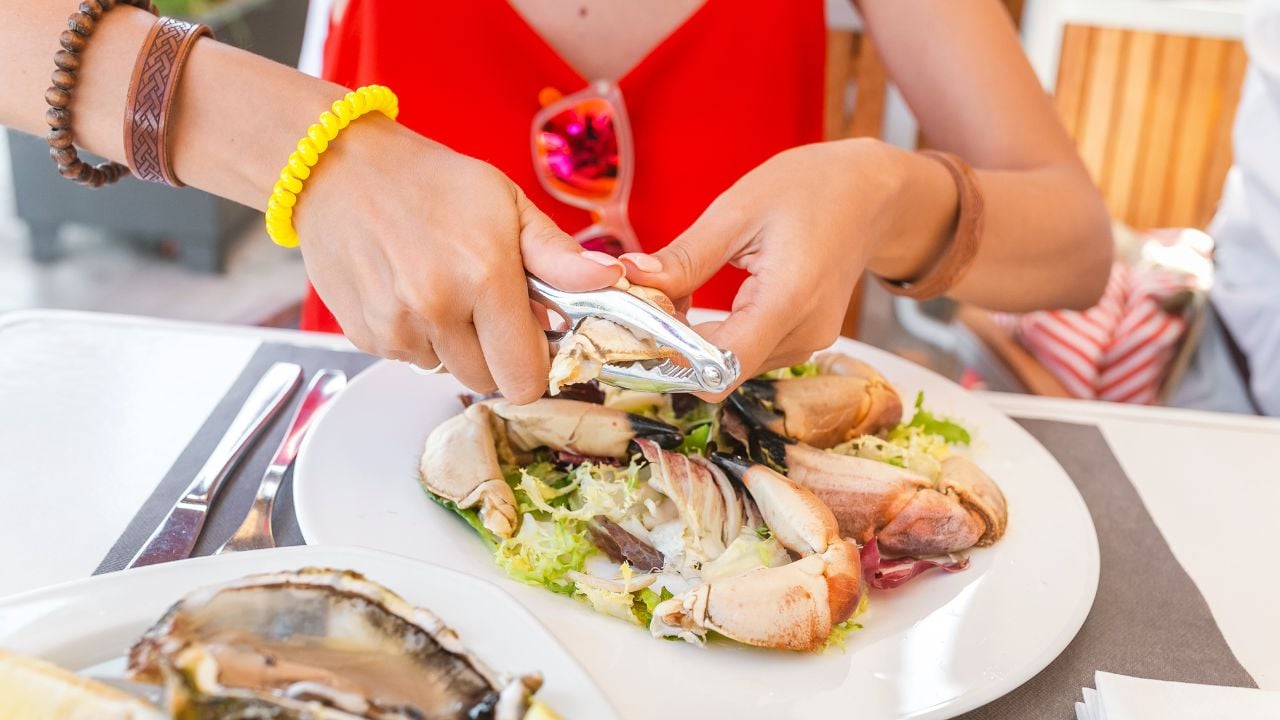
7 Stone Crab Season Rules Tourists Learn From Floridians

Pull up a stone crab with a legal-size claw, and you still might have to let her go with it.
If she’s carrying an egg sponge, her claws stay on, no matter their size.
Here are the stone crab season rules tourists learn from Floridians, before you set your first trap.
Note: This is general information, not legal advice. Fishing rules are subject to change, so confirm the current requirements with the Florida Fish and Wildlife Conservation Commission (FWC).
1. Season Dates
Stone crab season runs from Oct. 15 through May 1.
May 1 is the last day of harvest, and May 2 starts the closed season.
You can still find claws at a seafood counter after May 1.
That’s because a licensed wholesale or retail seafood dealer may sell them during the closed season, as long as the claws went into the dealer’s inventory before May 2.
Harvesting is another matter.
Claws can’t be harvested from traps pulled after the season closes.
2. Claws Only
Only claws are legal to harvest, so a whole stone crab can’t ride home in your cooler.
Both claws are legal to take, as long as each claw is big enough.
But taking both leaves the crab with few alternatives to defend itself from predators.
A study found that 47 percent of crabs that lost both claws died from the trauma.
That’s nearly half.
Adult crabs take about a year to regrow a lost claw.
Harvesters should remove claws with care so the crab isn’t permanently injured.
If you harvest claws yourself, your gear is a stone crab trap, a dip net or a landing net.
Spears, hooks and any other device that can puncture, crush or injure the crab’s body are illegal.
3. Minimum Claw Size
A stone crab claw has to clear a size minimum.
How big, exactly?
A claw must measure at least 2 7/8 inches before you can harvest, possess or sell it.
Recreational and commercial harvesters follow the same minimum.
A smaller claw can’t be kept, even if you pulled it from your trap.
How FWC Measures a Stone Crab Claw
You measure the length of the claw’s forearm, which the rule calls the propodus.
The line runs straight from the elbow to the tip of the lower immovable finger.
A legal claw comes out to 73 millimeters or more by that measure.
4. Egg-Bearing Crabs
Before you remove a claw, check the crab for an egg sponge.
Claws from an egg-bearing female are off limits, even when they clear the size minimum.
Removing her claws is unlawful, and so is having her on board your vessel.
Her claws stay on.
A crab carrying eggs has to go back into the water immediately, unharmed.
5. Daily Bag Limit
Your stone crab bag limit is 1 gallon of claws per person or 2 gallons per vessel, whichever is less.
Alone, you get 1 gallon.
Two people on one boat can keep 2 gallons between them.
A third person on your boat doesn’t raise the cap.
The vessel limit stays at 2 gallons.
FWC said in October 2025 that stone crab regulations are the same in state and federal waters.
6. Trap Registration
Stone crab trap rules start with paperwork.
Each year, a recreational harvester age 16 or older completes an online registration.
It costs nothing.
You need it even if you normally don’t need a fishing license.
You can fish only the 5 traps registered to you.
Each trap has to carry your name, address and registration number, permanently attached.
Registration numbers for stone crab traps begin with the letter S.
Your buoy must be at least 6 inches and carry a legible R at least 2 inches tall.
Harvesters under 16 skip the registration but still mark their traps with a name and address.
7. Trap Handling
Traps can go in the water as early as 10 days before the season opens.
Then comes the wait.
You may not tend them until the season starts.
After that, you pull traps only during daylight hours, and you pull them by hand.
A vessel rigged with a trap-puller is considered a commercial vessel.
Every recreational and commercial plastic or wood trap also needs an unobstructed escape ring measuring 2 3/16 inches in diameter.
When the season ends, traps have to come out of the water within five days.
Cooked Claws
Claws reach the seafood counter fully cooked, whether you buy them fresh or frozen, according to Florida’s Department of Agriculture and Consumer Services.
Cooking starts right after harvest to keep the meat from sticking to the inside of the shell.
Claws come in three size grades by claws per pound.
Medium runs 6 to 8 claws per pound, large runs 5 to 6, and jumbo runs 2 to 4.
Fewer claws per pound means bigger claws.
Keep cooked claws in the coldest part of your refrigerator, and use them within two days.
Claws with uncracked shells freeze for up to six months.
Thawing takes patience.
Plan on 12 to 18 hours in the refrigerator, since thawing in cold water affects flavor and texture.
Psst! How much do you know about seafood and the shoreline? Take our quiz and see how many you can get right.
Quiz
Coast and Catch IQ
Answer nine questions on lobster, blue crab and the shoreline. We bet you can’t get them all right. Prove us wrong?
Which of Florida’s two coasts has more tidal shoreline?
Joe's and the Mustard Sauce
Joe's Stone Crab on Miami Beach began in 1913 as a fish-sandwich restaurant, according to a Miami public radio story marking its 100th year.
Then came the claws.
As the family tells it, a marine biologist studying Biscayne Bay brought stone crabs over to see whether they could be cooked.
The restaurant's sales still come from icy cold stone crabs and a mustard dipping sauce.
The state's agriculture department also pairs claws with a mustard sauce in its stone crab guide.
If you'd rather skip mustard, there's drawn butter with fresh lime juice.
13 Things Floridians Never Have to Explain to Each Other
Ask a Floridian why they keep checking the sky, and they won't slow down to explain.
Out-of-staters need the whole story.
13 Things Floridians Never Have to Explain to Each Other
6 Things Floridians Notice Once Snowbirds Are Back

Somewhere in your normal routine, you notice that winter visitors are back.
They don't all arrive at once, but you can tell when the season starts picking up.
