
5 Things That Happen Inside a Washington Apple Warehouse All Winter

Every day all winter, someone in a Washington apple warehouse checks the air in each sealed storage room.
It’s one of the jobs that keep apples ready for your cart long after harvest.
Here’s what happens inside an apple warehouse all winter.
1. Sealing Each Room
In an apple warehouse, a controlled atmosphere (CA) room is an airtight room with cooling tailored to the variety inside.
An apple you buy next spring can have stayed sealed in a CA room for six to 12 months.
The Washington State Department of Agriculture (WSDA) requires a newly sealed room to get its oxygen down to 5% within 20 calendar days.
State rules set a minimum CA storage period of 60 continuous calendar days for most apple varieties.
Operators also report each room’s sealing date and the quantity of fruit by variety.
On Feb. 1, 2026, Washington had 105.2 million bushels in storage, down from 107.4 million a year earlier, and 80.5 million of them were in CA rooms.
2. Settings by Variety
The Honeycrisp and the Fuji you buy come out of rooms an apple warehouse sets to different numbers.
Washington State University (WSU) researchers say Honeycrisp and Fuji are second and third in Washington by volume, and the two don’t share a setting.
In Washington, Honeycrisp is generally stored at 2% to 4% oxygen and 0.8% to 1% carbon dioxide, while commercial Fuji storage runs 1% to 2% oxygen and less than 1% carbon dioxide.
Those levels can shift with where the fruit grew.
In one trial, researchers stored Honeycrisp at a colder setting than recommended to see how it affected chilling injury disorders such as soft scald and soggy breakdown.
They checked the fruit after nine months in CA and four weeks in regular air.
Under state rules, Gala and Jonagold need only 45 continuous calendar days in CA storage, while other apple varieties, Honeycrisp and Fuji included, need 60.
3. Daily Readings
WSDA rules require an apple warehouse to record the carbon dioxide and oxygen percentages and the temperature in each sealed CA room at least once a day.
A CA apple you buy next spring can come from a room that operators logged every day of the winter.
Each reading gets a time and date, and WSDA can audit the records.
In dynamic controlled atmosphere (DCA) storage, oxygen follows the low oxygen level, the amount of oxygen in storage before fermentation starts.
WSU lists chlorophyll fluorescence, respiratory quotient and ethanol concentration as the commercial systems for running DCA.
4. Notice Before Opening
The same rules require an apple warehouse to notify WSDA before it opens a CA room, and again before it packs any CA fruit from that room.
By March 1, 2026, the tracker’s Washington total was down to 89.5 million bushels, with 68.5 million in CA rooms, down from 80.5 million a month earlier.
That’s about 12 million fewer bushels in CA rooms in a single month.
A year earlier, the March 1 total was 93.7 million.
So the CA apple you bring home in March came out of a room that had been reported to WSDA before it opened.
5. Packing Out of Storage
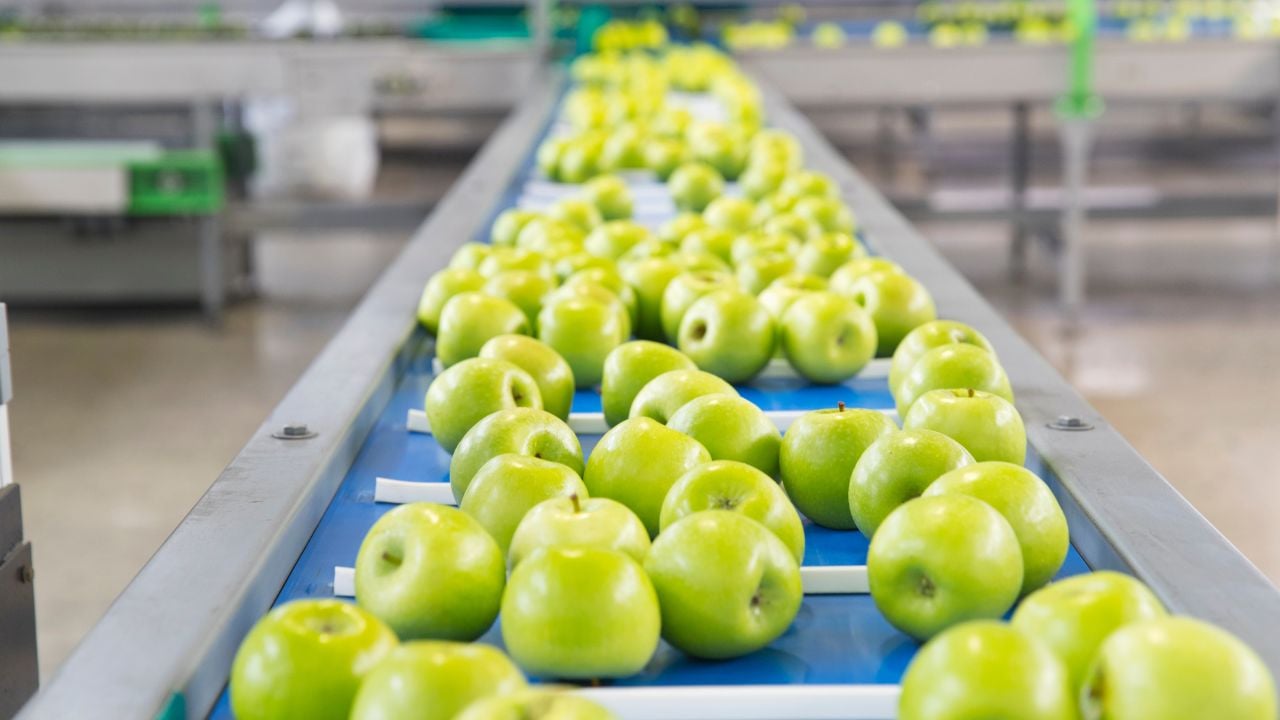
Before an apple reaches your cart, the apple warehouse pulls it out of storage to pack or presize it.
Presized fruit goes back into bins and back into storage until there’s a need for it.
Computer-controlled cameras and scales weigh, inspect and separate the apples by color, shape and size.
The Washington Apple Commission says Washington grades require a deeper, more uniform red on red varieties than U.S. grades do, and allow fewer surface blemishes, such as limb rubs, hail damage and russeting, on green and yellow varieties.
Fruit from certified CA rooms gets boxes marked CA and a state lot identification number.
From Feb. 1 to March 1, 2026, fresh-market apples in Washington CA rooms fell from 57.3 million bushels to 48.8 million.
Washington’s 2025-26 Apple Season
FreshPlaza reported that the 2025-26 Washington apple season began with Gala and Honeycrisp harvest in early August.
The Washington State Tree Fruit Association’s June 6, 2026 storage report had Washington apple holdings at about 35 million boxes, down from 38 million a year earlier.
The June report counts boxes, while the U.S. Apple Association’s monthly tallies above count 42-pound bushels.
On the Packing Line
At an apple warehouse, the packing line starts one of two ways.
With hydro handling, bins of apples go into a water dunk tank, while dry loading tips full bins directly onto the conveyor belt.
Trained personnel discard decayed fruit, known as culls, before grading.
Fruit is graded and sized by hand or by automated optical technology.
Full containers are labeled with the variety, size, grade and grower lot number, then weighed and placed on pallets.
Anything not shipping right away returns to cold storage.
Apple Exports
Some of what an apple warehouse packs won’t end up in your cart, since, FreshPlaza reported, Washington exports about 30% of its apple crop annually.
Apple exports brought in $819.32 million in 2025.
Washington’s warehouses pack from a harvest of about 132 million 40-pound boxes of fresh-market apples.
The leading export markets during the 2024-25 season were Mexico, Canada and Taiwan.
Psst! How much do you know about keeping apples fresh? Take our quiz and see if you can ace it.
Quiz
Apple Storage IQ
Answer nine questions on how apples are stored. We bet you can’t get them all right. Prove us wrong?
Washington State University says Washington Honeycrisp is generally stored at what temperature?
Storage Disorders
Even CA storage at an apple warehouse can produce physiological disorders tied to carbon dioxide toxicity.
A WSU figure shows a Fuji with tissue browning and cavities from carbon dioxide injury.
Not every apple in storage ends up in your cart.
A May 2026 Capital Press report on U.S. apple holdings said packout ratios changed for a number of varieties in late fall because quality problems affected fresh holdings.
Across U.S. holdings, 46% of Honeycrisp apples in storage and 26% of Granny Smith holdings were for processing, compared with 20% for Cosmic Crisp.
14 Everyday Habits That Only Make Sense to Washingtonians

Some Washington habits only stand out once you travel to another state.
See how many sound familiar.
