

6 Smart Thermostat Settings Tennesseans Should Change Before Winter

TVA recommends setting your thermostat to 68 degrees this winter.
Every degree lower saves you money.
If you’ve got a smart thermostat, it’s worth checking the rest of its settings, too.
Here are the smart thermostat settings Tennesseans might want to change before winter.
1. Auxiliary Heat Lockout
A smart thermostat’s auxiliary heat lockout keeps a heat pump’s backup electric heat from switching on above a set outdoor temperature.
Backup heating, such as electric strip heaters, is usually more expensive to operate, so unneeded hours of it can add to your electric bill.
On Nest thermostats, lockout temperatures can be set during professional setup and adjusted later in the Google Home app, so ask your installer, or check the app, what yours reads.
A Benchmark for Your Lockout Setting
Energy Trust of Oregon, a nonprofit energy-efficiency program, specifies a lockout temperature at or below 35°F for heat pumps in its 2025 specifications manual.
That’s an Oregon benchmark, not a Tennessee rule, but it’s a useful number to compare your lockout setting against.
2. Adaptive Recovery
A smart thermostat’s adaptive recovery setting is a learning feature.
The U.S. Department of Energy says thermostats with adaptive recovery “learn” from experience how to change from one temperature to another most efficiently.
Skip the setback on a heat pump’s thermostat if that causes the backup heating to come on.
Check your thermostat’s settings for adaptive recovery, and switch it on if it’s there.
3. Emergency Heat Mode
A smart thermostat’s emergency heat mode is a manual setting, and the Tennessee Valley Authority’s (TVA) EnergyRight program says it’s only for emergencies.
Auxiliary heat is the backup that comes on by itself, while emergency heat is the mode you switch on by hand.
The only time to use it is if your primary heat pump and auxiliary heat, the heat that turns on automatically if the heat pump malfunctions, both go out.
Because emergency heat costs significantly more than everyday heat, it will drive up your energy bill.
Before the first cold night, check your thermostat’s system mode, and if it’s on emergency heat with nothing broken, switch it back to regular heat.
Psst! How ready is your smart thermostat for winter? Run through this checklist and see where you stand.
4. Geofencing
Find the geofencing option in your thermostat’s settings and turn it on.
The federal ENERGY STAR program says geofencing lets a smart thermostat detect when you’ve left for the day and set your heating back to save money.
When you’re on the way home, the thermostat can automatically adjust the temperature.
A written schedule can’t know that you left early or got home late.
5. Away Temperature
A smart thermostat’s away temperature is the setback that geofencing triggers when you leave.
EnergyRight says that if you’re gone for eight or more hours, moving the dial back even further could save you upwards of 10% annually.
Pick a number that feels a bit too low, then raise it a degree at a time if the house feels too cool when you get back.
6. Home Temperature
Setting a smart thermostat’s home temperature to 68 degrees is TVA’s advice, and each degree you turn it down saves around 3% on your electric bill.
Agree on 68°F with everyone in your home, and make that the baseline in your thermostat.
TVA’s Demand Record
TVA’s demand record came on Jan. 22, 2025, when its preliminary figures showed 35,319 megawatts between 7 and 8 a.m. Central.
That morning, it asked customers to cut back between 6 and 10 a.m.
Its demand response programs delivered 1,300 megawatts of demand reduction that day.
For thermostats, the request was 65 to 68 degrees.
If your schedule starts the warm-up at 6 a.m., you’re heating inside that window.
TVA’s Smart Thermostat Rewards
TVA’s EnergyRight program runs Smart Thermostat Rewards, which residents and small businesses can sign up for.
Enrolling an existing thermostat earns a $65 enrollment rebate.
During a peak event, the program makes small, automatic adjustments of up to four degrees for up to four hours.
You can opt out of an event at any time using your thermostat or app.
Not all local power companies are participating, so check that your home is eligible before you sign up.
Keeping Your Thermostat Online
ENERGY STAR says a Wi-Fi thermostat lets you control your home’s heating and cooling remotely through your smartphone.
It also says a Wi-Fi thermostat should be reasonably close to the router to prevent periodic disconnections.
Before cold weather, check that yours still connects to your Wi-Fi.
Where the Heating Bill Goes
A smart thermostat controls your home’s heating and cooling, which ENERGY STAR estimates makes up almost half of the average American household’s annual energy bill.
That comes to more than $900 a year.
EnergyRight measures it differently, with heating and cooling making up about 31% of your total electricity use.
What Heats Tennessee Homes
Electricity is the main heating fuel in about 60% of Tennessee homes, based on 2020 federal survey data.
That figure doesn’t show how many of those homes have heat pumps.
Air-source heat pumps can reduce your electricity use for heating by up to 75% compared to electric resistance heating, the Department of Energy says.
Cold climate heat pumps are designed to perform in temperatures as low as 5°F.
Gas Furnace and Dual-Fuel Homes
Natural gas is the main heating fuel in about 35% of Tennessee homes, so your smart thermostat may be running a gas furnace instead of a heat pump.
Dual-fuel systems pair a heat pump with a gas furnace.
The heat pump handles most of the heating in milder weather, and the system switches to the furnace on its own when temperatures drop.
Beef Leads 7 Grocery Aisles Where Tennesseans Can’t Catch a Break This Year
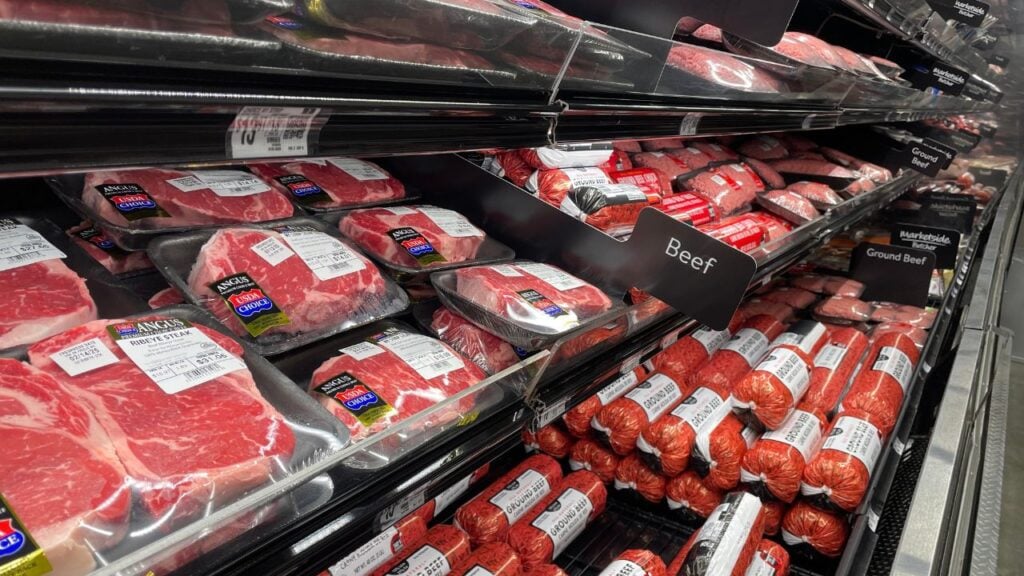
Grocery bills don’t rise at the same pace in every category.
This piece shows where Tennessee shoppers may see the steepest increases, with beef at the top.
Beef Leads 7 Grocery Aisles Where Tennesseans Can’t Catch a Break This Year
12 Things That Annoy Tennesseans the Older They Get

A few everyday aggravations can start to feel bigger as you get older.
This list names a dozen that Tennesseans may find harder to shrug off with age.
