
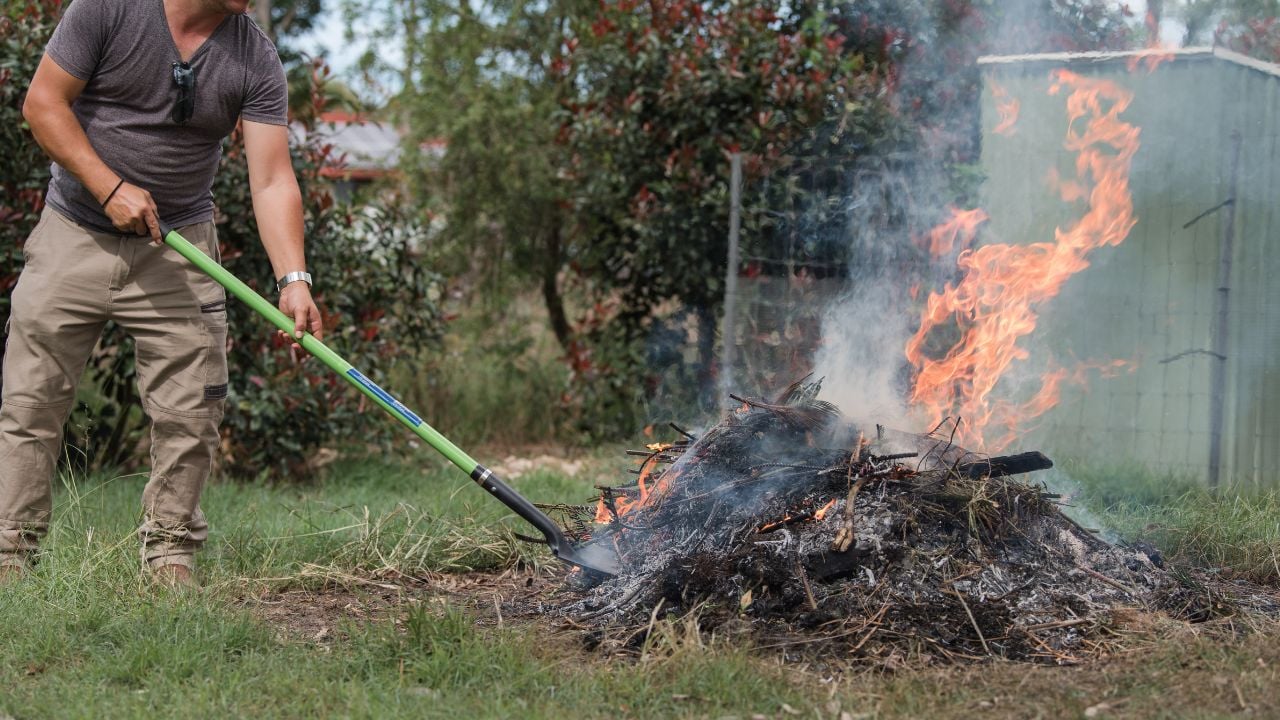
8 Outdoor Burning Rules Many Georgia Homeowners Break in the Fall

With the leaves piling up this fall, a match can seem like the easy fix, but there’s more to it than that.
In Georgia, you can only burn yard debris between official sunrise and sunset.
Here are the outdoor burning rules many Georgia homeowners break in the fall.
Note: This is general information, not legal advice. Outdoor burning rules and local ordinances are subject to change, so confirm the current requirements with the Georgia Forestry Commission.
1. Burning Anything but Natural Vegetation
Georgia’s rules limit a burn pile to natural vegetation, such as grass and hedge clippings, limbs, leaves, and pine cones.
The Environmental Protection Division (EPD) says it’s unlawful to burn man-made materials such as tires, shingles, plastics, lumber, and household garbage, even in a burn barrel.
A stray fence board in your leaf pile would count as lumber.
2. Hauling Debris to Burn Elsewhere
Debris must be burned on the property it came from.
The Georgia Forestry Commission (GFC) says debris can’t be collected at one location and hauled to another site to burn it.
Once it’s moved, it falls under EPD solid waste rules and can’t be burned.
That rules out adding a neighbor’s limbs to your pile, even as a favor.
3. Fires Too Close to Your House
Your burn pile must sit at least 25 feet from woodlands, forestland, and open fields with flammable vegetation.
It needs 50 feet from any structure, including sheds, barns, and your house.
On a small lot, that much room can be hard to find.
If your yard is too small for that, burning those leaves isn’t an option.
4. Burning Outside Daylight Hours
Georgia lets you burn outdoors only between official sunrise and official sunset.
The U.S. Naval Observatory lists Atlanta’s official sunrise on Nov. 7, 2026, at 7:02 a.m. and sunset at 5:40 p.m.
That’s a little over 10 and a half hours to burn.
On that day, a 6 a.m. burn would start about an hour too early.
By 4 p.m., less than two hours remain.
Psst! How much do you know about Georgia wildfires and fall leaves? Take our quiz and see if you can ace it.
Quiz
Georgia Fire and Leaf IQ
Answer these questions on Georgia wildfires, burn bans, and fall leaves. We bet you can’t get them all right. Prove us wrong?
What sparked the 2007 Sweat Farm Fire near Waycross, which grew into the Georgia Bay Complex?
5. Walking Away From the Pile
Georgia requires you to stay with your burn until the fire is fully extinguished.
You must take necessary precautions to keep the fire from escaping or spreading.
Examples include a continuous pressurized water source on site, a barrier such as bare soil or rocks, and hand tools like a rake or shovel.
6. Skipping Permits for Land-Clearing Burns
Burning debris from clearing land follows different outdoor burning rules than a leaf pile does.
Agriculture, forestry, and land-clearing burns require notification, a burn permit, or both.
Limbs and brush from storm cleanup are on that list too.
You can call 1-800-GA-TREES (428-7337) or apply online.
A permit is good only for the day it's issued, so a land-clearing project that runs a long weekend needs one for each day you burn.
Storm-debris, weed-abatement, and land-clearing burns are banned from Oct. 1 through April 30 in 27 counties that topped 65,000 people in the 2010 Census.
Which Burns Need a GFC Permit
Of the 13 kinds of legal open burning EPD lists, seven need a GFC permit.
Those seven are crop burning on small tracts, agricultural burning on larger ones, prescribed burning, storm debris, weed abatement, land clearing, and air curtain destructor burns.
Cooking fires, recreational fires, open-flame devices, and hand-piled leaf piles don't.
7. Burning on High Fire Danger Days
Choosing a day to burn is part of taking reasonable precautions.
Skip the burn when winds are gusty or strong, or when they push fire or smoke toward vegetation or structures.
Several days without significant rain and low humidity are reasons to hold off too.
GFC says you shouldn't burn when fire danger or the forecast is high, and it treats class 4 or 5 as dangerous.
Check the Fire Weather Forecast and the Fire Danger Rating for your area before every burn.
The Public Viewer adds a map of current wildfires, prescribed fires, and smoke forecasts.
8. Overlooking Your County's Burn Rules
Your county or city can add outdoor burning rules on top of the state's.
Gwinnett County, for one, prohibits burning yard debris on Sundays and at night.
Only leaves and limbs that fall on your property qualify.
The Fire Marshal's Office updates each day's burn status by 9 a.m.
No outdoor burning is allowed on a no-burn day.
Gwinnett bans burning within 20 feet of flammable, combustible, or explosive materials, unless the Fire Marshal or fire code specifies otherwise.
Heavy dark smoke from rubber, oil, or roofing is off-limits too.
Elsewhere, your local fire department, code enforcement office, or emergency management office can tell you what applies.
Summer Burn Ban
Georgia bans burning yard and land-clearing debris from May 1 through September 30 in 54 counties.
Your campfire or barbecue is exempt.
Cobb, Fulton, DeKalb, Gwinnett, Bibb, and Richmond are among those counties.
This year's ban ended Sept. 30.
EPD says breaking the ban may result in fines.
Georgia's 2021 Burn Law
Georgia's outdoor burning rules changed on July 1, 2021, when Senate Bill 119 took effect.
Landowners who burn hand-piled vegetation no longer need to call GFC first.
Local county and city ordinances supersede that change, so a burn that's legal under state law can be illegal where you live.
Gwinnett's Cooking and Recreational Fires
Gwinnett County's outdoor burning rules leave room for fires that aren't yard debris.
Compliant bonfires, cooking fires, and recreational fires in chimneys and outdoor fireplaces may be used on Sundays and at night.
Your fire still needs a competent person with it until it's out.
Equipment that can put the fire out, such as a garden hose connected to a water supply, must be readily available.
Escaped Burn Piles
Debris burning is Georgia's leading cause of wildfire, at over 50 percent of the state's fires.
If your pile escapes, you can be liable for any resulting damage to adjacent properties.
An Unlawful Burn Notice may be issued to a burner who doesn't follow the law, and suppression charges may apply.
5 Things a Georgia HOA Can't Stop You From Doing in Your Yard
Your homeowners association may have a lot of say over your yard, but not all of it.
Some state and federal laws protect a few of your yard choices.
5 Things a Georgia HOA Can't Stop You From Doing in Your Yard
7 Georgia Heir Property Rules That Cost Families Their Land

Inherited land with no will can leave many relatives each owning a fraction of the same yard.
Under Georgia's heir property rules, families can lose that land.
