
5 Pantry Staples Every Pennsylvanian Keeps That Out-of-Staters Have Never Seen

Ask an out-of-stater about chow-chow, and you’ll probably get a blank look.
In Pennsylvania, that sweet relish is just something you keep on the shelf.
Here are the pantry staples many Pennsylvanians have that out-of-staters have never seen.
1. Dried Sweet Corn
John Cope’s dried sweet corn dates to 1900, when Martin Cope founded the company in Lancaster County.
The nonprofit PA Eats places the Cope factory in Rheems, deep in Pennsylvania Dutch country.
Sweet corn is trucked in from across the mid-Atlantic from July to October, then roasted at a low temperature for about eight hours.
Drying keeps the corn’s sugars from turning into starch.
You can’t rush it.
You soak it overnight, then simmer it in the soaking liquid with butter, salt and pepper.
Many homes across the state put it on the holiday table.
2. Chow-Chow
Chow-chow is a relish with Pennsylvania Dutch roots, packed in a sweet brine that uses a lot of sugar.
Cauliflower, beans, onions, red and green tomatoes and carrots are typical.
Cooks often make it from produce odds and ends.
A vintage 1965 cookbook, The Complete Book of Pickles & Relishes, includes chow-chow recipes.
It adds tang and sweetness to what you spoon it onto.
A little goes far.
Chow-Chow Beyond the Pennsylvania Dutch Jar
Southern versions of chow-chow differ from the Pennsylvania Dutch jar.
The origin of the word “chow chow” is unknown, and one theory ties it to the French word for cabbage.
3. Apple Butter
Apple butter has roots in Pennsylvania Dutch cooking, where the dialect word for it is “lattwaerrick.”
The idea goes back to the Middle Ages, when monks made it to preserve the fruit.
Bauman’s of Sassamansville was founded in 1892 by John W. Bauman.
Bauman’s uses five pounds of fresh apples for each pound of apple butter.
That’s a lot of apples.
You can spread it on a biscuit, muffin or piece of toast, or mix it into a marinade for pork chops or chicken.
Serve it with potato pancakes, and you can skip the applesauce.
4. Hard Pretzels
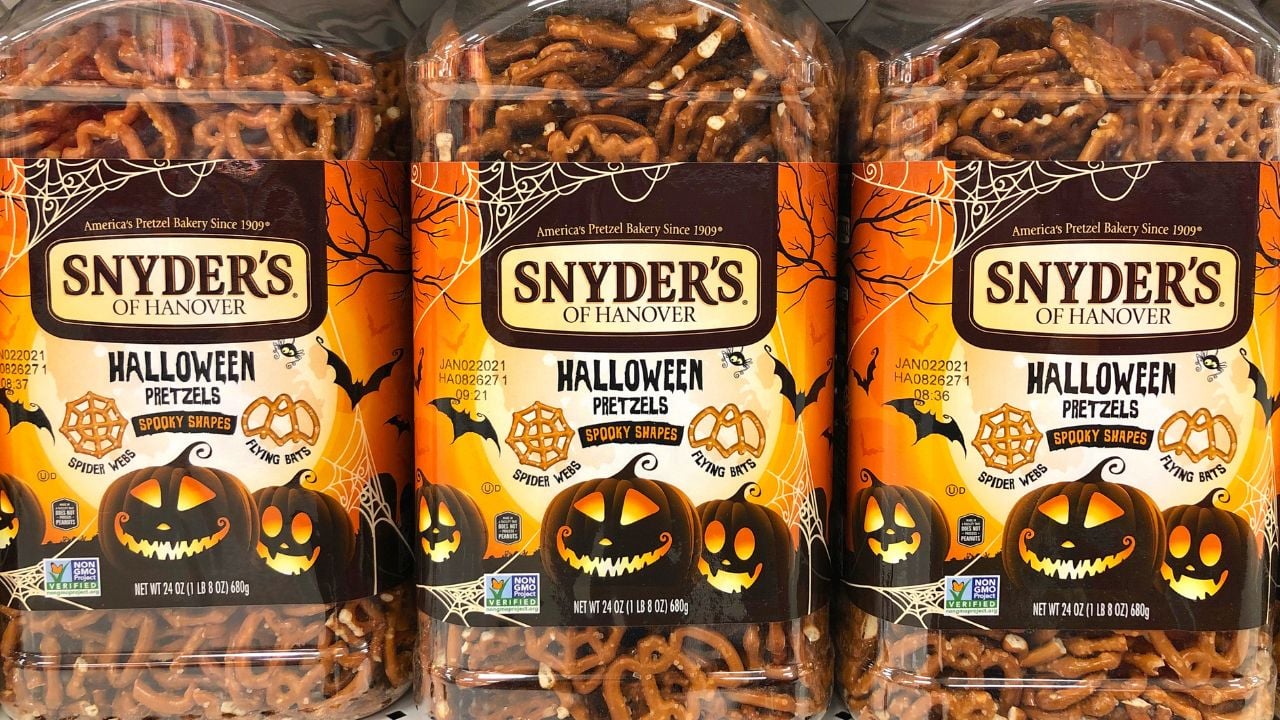
Hard pretzels are a big Pennsylvania business, since about 80% of U.S. pretzels are made in the state.
The state has 45 pretzel companies.
Julius Sturgis opened a pretzel bakery in Lititz in 1861.
The roots run deep.
Snyder’s of Hanover was founded in 1909, Utz in 1921 and Herr’s in 1946.
Check the label on the bag in your cupboard, and you may spot one of those names.
5. Animal Crackers
Stauffer’s Animal Crackers reportedly began in York in 1871, when David E. Stauffer founded the Stauffer Biscuit Company.
York got there early.
Tasting Table puts them among the earliest commercially produced cookies in the country.
David Stauffer had bought a local bakery and made water crackers, biscuits and pretzels before he reportedly developed a sweeter, cookie-like cracker.
Check your cupboard for the Stauffer’s box, and you’ll know which animal crackers came from York.
Psst! How Pennsylvania is your pantry? Run through this checklist and see where you stand.
Dried Corn Beyond the Side Dish
John Cope’s dried sweet corn goes further than a side dish, and you can cook it several ways.
Some cooks stir it slowly over low heat with milk added again and again, a method some call “Pennsylvania Dutch Risotto.”
You can also bake it into corn pudding or spoon bread, or stir it into corn chowder.
Pretzels Beyond the Cupboard
Hard pretzels have a military past, since Union troops in the Civil War preferred Sturgis pretzels to the hard tack.
Gov. Ed Rendell declared April 26, 2003, “National Pretzel Day.”
If you want an excuse to open a bag of hard pretzels, mark April 26 on your calendar.
Many pretzel bakeries run special promotions and giveaways that day.
More Pennsylvania Sweets
Goldenberg’s Peanut Chews are a Philadelphia candy that the company first produced during World War I as rations for soldiers.
Romanian immigrant David Goldenberg founded his candy company in 1890, selling from a small store front on Frankford Avenue in Philadelphia.
Just Born owns the brand and the Northeast Philadelphia facility where they’re made to this day.
Tastykake began baking on Feb. 25, 1914, in a small Germantown bakery in Philadelphia.
As of 2014, its South Philadelphia bakery made Krimpets, Juniors, pies and Kandy Kakes.
Georgia-based Flower Foods had bought the company about three years earlier.
Krimpets are a Philly classic.
Grab a pack off your shelf, and you’re eating a snack from a company that dates to 1914.
Pennsylvania Candy Beyond Peanut Chews
Mike & Ike launched in 1940 with fruit flavors that included cherry, strawberry, orange, lemon and lime.
The origin of the name “Mike & Ike” remains a mystery.
Mallo Cups come from Boyer Candy Company in Altoona, which brothers founded during the Depression.
Bill Boyer made the first candy in the family kitchen with his mother and sister.
They’re filled with whipped marshmallow creme and a layer of crunchy coconut, and since 2011 you can buy a dark chocolate version.
Where the Apples Come From
Apple butter depends on apples, and Pennsylvania has over 270 apple growers, according to PA Eats, who produce 10 to 12 million bushels a year.
Many of those growers are in the “Fruit Belt” of Adams, Cumberland, Franklin and York counties.
Brown’s Orchards in Loganville sells apple butter.
If you live in York County, you’re already inside the Fruit Belt.
15 Normal Things From the 1950s That Are Banned in Pennsylvania Today
Some ordinary habits from the 1950s would raise eyebrows today.
Regulators have since stepped in on much of it.
15 Normal Things From the 1950s That Are Banned in Pennsylvania Today
14 Things Pennsylvania Boomers Say Without Realizing They’re Offensive Nowadays

A Pennsylvania grandmother calls the flight attendant on her daughter’s trip a stewardess and means it as a compliment.
Neither she nor her neighbor is trying to offend anyone.
14 Things Pennsylvania Boomers Say Without Realizing They’re Offensive Nowadays
