
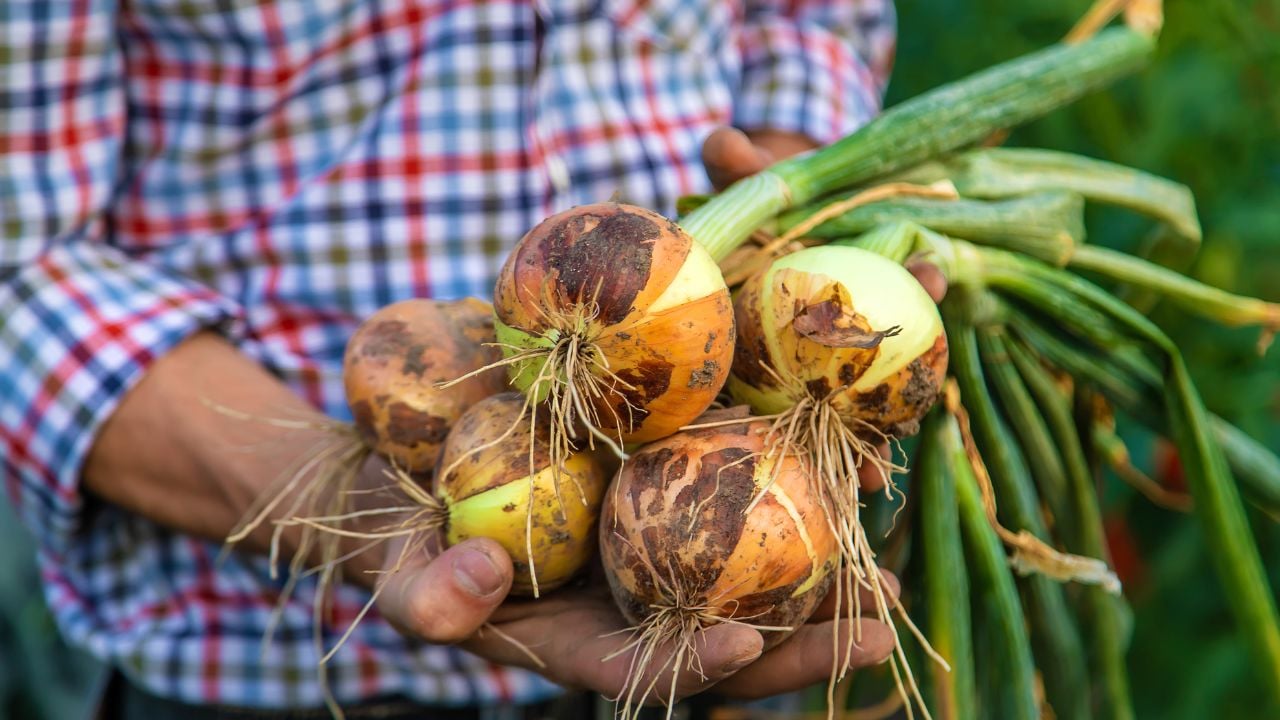
7 Vidalia Onion Rules Georgians Take Personally

A sweet onion grown one county over can’t be sold as a Vidalia.
Georgians who grow and sell the real thing take that seriously.
Here are the Vidalia onion rules Georgians take personally, and what they mean when you shop.
1. Name Rule
Vidalia onions can carry that name only if they’re the right variety and grown inside the right boundary.
Georgia law makes it a felony to sell or label other onions as Vidalias.
A conviction carries a fine of $1,000 to $5,000, a prison term of one to three years, or both.
The labeling rule also covers advertising, so a sign that uses the Vidalia name has to follow it too.
Many locals are protective of that name.
Vidalia Green Onions Have Rules Too
Vidalia green onions follow the same name rule as the bulb onions.
If you grow green onions and use the Vidalia name in sales or marketing, you have to register with the state on or before October 1 each year.
Your label on green Vidalia onions needs the name and complete business address of the producer or packer.
2. 20-County Border
Vidalia onions come from 20 counties in south Georgia, and Toombs and Tattnall are two of them.
The federal marketing order defines the production area by its boundaries, starting at a point in Laurens County where U.S. Highway 441 meets Highway 16.
A field of sweet onions can look the same on either side of the line.
Geography decides.
If your cousin grows sweet onions outside that boundary, they’re good onions, just not Vidalias.
3. Seed List
Vidalia onions have to grow from the right seed.
The federal order names hybrid yellow granex and granex parentage, plus similar varieties that the Vidalia Onion Committee recommends and the Secretary of Agriculture approves.
The state also tracks who buys onion seed in the production area.
Anyone who sells onion seed there has to give the Georgia Department of Agriculture a customer list by January 1 each year.
Each entry lists the buyer’s name and address, the date of sale, the variety and the amount.
So if you buy seed for a Vidalia field, your order lands on a state list.
4. March 1 Registration
Vidalia onions start the year with paperwork: Growers and packers must register with the state agriculture commissioner by March 1.
No registration, no Vidalia.
If you pack Vidalias, the grower you buy from has to be registered too.
If you file late, the state may fine you up to $1,000, and it won’t take applications after April 15.
Even a sale doesn’t pass the paperwork along, since a registration isn’t transferable.
5. Pack Date
Vidalia onions can’t be packed or put into commerce before the day the state agriculture commissioner announces each year.
The state’s packing date rule starts from the Monday of the last full week of April, but the commissioner can set a different date based on crop conditions and the panel’s advice.
For 2026, that day was April 13, after the Vidalia Onion Advisory Panel reviewed crop conditions.
If you grow Vidalias, you can dry and prepare them early, but you can’t pack them.
6. Package Label
Vidalia onions sold in a bag have to carry the common name onion on the package, along with an accurate net weight.
They also have to show where they’re from, with either “Product of Georgia” or the Georgia Grown logo.
The Georgia Grown logo has a catch: Its use requires a membership with the Georgia Grown Commodity Commission.
The rule also requires the producer’s or packer’s name and address, so look for that on the back of your bag.
7. Storage Seal
Vidalia onions that go into controlled atmosphere storage for sale after September 15 need state certification first.
If you run the storage facility, you have to ask the Georgia Department of Agriculture to inspect and certify both the building and the onions.
The department puts seals on the facility.
If a seal breaks for any reason, you have to notify the department, and your records for each storage cycle must list the seal numbers for two years.
In 2015, a state investigation cleared a Vidalia grower of passing off other onions as Vidalias.
The grower still got a one-year probation for improperly storing non-Vidalia onions with Vidalias.
Another offense during the probation could have cost the grower its Vidalia license.
Grade Standards
Vidalia onions are graded to the state’s adopted standard, the U.S. Standards for Grades of Bermuda-Granex-Grano Type Onions.
The commissioner can also set tolerances for each season, which are the allowable percentages for those grades.
The commissioner acts on the advice of the Vidalia Onion Advisory Panel.
The commissioner appoints that panel from growers and packers, plus at least one county extension agent from the production area.
Members receive no pay.
If you grow or pack Vidalias, that’s the group advising on your season’s grade tolerances and shipping date.
Trademark Fees
Vidalia onions carry a trademark, and Georgia law lets the agriculture commissioner collect a royalty or license fee for using it.
That money goes toward promoting Vidalia onions and paying the costs of monitoring how people use the mark.
If you want to use the Vidalia trademark on your product, the state can charge you for it.
The name can cost you.
Psst! How much do you know about Vidalia onions? Take our quiz and see how many you can get right.
Quiz
Vidalia Onion IQ
Answer these questions on the history and growing of Georgia’s famous sweet onion. We bet you can’t get them all right. Prove us wrong?
In the early days, a Toombs County farmer sold his mild onions for how much per fifty-pound bag?
Federal Paperwork
Vidalia onions come with federal paperwork on top of Georgia's.
Handlers pay the Vidalia Onion Committee 13 cents on each 40-pound carton, a rate that has applied since January 1, 2008.
That works out to about a third of a cent a pound.
If you handle Vidalias, you file a shipping report with the committee every month.
You keep your records of onions received and disposed of for at least two years.
16 Southern Sayings Georgians Have to Explain to Northerners

A grandmother in Marietta tells her daughter's fiance to grab a toboggan before they head out to look at the lights.
He glances around the garage for a sled, while she's already got a knit cap pulled down over her ears.
16 Southern Sayings Georgians Have to Explain to Northerners
7 Georgia Heir Property Rules That Cost Families Their Land

A farmhouse outside Waycross has stayed in one Georgia family for four generations, and none of the cousins who inherited it agree on what happens next.
Nobody wrote a will, and a dozen relatives now technically own a fraction of the same yard.
