

7 Things Georgians Can Legally Do When a Neighbor’s Dog Won’t Stop Barking

They say a dog’s bark is worse than its bite.
At 2 a.m., that’s not much comfort.
The good news is that you’ve got more choices than earplugs and a grudge.
Here are the things Georgians can legally do when a neighbor’s dog won’t stop barking.
Note: This is general information, not legal advice. Local ordinances, fines and court rules are subject to change.
1. Calling Animal Services
Cobb County treats a barking dog as a nuisance animal once the noise goes on for more than 15 minutes.
The clock isn’t the only test, since Cobb also covers a dog that seriously annoys a neighboring home and interferes with how you use your property.
The harder part is knowing who to call.
You can start by asking Animal Services to send an officer at (770) 499-4136, a line open weekdays from 9 a.m. to 5 p.m.
Between 5 p.m. and 9 a.m. and on weekends, you call the police non-emergency line at 770-499-3911, and 911 stays for emergencies.
Save both numbers.
Your county or city might draw the line somewhere other than 15 minutes, so check its code before you start timing the barking.
2. Filing an Atlanta Complaint
Under the ordinance Atlanta’s City Council approved in September 2022, one adult with a video of the barking can file a complaint.
Hit record when the barking starts, and your phone becomes evidence.
That ordinance calls a barking dog a nuisance once the noise lasts 10 minutes or longer, down from the 20 Atlanta used before.
A dog that barks for 12 minutes crosses that Atlanta line but not Cobb County’s 15-minute mark.
Measure first, though: To file in Atlanta, you have to live or work within 1,000 feet of the dog.
Without video, Atlanta asks for two unrelated adult witnesses at different addresses.
Video spares you the door-knocking.
Atlanta’s text lists meowing, whining and crowing alongside barking, so the ordinance covers more than dogs.
Fines start at $150 for a first Atlanta violation and rise with each repeat, topping out at $1,000.
3. Gathering a Second Witness
Athens-Clarke County won’t cite a barking dog’s owner unless at least two adult witnesses sign a written statement and agree to appear in Municipal Court.
So the neighbor across the street who hates the barking as much as you do suddenly becomes useful.
Athens-Clarke wants each statement to give the owner’s address, a description of the dog and the barking, and the date, time and place.
Athens-Clarke answers your first complaint with a written warning to the owner, and a second complaint within 90 days can bring the citation.
If the owner contests the citation, your witnesses may be subpoenaed to testify in Municipal Court, so give them a heads-up before they sign.
Athens-Clarke County Animal Services takes barking complaints at 706-613-3540.
9 Things a Georgia Landlord Can Legally Do That Tenants Never See Coming
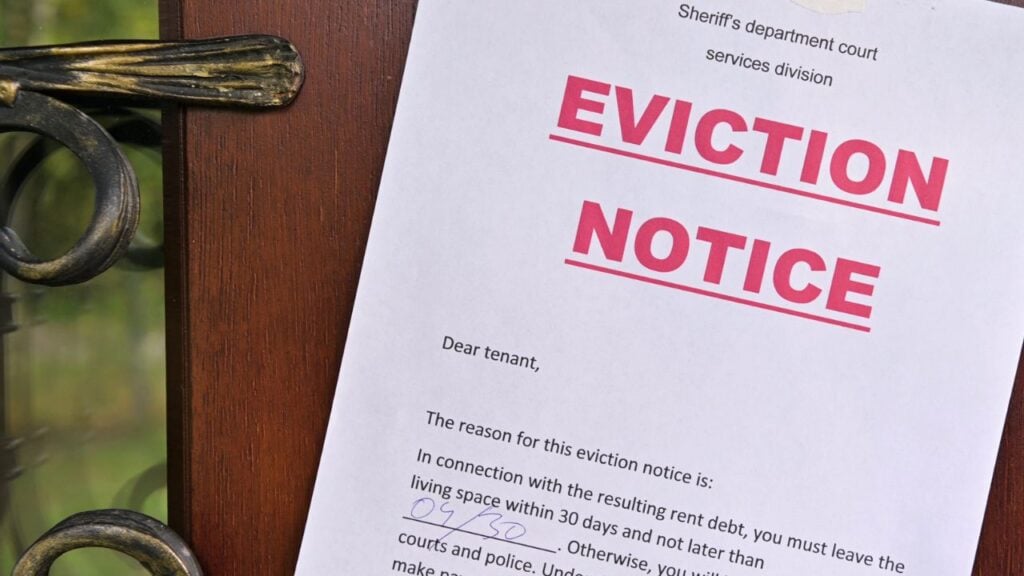
You open your lease renewal, and the new number makes you read it twice.
That’s only the first of the surprises tenants run into.
9 Things a Georgia Landlord Can Legally Do That Tenants Never See Coming
4. Complaining to Your HOA
Georgia’s Property Owners’ Association Act spells out what a homeowners association (HOA) can do when barking breaks the community’s rules.
The Act says every lot owner and everyone entitled to occupy a lot has to follow the community’s lawful rules.
If the governing documents allow it, the association can fine the owner and temporarily suspend voting rights and use of some common areas.
Bring that up when you talk to the board.
That power has a limit, though: The association can’t block the owner or other occupants from getting to their lot.
Your recorded declaration decides whether the Act applies to your community, so read it before you go to the board.
The same section lets aggrieved lot owners bring a suit over noncompliance, though it limits that to what it calls a proper case.
5. Filing a Nuisance Complaint in Court
You can ask a court to end barking that counts as a nuisance by filing a petition.
It’s the formal version of knocking on your neighbor’s door.
Inside city limits, the municipal court hears it.
In the unincorporated part of a county, the county’s magistrate court does, unless local law says otherwise.
Check which side of the city line the dog’s yard sits on before you file.
What Georgia Counts as a Nuisance
Georgia’s nuisance law covers anything that causes hurt, inconvenience or damage to another person, even when the act itself is lawful.
The inconvenience can’t be fanciful, so the test is whether an ordinary, reasonable person would mind the noise, not whether the lightest sleeper on your street does.
6. Suing for Damages
If the barking next door injures you, Georgia law can give you a right of action for a private nuisance.
That law defines a private nuisance as one limited in its harm to one or a few people, and a dog next door can fit that description.
Magistrate courts hear civil claims up to $15,000, so a suit for money over the barking can go there.
You pick the amount you demand, as long as it doesn’t pass that cap.
If you’ve filmed the barking or lined up witnesses, bring that evidence along.
Psst! How much do you know about Uga and Georgia’s pet rules? Take our quiz and see if you can ace it.
Quiz
Georgia Pet IQ
Answer these questions on Uga, legal pets and other Georgia animal trivia. We bet you can’t get them all right. Prove us wrong?
Which of these animals can’t legally be kept as a pet in Georgia?
7. Asking for Mediation
DeKalb County Magistrate Court offers online mediation for certain small-claims cases, a handy option if the barking leads you to file a claim.
Once you have a case number, you and your neighbor can register and message each other through the court's online platform.
A mediator is a neutral third party who guides the discussion but can't decide the case or give legal or financial advice.
That leaves the agreement to you and your neighbor.
If you settle, a DeKalb judge reviews and signs the agreement, and if you don't, the court puts the case on its calendar for a hearing.
Courts in other parts of Georgia run mediation programs too, from the Eastern Judicial Circuit's Mediation Center in Savannah to Floyd County's magistrate court.
12 Signs You've Lived in Georgia Too Long, According to Locals

Some habits follow you around once you've lived in Georgia long enough.
See how many of these signs you recognize.
12 Signs You've Lived in Georgia Too Long, According to Locals
