
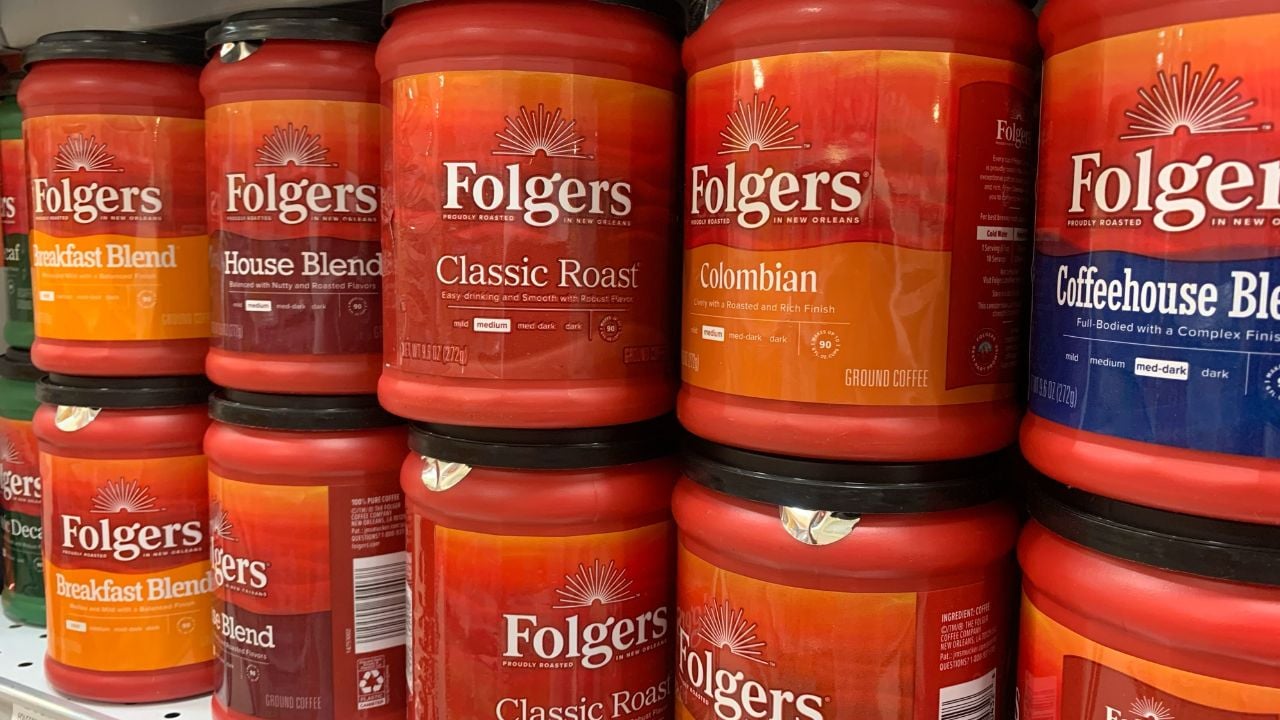
Folgers’ Can Got Smaller, but the 400-Cup Claim Didn’t. Ohioans Can Test It at Home

When your coffee pot runs all day for Thanksgiving guests, a big can of Folgers may not go as far as it used to, even though the 400-cup claim on the label says it does.
Here’s what Ohioans should check in the coffee aisle now that Folgers’ big can shrank.
Folgers’ Explanation
Folgers has belonged to The J.M. Smucker Company since 2008.
That company’s federal filings list its address as Orrville, Ohio.
Mouse Print reported the 51-ounce canister’s drop to 43.5 ounces in May 2022, along with the company’s explanation.
Folgers gave that explanation on Twitter, crediting a new roasting technology for grounds that weigh less and saying total servings would stay exactly the same.
You can’t see a roasting technology from the aisle, so start with the ounces on your can.
Package Size
Folgers lists its Classic Roast ground coffee in six canister sizes on its website as of late October 2026: 9.6, 19.2, 25.9, 33.7, 40.3 and 43.5 ounces.
Folgers’ site shows 43.5 ounces as its biggest can, with no 51-ounce size.
If you reach for the 40.3-ounce can instead, you get 3.2 ounces less coffee, about 7 percent less than the biggest can.
The smallest size, 9.6 ounces, is less than a quarter of the 43.5-ounce canister.
Folgers’ 7.5-ounce cut is about 78 percent of that smallest can.
400-Cup Claim
Folgers’ 43.5-ounce can makes up to 400 cups of 6 fluid ounces each, according to one online retail listing on October 23, 2026.
In 2022, Mouse Print reported that Folgers kept the cup count the same on canisters it had cut, with the smaller can still supposedly making 400.
If you fill a 12-fluid-ounce mug each morning, a can’s 400 six-ounce cups shrink to 200 mugs at most.
A 16-ounce travel mug cuts it to 150 at most.
The Math Behind Folgers’ Smaller Can
Folgers’ 7.5-ounce cut is 14.7 percent of the 51-ounce canister.
If the price held steady, each ounce in the 43.5-ounce can would cost 17.2 percent more than an ounce in the old canister.
The two percentages differ because the first measures what left the can and the second measures what your money buys per ounce.
If a can makes the full 400 cups, the old canister works out to 0.1275 ounces a cup.
On the same count, the 43.5-ounce can works out to 0.10875 ounces a cup.
Those are division results, not measurements of what goes into your coffee maker.
The 2020 Lawsuits
A 2020 report described lawsuits accusing Folgers of overstating how many cups its canisters make.
In a Florida lawsuit over cup counts, Folgers argued that how many cups you get depends on how strong you like your coffee.
Plaintiffs’ lawyers measured out a French Roast canister whose maker claimed up to 210 cups of 6 ounces.
Its back-label directions called for 1 tablespoon per 6-ounce cup.
They counted 156 cups brewed one at a time and 195 in 10-cup batches.
The report gives no outcome.
Price per Ounce
On BJ’s Wholesale Club’s website, Folgers’ 43.5-ounce canister cost $19.79 on October 23, 2026, with pickup set to a Willoughby, Ohio, club.
Your club’s price may differ.
That page shows a unit price of 45 cents an ounce, which is the price divided by the ounces you get.
A 40.3-ounce can priced above about $18.14 costs more than that 45-cent rate.
If a can makes the full 400 cups, that $19.79 comes to about 5 cents a cup.
Every cup short of 400 pushes that price higher.
The Cost of 7.5 Ounces
The Bureau of Labor Statistics put the national average for ground coffee at $5.835 a pound in May 2022, which made the 7.5 ounces Folgers cut worth about $2.74.
The September 2026 average of $9.332 a pound is nearly 60 percent above that.
At that price, you’d pay about $4.37 for the same 7.5 ounces.
BJ’s unit price of 45 cents an ounce would put them at about $3.38.
Those are national averages for all brands and sizes, not Folgers or Ohio prices, so your cart may differ.
Psst! How much do you know about the history behind your coffee aisle? Take our quiz and see if you can ace it.
Quiz
Coffee Aisle Trivia
Answer these questions on Folgers, Smucker’s and Ohio food history. We bet you can’t get them all right. Prove us wrong?
A supermarket in Troy, Ohio, rang up the first item ever scanned with a barcode on June 26, 1974. What was it?
The Kitchen Test
If you brew a single serving, Folgers' brewing guide calls for 1 tablespoon of grounds and 6 fluid ounces of water.
For ten servings, it calls for half a cup of grounds, or 8 tablespoons, with 60 fluid ounces of water.
That's 20 percent less coffee per serving than ten single servings would use.
Folgers 1850 lists 2 tablespoons per serving, double the regular rate, so a stronger cup uses up a can twice as fast.
How many cups you get from a can depends on how many tablespoons go into each.
Formulation and packaging may change, so check the package in your cart for the current details.
4 Department Store Restaurants Ohioans Still Miss
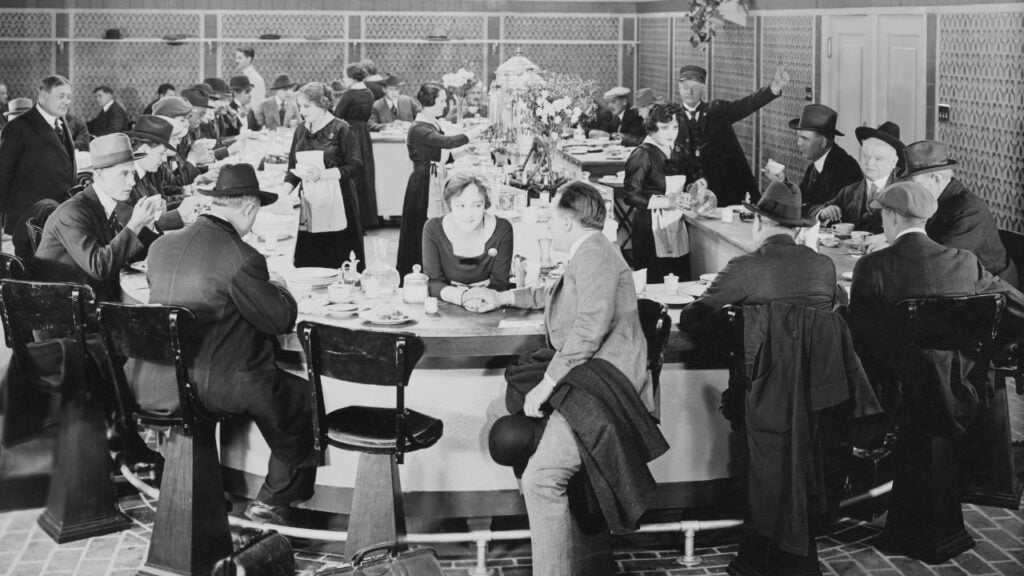
A downtown shopping trip used to come with a proper sit-down lunch, right inside the store.
Ohioans who made those trips still remember the food, the rooms, and that dressed-up feeling.
4 Department Store Restaurants Ohioans Still Miss
5 After-Hours Messages That Can Count as Paid Work in Ohio

Your phone buzzes after dinner, and it's work.
Answering takes a minute, but some of those minutes can count as time you should be paid for.
