

SNAP’s Maximum for a Family of 4 Rose to $1,023 This Month. Here’s What Else Changed

If your family of four gets Supplemental Nutrition Assistance Program (SNAP) benefits, your monthly maximum went up $29 on Oct. 1.
That’s less than a dollar a day.
The raise is small, and the U.S. Department of Agriculture (USDA) adjusted several other numbers the same day.
Here’s what else changed in SNAP this month.
Note: This is general information, not financial advice. Benefit amounts and eligibility rules are subject to change, so confirm the current details with your state SNAP agency.
A Ceiling, Not a Guarantee
SNAP’s maximum monthly benefit for a household of four in the 48 states and Washington, D.C., is now $1,023.
That figure is a ceiling, and your household only gets the full amount if its net income is zero.
Net income is what’s left of your household’s income after SNAP’s deductions.
SNAP multiplies that net income by 30% and subtracts the result from the maximum.
That’s why two families of four can get different amounts under the same ceiling.
The Math Behind SNAP’s $1,023
Take a family of four with $1,200 in net monthly income after SNAP’s deductions.
Your household is expected to put 30% of that, or $360, toward food.
Subtracting $360 from the $1,023 maximum leaves a monthly benefit of $663.
A family of four with $2,000 in net income would get $423.
The New Maximums
SNAP’s new maximum for a household of four is up $29 from $994 last year.
If you live alone, your maximum rose $8, to $306.
Maximums rose for larger households too: $562 for two people, $808 for three, $1,217 for five and $1,463 for six.
A household of seven gets $1,616, and a household of eight gets $1,841.
The $29 adds up to $348 over a year.
That’s about $7 more a month for each person at your table.
It’s a 2.9% raise.
Food-at-home prices were 2.2% higher in August than a year earlier, according to USDA’s Economic Research Service.
The maximums come from the cost of a low-cost market basket for a family of four.
Four people split $1,023, about $256 apiece, while a household of one gets $306.
Beyond the 48 States
SNAP has separate, higher maximums for Alaska, Hawaii, Guam and the U.S. Virgin Islands.
A household of four gets $1,655 in Hawaii, $1,507 in Guam and $1,315 in the U.S. Virgin Islands.
Alaska’s four-person maximums start at $1,306 in urban areas and rise in its rural zones.
A single person’s maximum is $496 in Hawaii, $452 in Guam, $394 in the U.S. Virgin Islands and $392 in urban Alaska.
The excess shelter cap varies by place too: $1,306 in Hawaii, $1,229 in Alaska, $903 in Guam and $606 in the U.S. Virgin Islands.
If you live in one of those places, your numbers come from separate USDA tables.
Higher Income Limits
If you have savings, they count toward SNAP’s asset cap of $3,000.
The cap is $4,750, up from $4,500, for a household with a member who’s 60 or older or disabled.
Income limits rose along with the maximums.
A household of four now needs gross income of $3,575 a month or less and net income of $2,750 or less.
Last year, a family of four’s limits were $3,483 gross and $2,680 net.
Those limits are set at 130% of the federal poverty level for gross income and 100% for net income.
If you live alone, your limits are $1,729 gross and $1,330 net.
For two people, the limits are $2,345 gross and $1,804 net.
Households generally have to pass both tests.
Deductions, Caps and the Minimum
SNAP’s standard deduction, a flat amount subtracted from your income before the benefit is calculated, rose too.
Your standard deduction depends on household size: $217 for one to three people (up from $209), $229 for four, $268 for five and $308 for six or more.
SNAP’s excess shelter deduction covers housing costs above half your income after other deductions.
The cap on it is $769 a month, up from $744.
If your household includes someone who’s 60 or older or disabled, that cap doesn’t apply.
SNAP also deducts dependent care costs that you need to cover for work, training or education.
The minimum monthly benefit for small households went from $24 to $25.
Psst! How much do you know about SNAP? Tap each card and see how many you can get right.
A Bigger Bill for States
SNAP’s administrative costs began shifting toward your state in fiscal year 2027, the federal budget year that started Oct. 1.
The One Big Beautiful Bill Act of 2025 cuts the federal share of those costs from 50% to 25%.
The rest falls to states, so your state’s SNAP office may feel that shift first.
A separate change ties what states pay toward benefit costs to their payment error rates, and it generally begins in fiscal year 2028.
Psst! How much do you know about how SNAP benefits are calculated? Take our quiz and see if you can ace it.
Quiz
SNAP Math IQ
Answer these questions on how SNAP benefits are calculated. We bet you can’t get them all right. Prove us wrong?
SNAP deducts what share of a household’s earned income when it works out a benefit?
Fewer People on SNAP
SNAP had about 36.1 million participants in July 2026, the latest month USDA reports.
That's down from about 41.6 million in July 2025.
The caseload shrank about 13%.
USDA labels its 2026 figures preliminary, so they may change.
If you get SNAP, you're part of a smaller group than a year ago.
The national average benefit in July was $187.56 a person, compared with $187.90 a year earlier.
SNAP reached about 19.6 million households that month, down from about 22.4 million in July 2025.
Albertsons Says Lower-Income Shoppers Are Buying Fewer Items. Here’s What That Means for Montanans

A $29 raise only goes so far at the register, and Albertsons says its lower-income shoppers are already buying fewer items.
Here's what that could mean for the Montanans who shop at Albertsons and beyond.
Albertsons Says Lower-Income Shoppers Are Buying Fewer Items. Here’s What That Means for Montanans
6 Thanksgiving Staples That Will Cost Alabama Families More This Year
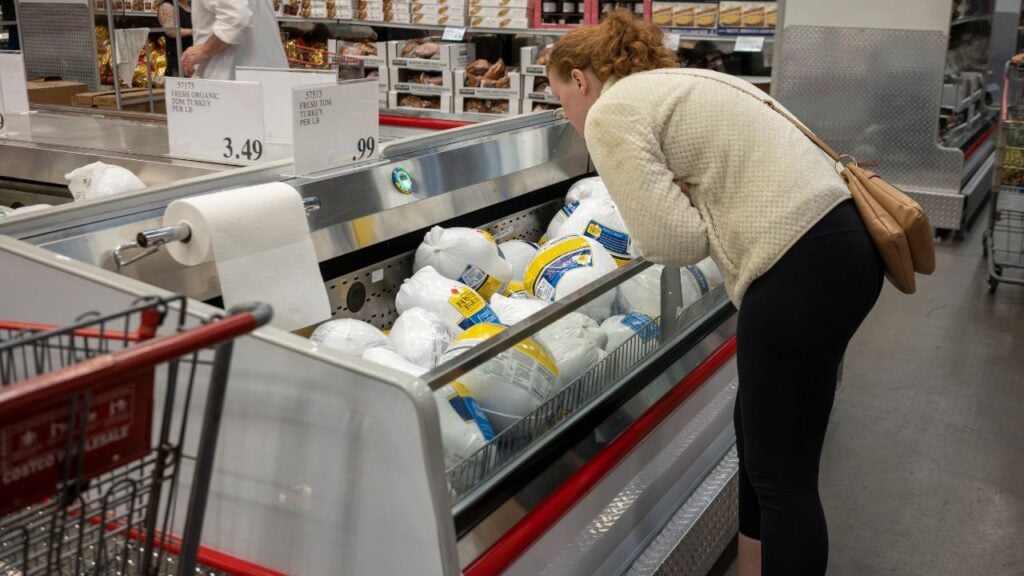
Your SNAP benefit has to cover the holiday table too, and these Thanksgiving staples may cost more this year.
Here's what to expect in the grocery aisle.
6 Thanksgiving Staples That Will Cost Alabama Families More This Year
