
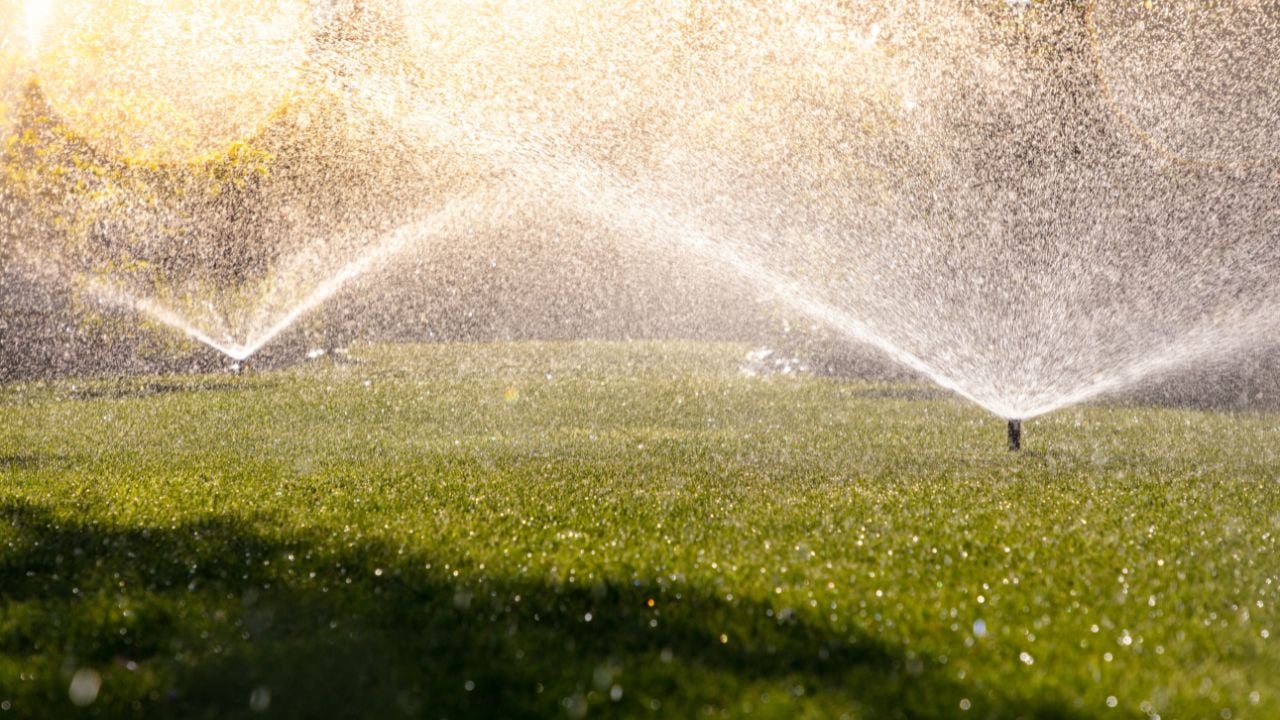
The Best Time of Day to Water Your Lawn During a Georgia Heat Wave

A guy in DeKalb County drags his hose out before sunrise and coils it back up before his coffee finishes brewing.
His neighbor waters after dinner instead, hose running long after the sun drops, his shirt stuck to his back from the day’s heat.
Only one of them is doing his Bermuda grass any favors.
Here’s the best time to water your lawn during Georgia’s hottest months.
Morning Is the Smarter Time to Water
National advice usually treats morning and evening as equally good choices.
That advice doesn’t hold up as well once Georgia’s summer humidity enters the picture.
Warm, humid nights let water sit on grass blades for hours after an evening watering.
That damp stretch is exactly what fungal disease needs to take hold.
Centipede grass, zoysia, and St. Augustine grass, common across Georgia lawns, are prone to a disease called large patch, which spreads fastest through cool, wet turf overnight.
Skip the overnight soak.
Water in the morning instead, and the sun has hours to dry the blades before the fungus gets its chance.
Georgia’s Watering Law Sets the Stage
Georgia has capped outdoor watering hours statewide since 2010, and the rule has nothing to do with any particular heat wave.
The Georgia Water Stewardship Act blocks anyone on public water from running a sprinkler, a hose-end timer, or an in-ground system between 10 a.m. and 4 p.m., every single day of the year.
That’s six hours off the table.
That leaves the rest of the day split into two windows, the stretch before 10 a.m. and the stretch after 4 p.m., and a heat wave doesn’t make an exception for either one.
Drought is already a factor.
Georgia’s Environmental Protection Division added urgency to that math this year, declaring a statewide Drought Response Level 1 in April, its first drought response declaration in several years.
More than half of Georgia remained in severe or extreme drought as of early summer, so those legal hours count for more than usual this year.
Sunrise Is the Best Hour
Morning still covers a wide range inside Georgia’s legal hours, anywhere from midnight to 10 a.m., and not every hour in that stretch works equally well.
Water too early, in the pitch dark at 1 or 2 a.m., and the grass sits wet almost as long as it would after a late-evening soak.
Sunrise loses the least water.
Many lawn and turf experts point homeowners toward the stretch closer to sunrise, generally before 9 or 10 a.m., late enough for daylight to start pulling moisture off the blades and early enough to beat the sun’s strongest hours.
The federal government backs up why the hour matters this much: About half the water Americans spray on lawns and gardens each summer evaporates, blows away, or runs off before it ever soaks in.
A sprinkler running at 6 a.m. loses far less to the air than the same sprinkler running at 5 p.m. still does, even though Georgia’s law allows both.
Grass Type Changes the Math
Not every Georgia lawn drinks the same amount, or on the same schedule.
Bermuda grass goes tan and dormant during a short dry spell instead of dying outright, then greens back up once real rain returns.
Centipede grass and St. Augustine grass root shallower and show stress faster, so a heat wave hits them first.
Zoysia falls in the middle, tougher than centipede or St. Augustine but slower to recover from a dry spell than Bermuda.
Most of Georgia sits inside what turf specialists call the transition zone, where warm-season grasses like these dominate the southern and central two-thirds of the state while cool-season tall fescue takes over the mountains and the upper Piedmont.
Tall fescue has a harder time than Georgia’s warm-season grasses during a heat wave, since a grass built for cooler climates never fully adapts to a north Georgia August.
It depends on the grass.
How Much and How Often
Getting the hour right doesn’t help much if the routine underneath it is wrong too.
Extension agents point Georgia homeowners toward two or three deep waterings a week instead of a quick daily sprinkle.
Depth beats frequency.
A deep soak pushes moisture eight inches into the soil, deep enough to pull roots downward instead of keeping them shallow and dependent on tomorrow’s watering.
Raise the mower blade to the upper end of the recommended cutting height for your grass, too, since taller blades shade the soil and slow how fast it dries out.
Overwatering carries its own risk during a heat wave, since soggy soil promotes the same fungal disease that evening watering does.
It can also wash nutrients below where the roots can reach them.
Psst! How much do you know about Georgia outside your back yard? Take our quiz and see if you can ace it.
Quiz
Peach State IQ
Answer these questions on Georgia’s records, symbols, and quirks. We bet you can’t get them all right. Prove us wrong?
Georgia is nicknamed the Peach State, but which state grows more peaches these days?
Some Methods Skip the Clock
Georgia's 10 a.m. to 4 p.m. ban doesn't apply to every way of getting water to a lawn.
Drip lines and soaker hoses are exempt any time of day, since they deliver water straight to the soil instead of spraying it into the air where the midday sun can grab it.
Hand-watering with a hose that has an automatic shutoff nozzle is exempt too, along with newly planted grass or seed during its first 30 days in the ground.
That exemption has limits.
A sprinkler on a timer still has to respect the six-hour ban, even if the rest of the yard is technically allowed to drink whenever it's thirsty.
Savannah Adds Its Own Rule
Georgia's statewide hours are the floor, not the ceiling, and some cities build stricter rules on top of them.
Savannah bans outdoor watering entirely on Fridays, then splits the rest of the week by address, even-numbered properties on Monday, Wednesday, and Saturday, odd-numbered properties on Tuesday, Thursday, and Sunday.
The reason traces back to the 1940s, when saltwater started contaminating the Floridan Aquifer, the underground source of Savannah's drinking water.
Rules vary by city.
Check your own city or utility before you assume the statewide hours are the only rule that applies to your sprinkler.
Reading Your Own Lawn
Georgia's legal hours and a grass type's drought tolerance still leave one question every homeowner has to answer alone, whether the lawn needs water today.
Walk across the grass and look back at your footprints.
Blades that spring back up within a few seconds still have enough water pressure inside their cells to stay stiff, a force plant scientists call turgor.
Footprints don't lie.
Flattened blades that stay pressed down mean the lawn has already run short on water, and that's the moment to water, heat wave hours or not.
Catch the wilt at that stage, and one deep watering inside the legal window usually brings the color back within a day or two.
Wait until the whole yard crunches underfoot instead, and even a perfect sunrise soak won't undo a week of neglect overnight.
9 Georgia Backyard Creatures That Startle Newcomers (and 2 That Should)
A hognose snake in the pine straw can flare its neck flat and hiss like it means business, then flop over and play dead a second later.
That's just one of the backyard surprises waiting for anyone who trades a lawn up north for a lawn in Georgia.
9 Georgia Backyard Creatures That Startle Newcomers (and 2 That Should)
9 Squatter Laws Every Georgia Homeowner Should Know in 2026
A house sitting empty after a funeral in Georgia can go untouched for a year while relatives argue over who inherits it.
Nobody has to break a window for that gap to turn into a legal fight over who gets to keep it.
