
Two Truths and a Lie About Florida Beaches: Can You Spot the Fake?

Can you tell a real Florida beach fact from a convincing fake?
Each round we’re about to present gives you three statements, and one of them is a lie.
See if you can spot the Florida beach fib before scrolling to the answer.
Sand and Shells
1. Siesta Key’s famous sand is close to 99% pure quartz, which is why it stays cool underfoot on a scorching Florida afternoon.
2. Sanibel Island runs east to west instead of north to south, so Gulf currents pile shells onto its shore and give the world the “Sanibel stoop.”
3. Florida’s official state shell is the queen conch.
The lie?
Number 3 is the fake, because Florida’s state shell is the horse conch, the largest gastropod in American waters, not the queen conch you’re picturing from the Keys.
Siesta Key’s quartz washed down from the Appalachian Mountains over millions of years, which is why it feels like walking on flour.
Sanibel shellers turn up whelks, olives, and the occasional junonia, the prize that most collectors spend years hunting.
The Water
1. Florida’s Gulf coast runs warmer and calmer, while the Atlantic side draws cooler water and bigger, steadier waves.
2. The Gulf coast around Clearwater gives Florida its best surf, which is why champion surfer Kelly Slater grew up chasing waves there.
3. Gulf water off Southwest Florida can climb into the low 90s during a July afternoon.
The lie?
Number 2 lies twice, because the calm Gulf is too flat for serious surfing, and 11-time world champion Kelly Slater grew up on the Atlantic side in Cocoa Beach.
Surfers still flock to the Space Coast for its steady swell, while Gulf beachgoers get bathwater and barely a ripple.
Wildlife
1. Florida beaches host roughly 90% of the loggerhead nesting for the entire northwest Atlantic, the biggest gathering of nesting loggerheads on the planet.
2. Manatees crowd into Florida’s warm springs in summer to escape the heat of the Gulf.
3. Florida’s spring water holds a steady 72 degrees year-round, which is what makes those springs safe winter shelter for manatees.
The lie?
Number 2 flips the season, because manatees pack into warm springs in winter for warmth, not in summer, since they can’t handle water below about 68 degrees for long.
Places like Blue Spring near Orange City fill up with hundreds of manatees on the coldest January mornings.
The rest of the year, kayakers paddle right past the spot where hundreds of manatees once huddled through the cold snaps.
The Coasts
1. Florida holds more coastline than any other state in the country.
2. Florida’s tidal shoreline stretches about 8,436 miles once you count every bay, inlet, and island.
3. Only about 825 of those miles are actual sandy beach.
The lie?
Number 1 is the fake, because Alaska dwarfs every state with nearly 34,000 miles of shoreline, leaving Florida in a solid second place.
That runner-up finish still gives Florida more coast than any state in the lower 48, which is plenty for a lifetime of sand.
Beach Towns
1. You can drive right onto the hard-packed sand at Daytona Beach, as long as you keep it to the enforced 10 mph speed limit.
2. Miami Beach’s South Beach holds the largest concentration of 1920s and ’30s Art Deco buildings in the country.
3. The Naples Pier is Florida’s longest pier.
The lie?
Number 3 is the fake, because the Naples Pier runs about 1,000 feet, while the Navarre Beach Pier in the Panhandle stretches 1,545 feet and takes the title as Florida’s longest.
Navarre’s concrete pier replaced a wooden pier that Hurricane Ivan tore apart in 2004.
Daytona’s drivable sand, meanwhile, packs so hard because the grains are fine and tightly bound, which is what let early racers set land-speed records right on the beach.
Records
1. Siesta Key beat every beach in the country to earn the top spot from coastal scientist “Dr. Beach” back in 2011.
2. The sugar-white sand along the Panhandle is fine quartz that eroded off the Appalachian Mountains and washed south over thousands of years.
3. That same Panhandle sand gets its brilliant white color from finely ground coral and crushed seashells.
The lie?
Number 3 is the fake, because the Panhandle’s white sand is nearly pure quartz from the Appalachians, not coral or ground shell.
Dr. Beach retires each winner from future rankings, so Siesta Key’s 2011 crown means it can’t win the top spot twice in a row.
Rules and Safety
1. New Smyrna Beach in Volusia County racks up so many unprovoked shark bites that it’s called the shark bite capital of the world, though the bites are rarely serious.
2. Picking the sea oats that grow on Florida dunes is against the law, because their roots hold the sand in place.
3. Florida’s colored beach warning flags exist to tell you exactly when a rip current is present.
The lie?
Number 3 is the fake, because Florida’s warning flags signal general surf conditions, from calm green to closed double red, and they don’t call out rip currents on their own.
A purple flag gets its own meaning too, warning you that jellyfish or other stinging marine life are drifting in the water that day.
The shark bite numbers sound scary until you look closer at the science.
Most bites in Volusia County come from small blacktip and spinner sharks mistaking a foot for a fish, and the county has logged hundreds of bites over the decades with almost no deaths.
15 Florida Beaches Ranked From Packed to Peaceful
Two Florida beaches can sit an hour apart and feel like different planets.
On one, you’re threading between umbrellas for three feet of open sand, and on the next, your footprints are the first of the day.
15 Florida Beaches Ranked From Packed to Peaceful
9 Florida Beaches Locals Avoid on the Fourth of July (and 3 They Pick)
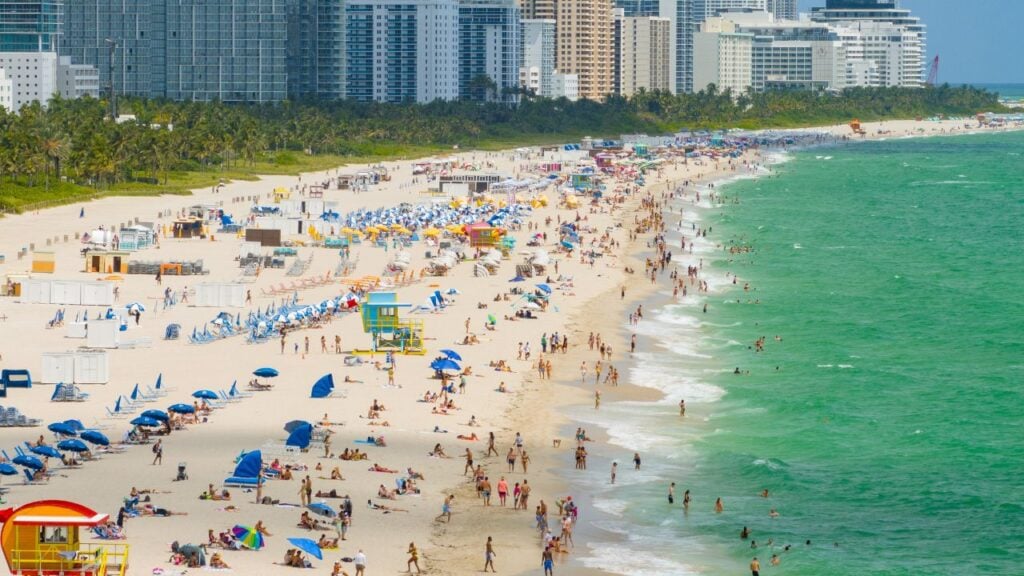
Floridians roll their eyes when a tourist announces plans to hit Clearwater Beach on the Fourth.
Locals already know how that day ends, with a parking lot full by 9 a.m. and a long crawl back to the car.
9 Florida Beaches Locals Avoid on the Fourth of July (and 3 They Pick)
