
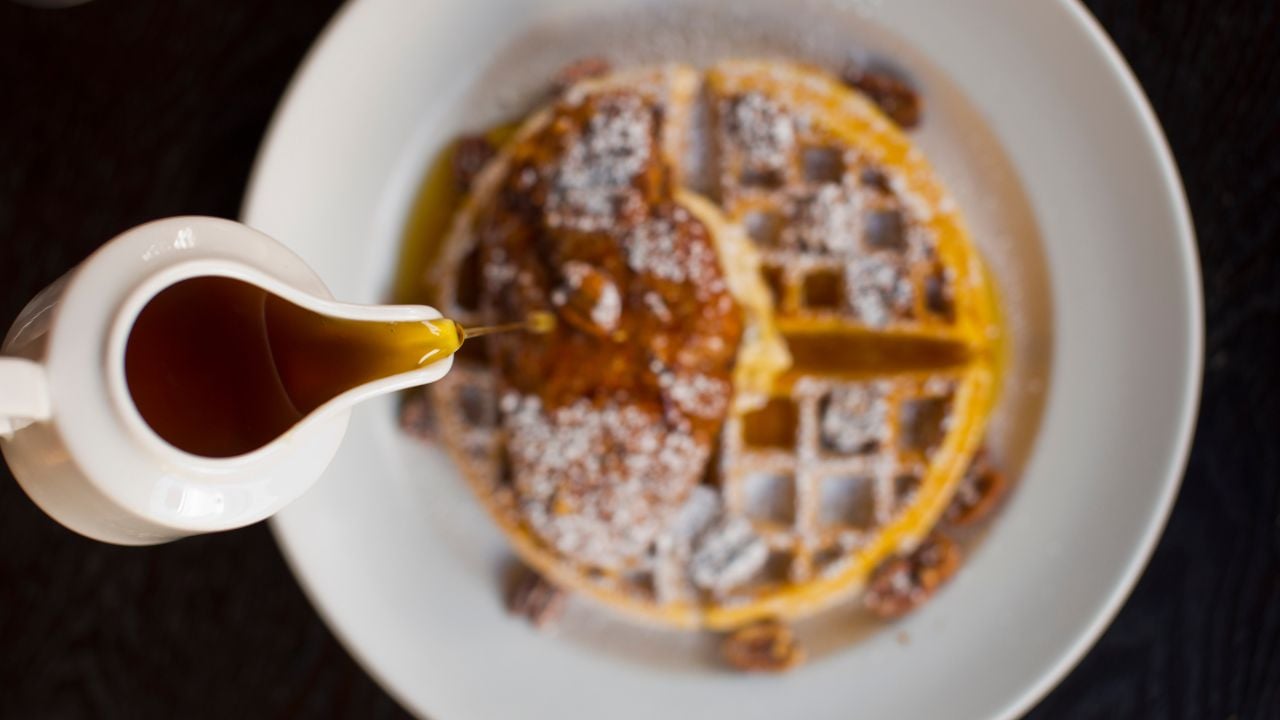
Vermont Makes Over Half of America’s Maple Syrup, So Why Does a Gallon Cost So Much?

Vermont makes more maple syrup than any other state, so you might expect a bargain.
But the price tag on a gallon makes some locals put the jug down.
Here’s what the state’s numbers say about its maple crop and the price of a gallon of syrup.
The 2026 Crop in Numbers
Vermont’s Agency of Agriculture says the 2026 maple crop was 3.091 million gallons.
The Agency’s June 11 release shares federal farm numbers.
They put Vermont over 50% of U.S. maple production, the top spot once again.
In the release, Gov. Phil Scott describes maple as part of the state’s identity and economy.
Producers set 8.2 million taps in 2026 to get there.
Gallons Per Tap
Vermont’s maple producers got an estimated 0.377 gallons of syrup from each tap in 2026, the Agency’s release says.
That’s about 48 fluid ounces, or a quart and a half, from every tap.
Across 8.2 million taps, that adds up to the crop total.
The $51.40 Average
Now the price.
The $51.40 figure is the average retail price of a gallon of Vermont maple syrup in 2025.
It’s a yearly average, not a price tag on any shelf.
The release doesn’t tie it to any co-op, supermarket or other seller.
The Agency’s August 2026 monthly report counts retail as sales straight to shoppers.
That means online orders, farmers markets or roadside stands.
The 2026 release doesn’t say whether the $51.40 uses that same definition of retail.
So your bottle may differ.
Let’s break it down.
A gallon is 128 fluid ounces, so $51.40 comes to about 40 cents an ounce.
At that average, a quart comes to $12.85. A pint is about $6.43, and a half-pint is about $3.21.
The release also puts the value of Vermont’s 2025 maple syrup production at $101.7 million.
The release and Vermont Business Magazine’s copy both print the figure as “$101,704 million,” an apparent typo.
Divide that by the 3.06 million gallons made in 2025, and you get about $33 a gallon.
That’s well below $51.40.
The two figures measure different things, and retail is only one of the ways maple syrup sells.
Gallons Per Person
Divide Vermont’s 2026 maple crop by the number of people in the state, and you get nearly 4.8 gallons each.
That uses the Census Bureau’s July 2025 estimate of 644,663 people.
Split evenly, your share would come to about 38 pints.
About 3,500 people make syrup in Vermont each year. The group’s executive director told VTDigger that in April.
There’s no official tally.
Psst! How much do you know about maple syrup? Take our quiz and see if you can ace it.
Quiz
Maple Syrup IQ
Answer eight questions on maple trees, sap, and syrup. We bet you can’t get them all right. Prove us wrong?
In the 1970s, Vermont’s yearly maple syrup output fell to roughly how many gallons?
2026 Season Results
The state's maple sugar makers' group ran a survey. Vermont Business Magazine shared the results.
Of the sugarmakers who answered, 41% called 2026 an average crop year.
Another 37% had an above-average or record-breaking season.
So most of the sugarmakers who answered had an average or better year.
About 23% reported a below-average crop.
If you're wondering when it all happens, March is typically when Vermont's season kicks off, the Agency says.
The University of Vermont's maple research guide describes a late-winter run of about six weeks.
Each year, the governor taps a maple tree at the state's First Tapping event.
The Agency also lists Maple Open House Weekend and the Vermont Maple Festival as part of the fun.
Sap Behind the Syrup
Maple syrup starts as sap.
You need around 40 parts of sap to make 1 part syrup, according to the University of Vermont's maple research guide.
Run that ratio on Vermont's 3.091 million gallons, and the 2026 crop took roughly 124 million gallons of sap.
Spread across the 8.2 million taps, that's about 15 gallons of sap for each one.
Each tap is a hole about 3 inches deep and a little under half an inch wide.
Boiling does the work.
A quart of syrup on your shelf took about 10 gallons of sap, the Cary Institute says.
Sugar maples are the most productive tree for syrup.
Two Decades of Growth
Vermont's tap count has grown fast since 2003, according to the Agency of Agriculture.
That year, producers had 2.12 million taps, and by 2024 the count had reached 8.4 million.
That's nearly four times as many.
Gallons rose too.
Since 2003, production has gone from around 500,000 gallons to 3.108 million in 2024.
Even with 8.2 million taps in 2026, down from 8.4 million in 2024, production stayed above 3 million gallons.
So the next bottle you see labeled Vermont comes from a trade that has roughly quadrupled its taps in two decades.
Psst! How many maple myths can you spot? Flip each card and see if you can get them all right.
Price Report Sources
The Agency also posts monthly maple syrup price reports. It runs them with a federal Market News service.
The page lists monthly reports from July 2025 through August 2026.
Producers who join send in how much they sold, their weighted average prices and their grading information.
If you want the latest monthly numbers, check that page.
The reports sort sales into three groups: retail, wholesale and bulk. Each group is then split by four syrup grades.
That's the detail behind the headline.
5 Vermont Cheddar Rules Vermonters Won't Bend
Cheddar is serious business in Vermont.
These are the cheddar standards Vermonters won't bend.
5 Vermont Cheddar Rules Vermonters Won't Bend
9 Things That Change the Second Vermonters Cross Into New Hampshire
A quick trip across the state line into New Hampshire comes with a few surprises.
These are the things that change the second you cross.
9 Things That Change the Second Vermonters Cross Into New Hampshire
