

Why Alabama and Mississippi Both Claim the First Mardi Gras and the First Capital of French Louisiana

Ask an Alabamian and a Mississippian who held the first Mardi Gras, and you’ll get two confident, different answers.
Neither are wrong; both states can point to historical records.
Here’s how each side makes its case, and why the argument goes beyond Mardi Gras.
The Mobile Carnival
Mobile’s Mardi Gras claim starts with a museum entry in the Encyclopedia of Alabama, which says the city’s Carnival has been celebrated annually since 1703.
If you read that entry, you’ll see it calls Carnival the oldest regular celebration in the United States marking the start of Lent for many Christian denominations.
A second encyclopedia entry, titled Mobile’s Mardi Gras, goes further.
It says Mobile’s celebration was the first in America.
Explorer Pierre Le Moyne d’Iberville recorded the first observance of Mardi Gras in Mobile in his journal in 1699.
If you want a federal version, the Advisory Council on Historic Preservation describes Mobile in its Preserve America profile as the site of America’s first known Mardi Gras celebration.
You’ll notice the council hedges with the word known.
The Ship Island Expedition
The magazine Today in Mississippi makes the other case for the first Mardi Gras.
It says King Louis XIV sent d’Iberville in 1698 to find the end of the Mississippi River.
D’Iberville anchored off Ship Island on Feb. 10, 1699.
On March 3 of that year, the magazine says, his party celebrated Mardi Gras, making them the first to celebrate the holiday in the Americas.
Mobile may also have been the first place to host a Mardi Gras parade.
The catch?
If you check Louisiana’s encyclopedia, 64 Parishes, you’ll find narrower wording.
It calls the March 3, 1699, festivities the first recorded celebration of the holiday in French Louisiana.
European colonists brought the observance to the Americas in the sixteenth and seventeenth centuries.
If you follow that date to the place, you’ll end up along the Mississippi River south of present-day New Orleans, where d’Iberville’s men named the spot Point du Mardi Gras.
Biloxi’s First City Parade
Biloxi’s first city-sponsored Mardi Gras parade was on March 3, 1908, according to Today in Mississippi.
Anna Harris, director of the Coastal Mississippi Mardi Gras Museum, said the parade marked the official beginning of Mardi Gras in Mississippi.
If you’re wondering what the city sponsored, it included a Queen Ixolib, which is Biloxi spelled backwards, plus 17 floats and 50 flambeau carriers.
Old Mobile, 1702
The Park Service’s listing for the Old Mobile Site describes the settlement, also known by its fort’s name, Fort Louis de la Louisiane, as the first colonial capital of French Louisiana.
The town and its fort served as the capital until mid-1711, when the settlement was relocated to the present site of Mobile.
Gregory Waselkov directed the University of South Alabama’s excavation of Old Mobile.
In 64 Parishes, he writes that d’Iberville established the first capital of French colonial Louisiana in January 1702.
Protests from colonists with flood-prone lots persuaded Bienville, d’Iberville’s younger brother, to relocate Mobile to the head of the bay in 1711.
France’s colonial minister, Jérôme Phélypeaux, objected to the name Mobile for a capital.
Bienville answered, perhaps with tongue in cheek, that the place could be called Immobile.
King Louis kept the name.
If you’re comparing sizes, the Park Service says Old Mobile had between 80 and 100 structures at its peak, most of them homes for about 350 inhabitants.
Waselkov gives different figures for the early town, roughly three hundred residents who cleared the forest and built eighty buildings on a seventy-acre tract.
Fort Maurepas, 1699
The Mississippi Department of Archives and History calls Fort Maurepas the first European settlement in Mississippi and the first capital of the French colony of Louisiana.
The Mississippi Encyclopedia says d’Iberville didn’t find a suitable site along the Mississippi River and authorized a fort on Biloxi Bay.
If you’re checking the timeline, construction started on April 8, 1699, with the work done by April 25.
D’Iberville left a garrison of about 80 men, naming Jean de Sauvole commandant and Bienville lieutenant.
He raised the garrison to roughly 120 when he returned in January 1700.
Waselkov places Fort Maurepas in present-day Ocean Springs, Mississippi.
The Mississippi Encyclopedia reports that Sauvole died of a fever and Bienville took command of the fort in August 1701.
The state archives says the intense heat killed crops, fresh water became scarce and illness spread.
The reason given for the 1701 move east to Mobile was being closer to France’s ally Spain in case of war with England.
If you set that beside Old Mobile’s dates, you’ll see the archives’ 1701 move comes before the January 1702 start the Park Service and Waselkov give.
By the spring of 1702, the French had abandoned Fort Maurepas.
Psst! How much do you know about Gulf Coast French colonial history? Take our quiz and see if you can ace it.
Quiz
Gulf Coast French Trivia
Nine questions on French colonial history along the Gulf Coast. We bet you can’t get them all right. Prove us wrong?
According to the Encyclopedia of Alabama, what did cotton broker Michael Krafft and his friends carry in a spontaneous 1831 parade through downtown Mobile?
A Fort and a Town
Waselkov describes Fort Maurepas as a temporary base from which the French searched the region for a townsite.
If you want the town's layout, the Park Service describes a wooden fort, a church and an administrative center, with houses on large lots set within a formal street grid.
If you walked inside Fort Louis de la Louisiane, Waselkov's list says you'd have found a church, a guardhouse, a storehouse and Bienville's quarters.
The Mississippi Encyclopedia says Fort Maurepas had four bastions of squared logs and twelve guns, with barracks, a storehouse and a chapel inside.
5 Roadside Businesses That Once Defined a Drive Through Alabama
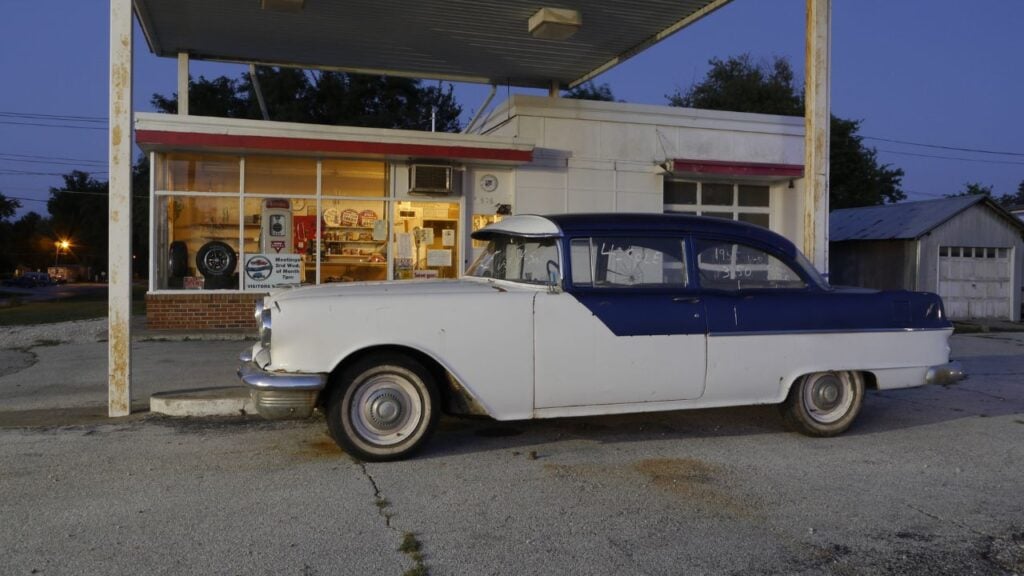
Roadside businesses once defined a drive through Alabama.
Five of them are in this list.
5 Roadside Businesses That Once Defined a Drive Through Alabama
9 Mississippi Storefronts That Have Changed Hands More Than Anyone Can Count

Some Mississippi storefronts have changed hands more than anyone can count.
This list has nine of them.
9 Mississippi Storefronts That Have Changed Hands More Than Anyone Can Count
