
Why West Virginia Split From Virginia, and the Counties That Almost Didn’t Go

Look at a map of West Virginia and Virginia, and the border you see ended up in front of the U.S. Supreme Court.
It started long before the Civil War as a fight over who got to vote, and two counties had to wait until 1863 to pick a side.
Here’s how a state broke off, and what it took to pull the last counties in.
East-West Divide
West Virginia’s split from Virginia started decades before the Civil War, and it started at the ballot box.
Virginia’s 1776 constitution gave voting rights only to white men who owned land, which shut out men who owned none.
It also gave every county two delegates, no matter how many people lived there.
The Archives contrasts the large slave population of eastern Virginia with the general absence of slaves in western Virginia.
In 1830, Virginia voters approved a new state constitution, 26,055 to 15,566.
Voters in what’s now West Virginia rejected it, 8,365 to 1,383.
Virginia’s 1850 constitution finally let every white man over 21 vote without owning property.
Wheeling Conventions
Virginia’s vote to secede is what brought western delegates to Wheeling, where they met twice in the spring of 1861.
Delegates from 27 western counties met first on May 13, 1861, and agreed to meet again if secession passed.
Virginia voters ratified the secession ordinance on May 23, 1861; Governor John Letcher announced the count as 125,950 to 20,373.
Because many vote totals were lost, it is unclear how western Virginians voted.
The second convention opened June 11, 1861, with 88 delegates from 32 counties seated.
It began as a reorganization of Virginia’s government, not a breakaway.
Delegates ruled that secession had left all of Virginia’s state government offices vacated.
They voted unanimously for an ordinance reorganizing the government.
On June 20, they elected Francis Pierpont of Marion County governor.
Virginia now had two governors.
Western complaints over votes and representation were decades old.
At Wheeling, the delegates declared the government offices vacated and reorganized the government.
That Reorganized Government of Virginia, the Union government Pierpont led, is the one West Virginia’s backers worked through.
That August, the Wheeling convention passed an ordinance allowing a new state to be carved out of Virginia.
The October 24, 1861, referendum covered the 39 counties of the proposed state plus Hampshire and Hardy.
In May 1862, the Reorganized Government’s General Assembly consented to the new state.
Congress still had to agree.
Why West Virginia Needed Virginia’s Yes
West Virginia needed two yeses under the Constitution‘s rule on new states, one from the legislature of the state being divided and one from Congress.
Richmond had seceded, so West Virginia’s backers took the question to the Reorganized Government’s General Assembly instead.
That government stayed in place as Virginia’s Union government until 1868.
Congress’s Slavery Condition
Congress agreed to admit West Virginia only if the new state changed its constitution on slavery.
The bill reached Abraham Lincoln on December 22, 1862, and he didn’t sign it right away.
He asked his six cabinet members for written opinions on whether admission was constitutional and advisable.
Their views split equally.
He signed the bill on December 31, 1862.
Voters approved the changed constitution on March 26, 1863, by 28,321 to 572.
Lincoln issued his proclamation on April 20, 1863.
West Virginia became the 35th state on June 20, 1863.
Opt-In Counties
Seven counties were left to a local vote when the constitution named 44 for certain.
A boundary committee proposed adding 32 counties to the 39 already included.
The Archives says debates followed and a number of proposed counties were rejected, some for large numbers of slaves, secession sentiment or debt.
On December 13, 1861, the convention settled on the 39 original counties plus five more: Greenbrier, Mercer, McDowell, Monroe and Pocahontas.
Add the five to the 39, and you get the 44 named counties.
The West Virginia Encyclopedia says the boundaries were drawn partly to keep the Virginia route of the Baltimore and Ohio Railroad in Union territory.
Pendleton, Hardy, Hampshire and Morgan were the first optional group, and their voters opted in.
Berkeley, Jefferson and Frederick were the second.
No vote was held there at the time because the Confederacy controlled them.
Berkeley and Jefferson
Berkeley and Jefferson counties had to wait until 1863 to vote on joining West Virginia.
The Reorganized Government set up the vote in laws dated January 31 and February 4, 1863, and polls opened in both counties on May 28.
Pierpont certified large majorities for joining.
West Virginia admitted Berkeley on August 5 and Jefferson on November 2, 1863.
Virginia later told the Supreme Court that a fair vote had been impossible and that polls hadn’t opened at many of the voting places.
Frederick County never joined West Virginia.
Psst! How much do you know about West Virginia? Take our quiz and see if you can ace it.
Quiz
Mountain State Trivia
Answer these questions on West Virginia’s statehood and its geography. We bet you can’t get them all right. Prove us wrong?
West Virginia finished paying its share of Virginia’s debt in which year?
Virginia v. West Virginia
Virginia sued West Virginia to get Berkeley and Jefferson back, and the case ended up before the U.S. Supreme Court.
On December 5, 1865, the Virginia legislature repealed the acts that had consented to the transfer.
Congress answered in March 1866 with a joint resolution that recognized the transfer of both counties and consented to it.
The House Judiciary Committee had backed that resolution in a January 1866 report.
It counted the October 1865 vote for the Union ticket at 923 to 137 in Berkeley and 304 to 199 in Jefferson.
A test oath kept voters who had served in the Confederate army or aided the rebellion from voting.
The Court ruled for West Virginia in 1871, by a vote of 6-3.
The justices didn't reopen the 1863 count.
Justice Miller's majority opinion treated the governor's certification as final between the two states.
Virginia couldn't undo the transfer years later.
Justice Davis dissented, joined by Justices Clifford and Field.
He argued that Virginia withdrew its consent in December 1865, before Congress consented, so no agreement between the two states was ever complete.
5 West Virginia Tunnels and Bridges Drivers Underestimate
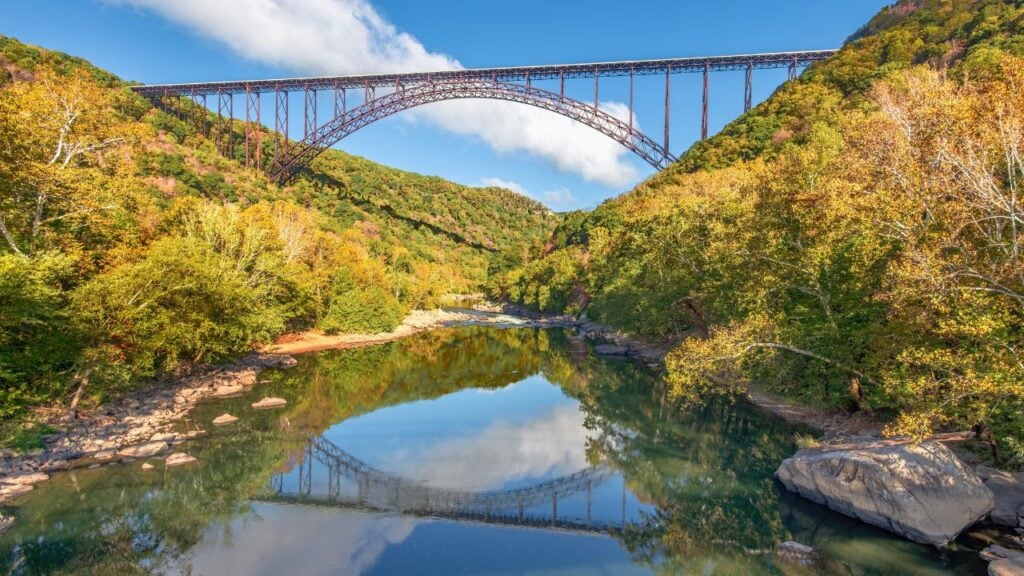
Tunnels and bridges are easy to take for granted.
But you may never have wondered who built yours, why it's shaped that way, or what almost went wrong underneath it.
5 West Virginia Tunnels and Bridges Drivers Underestimate
4 West Virginia Foods Nobody Makes Until It Gets Cold

Cold weather is easier to welcome when you know what's coming out of the kitchen.
In West Virginia, some old family recipes feel as much a part of the season as reaching for your heavier coat.
