
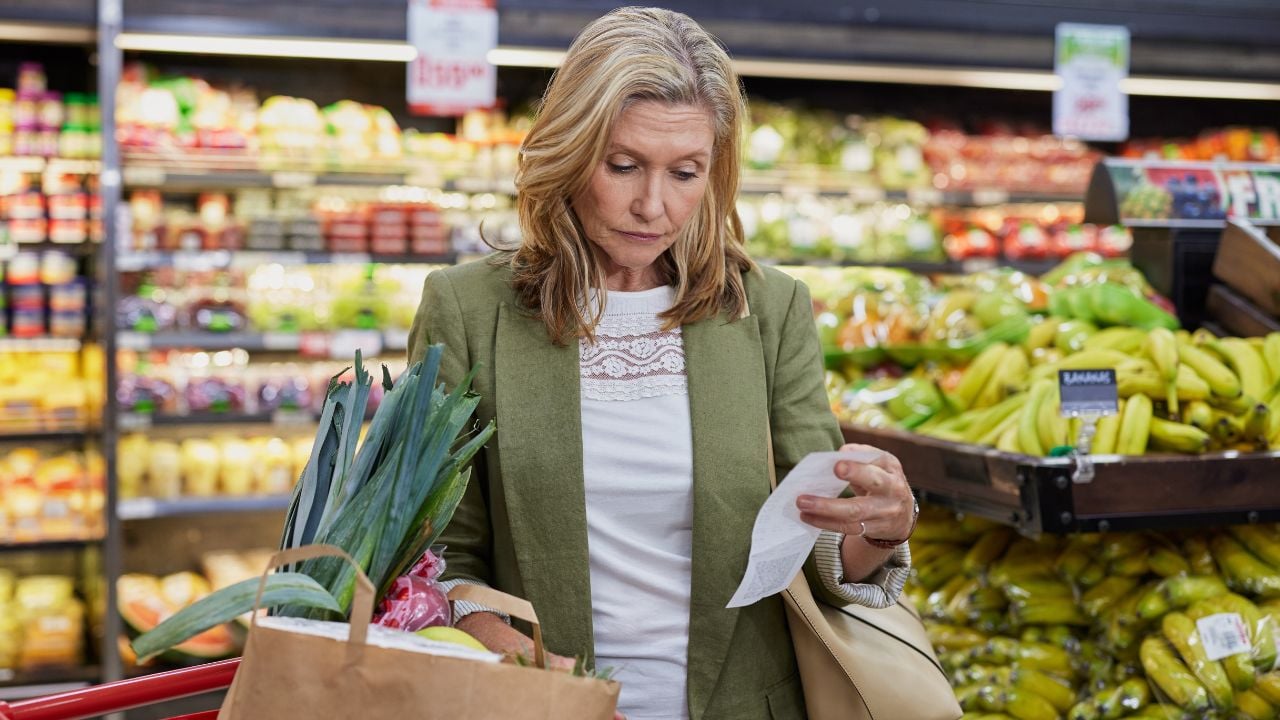
Wisconsin Voters Say Grocery Prices Are Up. Do the Official Numbers Agree?

If gas prices feel worse than grocery prices lately, you’re not the only one in Wisconsin.
A Marquette poll asked registered voters how their costs have changed over the past six months.
Here’s what Wisconsinites told the poll about grocery bills, and what the official price data shows.
Who Ran the Poll and How
Marquette drew 627 of its 843 voters from Wisconsin’s voter registration list.
The other 216 came from a survey panel drawn from postal addresses across the state.
In all, 749 people took the survey online, and 94 spoke with a live interviewer by phone.
Everyone polled was a registered voter, so the results describe voters, not everyone you see in the checkout line.
The poll’s margin of error is plus or minus 4.3 points.
With that margin, the 56% could sit anywhere from roughly 52% to 60%.
Grocery Price Answers
Voters were asked how the price they pay for groceries has changed over the last six months.
Up a lot was the top answer, while only 12% said grocery prices stayed about the same.
Another 27% said up a little.
In all, 84% said prices have gone up, which is more than 8 in 10 voters.
If your total feels higher, you’re in the majority.
The share saying prices went up was 76% in October 2025, 68% in February and 81% in August.
In August, 52% picked up a lot, four points below this month’s top answer.
For a rough comparison, a four-point gap is about the size of the poll’s 4.3-point margin of error.
How the Question Was Worded
The grocery question offered five answers, from gone down a lot to gone up a lot, with stayed about the same in the middle.
That makes the 56% the top step on a five-step scale, not the share who said prices went up at all.
It asked about the price a voter pays for groceries, so the answers show how voters feel their grocery costs have changed, not a tally of what each household spent.
Percentages are rounded to whole numbers, so a total can differ from the sum of its parts by a point.
That’s why 56% and 27% sit beside a total of 84%.
Official Price Data
The poll asked about six months, while official figures compare one August with the next.
The U.S. Department of Agriculture’s Economic Research Service (ERS) says grocery prices were 2.2% higher in August 2026 than in August 2025.
Across the Midwest, the Bureau of Labor Statistics (BLS) found food at home prices up 1.6% over the 12 months ending in August.
Using those rises, $100 of groceries a year ago would cost about $101.60 to $102.20 today.
Items moved in opposite directions.
Beef and veal were 5.9% higher in August, while eggs were 23.0% lower.
Fresh vegetables were 2.6% higher, and sugar and sweets were 6.1% higher.
The beef figure is national, but a cart heavy on beef may cost more than it did a year ago.
Psst! How much do you know about Wisconsin’s food and farms? Take our quiz and see if you can ace it.
Quiz
Wisconsin Food IQ
Answer these questions on Wisconsin food, farms and grocery rules. We bet you can’t get them all right. Prove us wrong?
Under Wisconsin’s rules, butter can’t be sold in the state unless it has been what?
Gas Price Answers
Gas drew a sharper reaction than groceries.
On the same six-month question, 75% said the price they pay for gas has gone up a lot, against 56% for groceries.
That's 19 points higher than gas drew in August, well beyond the margin of error.
Add the 17% who said up a little, and 92% say gas has gone up, from 81% in August.
In February, before the start of the war with Iran, 18% said gas had gone up and 50% said it had gone down.
By September, the answers had flipped.
The BLS Midwest report puts the 12-month rise in gasoline at 27.0% in August, with energy prices as a whole up 16.5%.
The Energy Information Administration put the Midwest's average regular gasoline price at $4.109 a gallon for the week of Oct. 5.
At that price, a 15-gallon fill-up costs about $62.
Voters' Finances
Marquette also asked whether voters personally are better off, about the same or worse off than a year ago.
Worse off narrowly led at 43%, a near tie with the 41% who said about the same, while 16% said better off.
The worse-off share was 30% in February and 38% in August.
Today's 43% is 13 points above February.
Prices overall rose faster than groceries.
All items were up 3.6% over the 12 months ending in August, more than twice the 1.6% for food at home.
A basket that cost $100 a year ago would cost about $103.60 now.
Expectations and Forecasts
Looking ahead, roughly 3 in 4 voters (74%) expect inflation and the cost of living to increase over the next 12 months.
Another 16% expect it to stay about the same, and 10% expect a decrease.
Inflation and the cost of living are the most important issue for 45% of registered voters, compared with 43% in August.
The ERS forecasts grocery prices will rise 2.4% this year, with a range of 1.8% to 3.0%.
Overall food prices are forecast to rise 2.9% this year.
A 2.4% rise would turn $100 of groceries from last year into $102.40.
7 Meijer mPerks Features Wisconsinites Forget to Use
You can remember everything on your grocery list and forget to check mPerks before your trip.
By the time you're unloading bags in your driveway, checking for savings feels like homework for next week.
7 Meijer mPerks Features Wisconsinites Forget to Use
7 Arguments Wisconsin and Minnesota Have Never Settled

Wisconsin and Minnesota often fight over football, but the disagreements don't stop at the sideline.
The two states often argue about more than football.
