
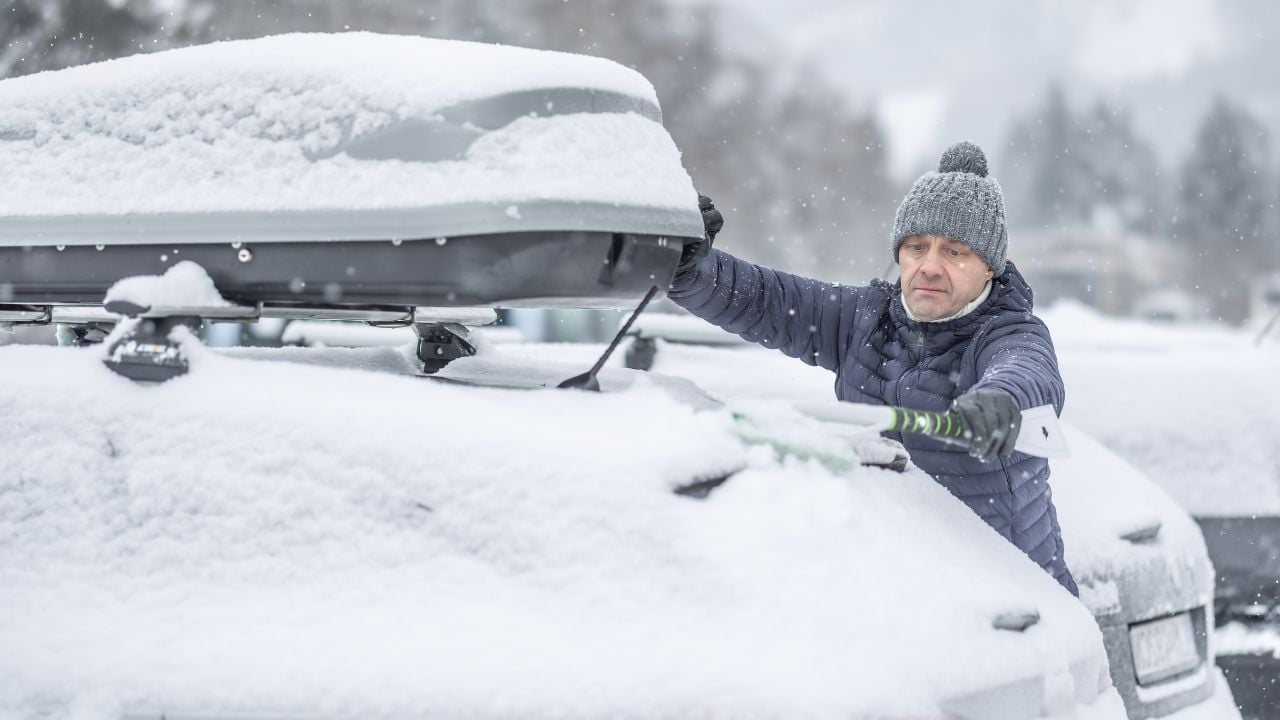
5 States Where Drivers Can Be Ticketed for Leaving Snow on Their Car Roof

The first real snow of the season is coming, and with it, some mornings when you might tempted to only clear your windshield.
That shortcut is a fast way to get a ticket in some states, though.
Here’s where drivers can be ticketed for leaving snow on their car roof.
Note: This is general information, not legal advice. Traffic laws and fines are subject to change.
1. New Jersey
New Jersey can fine you for snow left on your roof, even if none of it ever falls off.
The state’s law tells drivers to make all reasonable efforts to clear accumulated ice or snow from the car’s exposed surfaces before driving on a street or highway.
The fine runs $25 to $75 for each offense.
Lawmakers passed the rule in 2009, and it took effect a year later.
Under the law, the ticket adds no motor vehicle points and no automobile insurance eligibility points.
State highway-safety officials name the roof, along with the hood and windows, among the spots to clear.
2. Pennsylvania
In Pennsylvania, you must make reasonable efforts to clear accumulated ice or snow within 24 hours after it stops falling.
The fine is $50 for each offense, even if no snow or ice comes off your car.
The law also lets an officer stop a vehicle that breaks the rule if the officer believes the snow or ice may pose a threat to persons or property.
The current section was added by Act 90 of 2022.
The statute lists the hood, trunk and roof of the vehicle among the surfaces to clear.
3. Connecticut
Connecticut’s rule turns on danger.
You must remove accumulated ice or snow so that it doesn’t pose a threat to persons or property while you drive on a street or highway.
The ticket is an infraction with a $75 fine.
Commercial vehicle drivers carry the same duty.
The rule took effect in late 2013.
The statute names the hood, trunk and roof, so threatening snow left on your roof counts as a violation.
Psst! How much do you know about winter driving? Take our quiz and see if you can ace it.
Quiz
Winter Driving IQ
Answer ten questions on snow, ice and tires. We bet you can’t get them all right. Prove us wrong?
In the penny test for tire tread, what does it mean when you can still see the top of Lincoln’s head with the coin upside down in the groove?
4. Rhode Island
Rhode Island's snow law covers any significant amount of snow or ice on your vehicle, so a loaded roof can draw a ticket.
Snow counts as significant when it could reasonably blow off and block another driver's view.
The state's schedule of violations lists $100 for section 31-23-16, the section that holds the snow and ice rule.
5. New Hampshire
New Hampshire's negligent-driving law, RSA 265:79-b, never mentions snow or your roof.
Still, a 2019 state courts library said police cite it, known as Jessica's Law, when drivers don't clear snow off their vehicles.
Jessica's Law takes its name from a 20-year-old woman killed when ice flew off the top of a truck.
Lawmakers passed it in 2001, and it went into effect in 2002.
The law covers driving in a way that endangers, or is likely to endanger, any person or property.
A first offense costs you $250 to $500, and a second costs $500 to $1,000.
Those first-offense fines sit well above the base fines in the other four states.
New Jersey's run $25 to $75, Pennsylvania's $50, Connecticut's $75 and Rhode Island's $100.
In February 2019, CBS Boston reported that a New Hampshire State Police trooper stopped 20 vehicles covered in snow or ice in about three hours and issued 21 tickets.
The same report said the trooper had cited 17 other drivers the week before.
Those stops covered vehicles with snow or ice generally, so the clearest roof link is the ice that flew off the truck behind the law's name.
Fines for Snow That Flies Off
Snow that slides off your roof can cost the most when it causes injury or damage.
New Jersey and Connecticut both charge private-car drivers $200 to $1,000 for each offense.
That fine applies when loose snow or ice flies off and causes injury or damage.
Leaving the snow on, with nothing falling, runs $25 to $75 in New Jersey and $75 in Connecticut.
Pennsylvania's range is $200 to $1,500.
Under 75 Pa.C.S. 3721, that tier needs a death or serious bodily injury, so a cracked windshield alone doesn't trigger it.
Where New Jersey's $1,500 Snow-and-Ice Fine Applies
New Jersey's $1,500 snow-and-ice fine is for commercial vehicles, not the car in your driveway.
A commercial operator faces $500 to $1,500 for each offense when loose snow or ice causes injury or damage.
That fine can land on the operator, the owner or the company leasing the vehicle.
Storm and Parked-Car Exemptions
Not every snow-covered roof earns you a ticket in these states.
New Jersey and Connecticut both exempt you when a snow or ice storm began and continued for the whole time you were driving.
Both also exempt a car while it is parked.
A commercial driver in New Jersey owes no fine while heading to a location with snow-removal equipment, unless that driver already passed one after the snow or ice built up.
Pennsylvania excuses bus, school bus, mass transit and motor carrier drivers who are on the way to a facility to clear their vehicles.
Pennsylvania also excuses any driver for whom clearing the vehicle would threaten the driver's health and safety.
Rhode Island excludes snow that piles up on your vehicle during adverse weather while you drive.
3 Cold-Weather Dog Rules That Can Get Pennsylvanians Cited

Pennsylvania's winter rules reach past the road and into the backyard.
Here are three cold-weather rules for dog owners that can lead to a citation.
3 Cold-Weather Dog Rules That Can Get Pennsylvanians Cited
How Much More Will Heating Oil Cost This Winter?
Winter heating costs are on many New Jersey households' minds.
One forecast offers a glimpse of what the season could mean for the budget.
How Much More Will Heating Oil Cost This Winter? This Forecast Offers a Glimpse for New Jerseyans
