
6 Georgia Watering Rules Homeowners Break Without Realizing It

Watering the yard seems simple enough: turn on the hose and go.
Georgia has state rules about how and when you water, and some apply even when there’s no drought in the news.
Here’s what to check before you water again.
Note: This is general information, not legal advice. Watering rules and drought levels are subject to change, so confirm the current requirements with the Georgia Environmental Protection Division or your local water provider.
1. The 10 A.M. Cutoff
The 10 a.m. cutoff comes from a state law that lets you water ground cover, trees, shrubs and other plants only between 4 p.m. and 10 a.m. daily.
The Georgia Water Stewardship Act made that schedule statewide when it took effect on June 2, 2010.
It covers you if your water comes from a system permitted by the Environmental Protection Division.
A sprinkler timer set to start at 10:30 a.m. runs outside the window, and so does a noon cycle meant to save a wilting lawn.
Both need new start times.
2. The 30-Day Clock on New Plants
The 30-day clock exempts new and replanted plants, seed and turf from the watering window during installation and for 30 days after.
After that period ends, the 4 p.m. to 10 a.m. schedule applies to that planting again.
Sod you laid in August was back under the watering window by October 1 at the latest.
Check your calendar.
How the 30-Day Clock Counts
The 30-day exemption also covers the installation itself, so you can water at any hour on the day you plant.
Counting the planting day as day zero, day 30 should be your last exempt day, though the rule doesn’t spell out the count.
A 10:30 a.m. sprinkler run after day 30 breaks the rule.
3. Fine Print on Hand-Watering
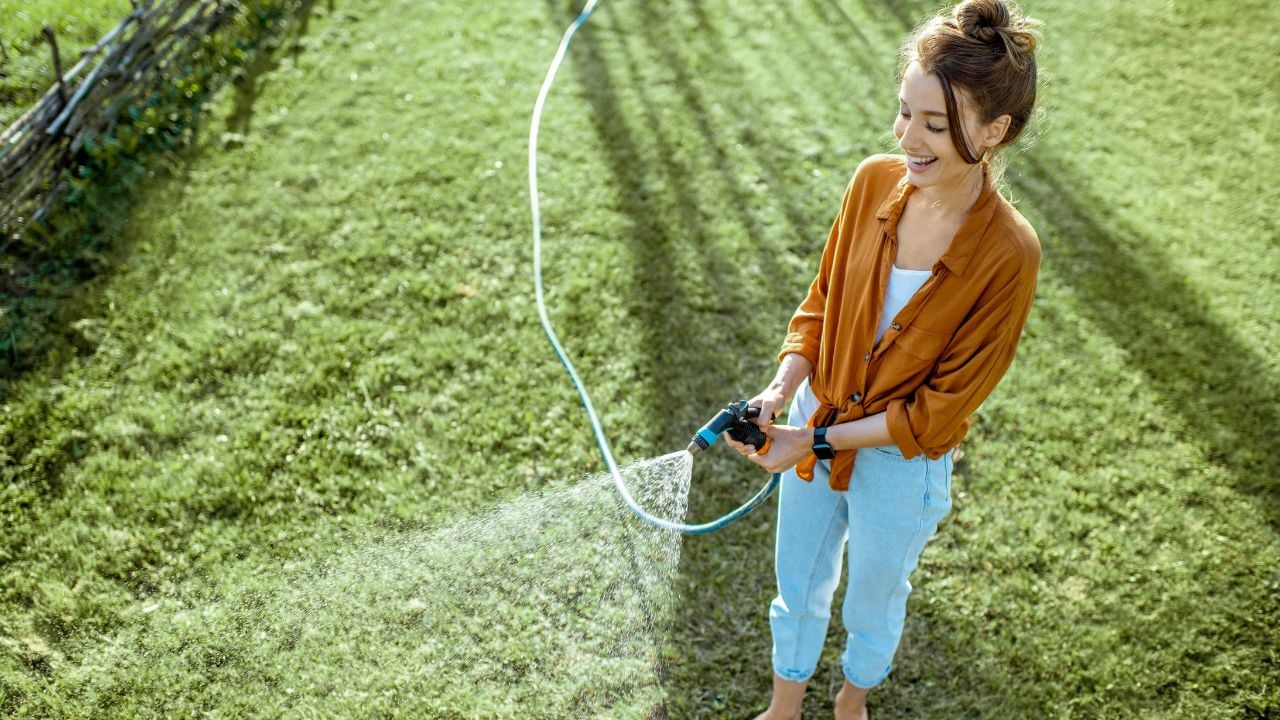
Hand-watering is exempt from the 10 a.m. cutoff, but only with a hose with automatic cutoff or a handheld container.
A watering can qualifies.
So does a hose with automatic cutoff, even at 11 a.m.
A sprinkler left running while you’re inside isn’t hand-watering.
The Environmental Protection Division’s list of exemptions never mentions sprinklers.
Psst! How much do you know about Georgia’s water laws? Take our quiz and see if you can ace it.
Quiz
Georgia Water IQ
Answer these questions on Georgia’s water laws and drought rules. We bet you can’t get them all right. Prove us wrong?
In April 2026, how much of Georgia was in D2 through D4 drought on the U.S. Drought Monitor?
4. Gray Water Rules
Gray water comes with conditions.
It's the waste water from bathroom sinks, bathtubs, showers, clothes washers and laundry sinks.
Reusing it is exempt from the 10 a.m. cutoff, but only if you follow Georgia Code Section 31-3-5.2 and local board of health rules.
That code allows gray water to be applied only by hand, using garden watering cans or similar hand-held containers.
A sprinkler or a hose running off your washing machine doesn't fit that wording.
The code also bars gray water on food plants.
Local governments can punish violations with fines of up to $100.
5. Food Garden Exemption
The food garden exemption covers your tomatoes and collards.
The hydrangeas beside them don't qualify because the exemption names personal food gardens and flower beds aren't on the list.
At Level 3, a sprinkler on that bed at 2 p.m. would break the rule.
Drip irrigation and soaker hoses are exempt at any hour.
A drip line avoids that.
6. Stricter Local Rules
In an emergency that immediately threatens public health, safety or welfare, your city or county can set watering rules stricter than the state's.
The limit?
Seven days, unless the Environmental Protection Division's director grants a variance.
State law has every county and city adopt the watering schedule by ordinance, so the rule you follow is local.
Your county or city punishes violations as ordinance violations, so the fine depends on where you live.
Cobb County's posted schedule follows the same 4 p.m. to 10 a.m. window and starts with a written warning for a first violation.
A second brings a $100 fine, a third brings $250, and a fourth or later brings $500 plus possible service disconnection.
Reason Behind the Window
Evaporation is the reason.
The Metropolitan North Georgia Water Planning District says the 4 p.m. to 10 a.m. window works because cooler temperatures help reduce evaporation.
Watering too often, or during peak heat, wastes water through evaporation and runoff.
That district covers 15 counties in the metro Atlanta region.
It also urges you to water wisely, fix leaks and cut unnecessary outdoor use.
Level 2 and Level 3 Limits
Drought levels change your watering rules in steps, and Level 1 is the first.
The division's director declares each level and notifies the public with a press release.
Level 1, in place statewide since April 27, 2026, has public water systems run a public information campaign.
The division maintained that level in an August 14 decision.
Watering from 4 p.m. to 10 a.m. is unaffected.
Once a drought reaches Level 2, even-numbered addresses water on Wednesday and Saturday, and odd-numbered addresses water on Thursday and Sunday.
The same level bans washing driveways, sidewalks and vehicles from cars to boats and golf carts.
It also bans ornamental fountains and charity car washes.
Level 3 goes further.
At that level, outdoor irrigation of ground cover, trees, shrubs and other plants isn't permitted.
Food gardens are one exception, but you have to water them between 4 p.m. and 10 a.m. unless you use drip irrigation or soaker hoses.
Exemptions Without a Clock
The state's list of exemptions from the 10 a.m. cutoff runs to 13 uses, and some of them may apply to your yard.
Commercial farms, golf courses, athletic fields and hydroseeding are on it.
A few apply to homes.
Reclaimed wastewater from permitted systems is exempt.
So is capturing and reusing storm water or cooling system condensate, where local ordinances and state guidelines allow it.
If you water from a private well on your property, the window doesn't apply to that water.
Installing, maintaining and calibrating an irrigation system is exempt as well, so you can calibrate your sprinkler zones at noon without breaking the rule.
12 Home Maintenance Jobs Georgians Forget About Until Something Breaks
Georgia sits inside what University of Georgia Extension entomologists call the termite belt.
That's the kind of job you learn about after the fact.
12 Home Maintenance Jobs Georgians Forget About Until Something Breaks
7 Rules That Decide What Georgians Can Do About a Neighbor's Camera Pointed at Their Yard
Point a camera at the wrong patch of a neighbor's backyard in Georgia, and the charge can be a felony.
Many homeowners who install a camera, or fume about one aimed their way, don't know where Georgia draws that line.
7 Rules That Decide What Georgians Can Do About a Neighbor's Camera Pointed at Their Yard
