
6 Things in Every Florida Garage That Confuse Northerners

Back up north, ants were a picnic problem. In a Florida garage, there’s bait on the shelf for them.
Floridians stock their garages for the climate, and some of it looks odd to anyone raised in snow country.
Here are the things in every Florida garage that confuse Northerners.
1. Hurricane Shutter Panels
Look along the wall of many garages, and you’ll find hurricane shutter panels stacked there.
To a Northerner, a pile of metal panels or plywood in the garage can look like leftover building supplies.
Florida’s Division of Emergency Management says your windows and doors need to be impact resistant or have a protective covering.
Rated shutters qualify, and so does properly secured 5/8-inch plywood.
Plywood counts.
Your garage door is one of five areas to reinforce, along with the roof, straps, windows and doors.
In testing, a 9-pound 2×4 strikes impact-rated products end-on at 34 mph.
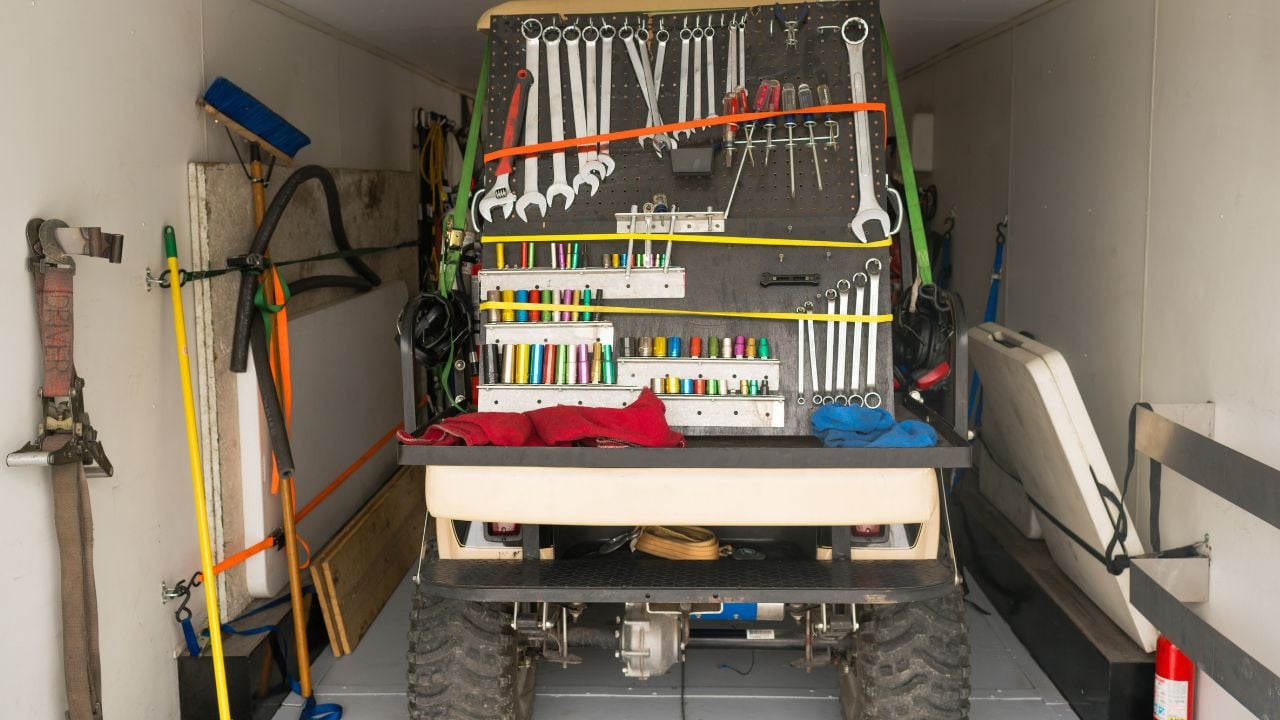
2. Golf Cart
Golf carts often park beside the car in a garage.
If your old garage held only a car, a golf cart parked inside can seem like a toy that wandered in.
Florida law lets a city or county designate streets for golf carts.
On those streets, drivers 18 and older have to carry a government-issued photo ID.
Younger drivers need a learner’s or regular driver license.
Local governments can also allow carts on certain sidewalks by ordinance, with a top speed of 15 miles per hour.
Unless the local government approves night driving, you can run a cart only between sunrise and sunset.
Sunset is your curfew.
If you break those rules, it’s a noncriminal traffic infraction.
3. Portable Generator
A portable generator is a common find in many garages.
If outages back home meant a flashlight and a blanket, a generator in your garage can seem like overkill to you.
Four major hurricanes struck Florida between mid-August and late September of 2004.
Together, the storms cut power to several million homes.
A portable generator is how you keep your refrigerator running when the lights go out.
A report from the Centers for Disease Control and Prevention on those storms says the Consumer Product Safety Commission investigated six deaths in Florida attributed to carbon monoxide poisoning.
Portable generators were responsible for nearly all of the carbon monoxide exposures counted.
Where a Portable Generator Runs
Of 47 nonfatal carbon monoxide incidents tied to a known portable generator after Florida’s 2004 storms, 16 happened with the generator inside a garage.
In all, 167 people had nonfatal poisoning, from 51 exposure incidents.
Never run a portable generator indoors, in a garage, or outdoors near doors, windows or vents.
4. Bottled Water
Bottled water in the garage follows the Orange County health department’s hurricane supply list, which calls for one gallon per person per day.
If you’re used to filling a glass from the tap, a wall of stacked gallon jugs can look like an odd habit to you.
It calls for at least a seven-day supply of food and water.
That’s 28 gallons for a family of four.
Pick foods that don’t need refrigeration, cooking or preparation.
The federal Ready.gov guide says more water may be necessary if you live in a warm climate.
Water that isn’t commercially bottled needs replacing every six months.
Psst! How much do you know about hurricanes? Take our quiz and see if you can ace it.
Quiz
Hurricane Season IQ
Answer these questions on hurricane history and the storm scale. We bet you can’t get them all right. Prove us wrong?
Which storm still holds the record for the lowest air pressure at a U.S. landfall?
5. Fishing Gear
Fishing gear in the garage makes sense in a state where the Florida Fish and Wildlife Conservation Commission cites 4 million anglers.
If you've never lived near the coast, a wall of rods and tackle may look odd to you.
You need a saltwater license to take saltwater fish, crabs or clams.
Crabs count too.
Anglers bought 1.5 million recreational saltwater licenses in fiscal year 2019-2020.
If you're a resident who fishes from the shoreline, the annual license costs nothing.
It covers fishing from the shoreline or a structure attached to shore, but not from a boat.
6. Fire Ant Bait
Fire ant bait is a familiar sight on many garage shelves.
If ants back home were a picnic problem, you may wonder why some garages keep a shelf of bait on hand.
The University of Florida's extension service calls the stings painful and burning, with pustules and intense itching.
The effects of a sting can last up to 10 days.
Because of Florida's sandy soil, fire ants may not build the sizable mounds you'd find in states with clay soil.
Spraying the foraging workers you see doesn't help because only about 20% of a colony forages at a given time.
Bait does the work.
Treatment combines broadcast bait across your yard with bait applied to individual mounds.
No control method permanently eliminates fire ants from an area.
12 Things Northerners Get Wrong About Florida Winters
Newcomers who picture year-round flip-flops are in for a surprise.
Winter tells them otherwise.
12 Things Northerners Get Wrong About Florida Winters
13 Things Floridians Never Have to Explain to Each Other
Ask locals why they keep checking the sky on summer afternoons, and they often won't slow down to explain.
Out-of-staters need the whole story.
