
7 Decisions an Ohio Township Trustee Makes Without Asking Anyone Above Them

Three elected trustees run each of Ohio’s 1,308 townships, the Ohio Township Association told state lawmakers in February 2025.
No county commissioner sits in that room.
These are the decisions an Ohio township trustee makes without asking anyone above them.
Note: This is general information, not legal advice. Ohio Revised Code provisions covered here are subject to change.
1. Setting the Zoning Rules
Ohio township trustees can write and adopt a full zoning resolution for their unincorporated territory, covering lot size, building height, and what gets built where.
No county planning office signs off.
No state agency reviews it first.
The board just votes.
That’s a call three trustees make together, the same three who run each of Ohio’s 1,308 townships.
Ohio law makes zoning optional for a township, so many rural boards have never adopted one.
A township next door might regulate every new pole barn down to the setback line.
State law draws one hard line trustees can’t cross: It exempts farmland and the buildings that go with it.
That gap between one township and the next comes down to three people, not a county.
2. Deciding Which Roads Get Fixed
Every mile of a township road falls under its trustees, who decide what to plow, patch, and rebuild.
State law hands that board full authority over those roads.
Nobody at the county has to approve the call.
Trustees decide alone.
That covers snowplowing, culvert repairs, and gravel on a dead-end road nobody outside the township has ever driven.
3. Choosing Fire Protection
Ohio township trustees decide how their township gets fire protection, whether that means buying trucks and hiring firefighters directly or contracting the whole job out.
State law lets the board buy fire apparatus, employ firefighters, or sign with a volunteer fire company.
The board decides alone.
Trustees can also join with a neighboring township or a nearby city to form a joint fire district.
That agreement only needs a majority vote from each board involved, never a county or state signature.
The same authority lets them fold in ambulance service, joining with another township or a city to run one district that covers both.
4. Hiring or Skipping Police
A township’s trustees pick whether it runs a police department or leans on someone else’s badge instead.
Trustees can create a township police district, set the number of officers, and write the pay scale.
They can also contract for coverage instead, from a county sheriff, a nearby city, or another township.
The choice is theirs.
Many of Ohio’s smaller townships never build a department at all.
They sign a contract instead and let the sheriff’s cruisers cover the gravel roads.
State law does add a guardrail: Nobody with a felony conviction gets to wear the badge, no matter what the board decides.
Why a Township Isn’t a City
An Ohio township is unincorporated ground, not a city or a village.
That difference is why the trustees on this list answer to nobody above them.
Ohio’s constitution hands cities and villages home rule power to write their local laws.
The legislature never extended that grant to townships.
Township trustees can only act where a named line in state law hands them the authority.
That’s why every power on this list traces back to one exact section of the Ohio Revised Code.
5. Clearing Weeds and Junk
Trustees can order any property owner to clear tall weeds, garbage, or scattered debris.
They don’t need a judge’s order to start the clock.
A first violation gets the owner about a week’s written notice.
A repeat violation inside 12 months cuts that window to four days.
Ignore it, and the township does the work.
Then it bills the cost back.
That bill lands on the county tax duplicate as a lien on the property, so the county auditor collects the money, not a court.
No lawsuit required.
6. Running the Cemetery
A cemetery, once a township has one, belongs to its trustees.
Nobody looks over their shoulder while they run it.
The board sets the price of every burial lot.
That price can be waived for a family that can’t afford one.
State law even lets trustees reclaim an unused lot after 20 to 50 years and refund the buyer 80 percent of what they paid.
They set that number alone.
No county cemetery board reviews it.
No state office does either.
Psst! How much do you know about Ohio’s townships? Take our quiz and see how many you can get right.
Quiz
Ohio Township IQ
Answer these questions on Ohio’s townships and the land grid they grew from. We bet you can’t get them all right. Prove us wrong?
Under the rectangular land survey that laid out most of Ohio, how many acres fill one square-mile section?
7. Renting the Township Hall
Renting the township hall is up to its trustees, right down to which groups get first pick.
State law lets the board set rental terms it considers fair, including preference for township residents, local clubs, or charitable groups.
They set the price.
A wedding reception, a Boy Scout troop meeting, a Tuesday-night euchre game: Trustees can charge each one differently, or charge nothing at all.
The rent money has to go back into the building or the township's general fund, never anyone's pocket.
Where Trustees Need a Sign-Off
Township trustees lose that free hand the moment a road stops being a township road.
Cross onto a county road or a state route running through the same township, and the rules flip.
There, trustees need the county commissioners or the Ohio Department of Transportation to sign off before they touch a pothole.
Different road, different rules.
A county road answers to the county commissioners.
A state route answers to the Ohio Department of Transportation, and neither one waits on a township trustee's vote.
8 Ohio Diner Traditions That Are Slowly Disappearing

Ohio lost close to 400 restaurants, cafes, and breweries in its northeast corner alone in 2025, even as nearly 600 new places opened that same year.
Rent, thinning staff, and food costs that never eased up after the pandemic are squeezing owners who've run the same counter for decades.
8 Ohio Diner Traditions That Are Slowly Disappearing
9 Things That Change the Second You Cross From Ohio Into Kentucky
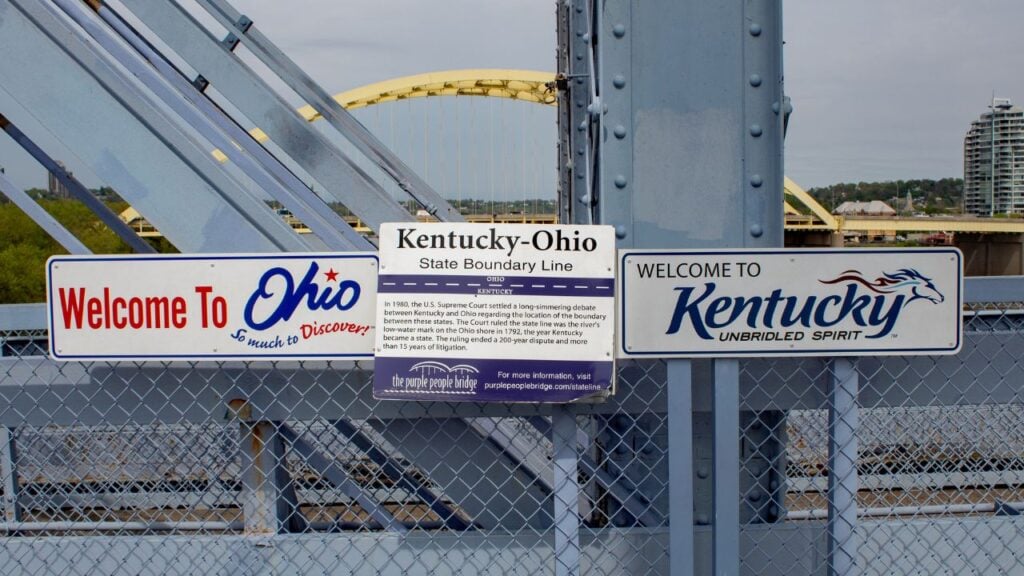
Drive across the Roebling Suspension Bridge from Cincinnati, Ohio, and Covington, Kentucky appears on the other side.
Nothing about the trip looks different, but the tax on the receipt and the price at the pump change the second the tires roll off the bridge.
9 Things That Change the Second You Cross From Ohio Into Kentucky
