
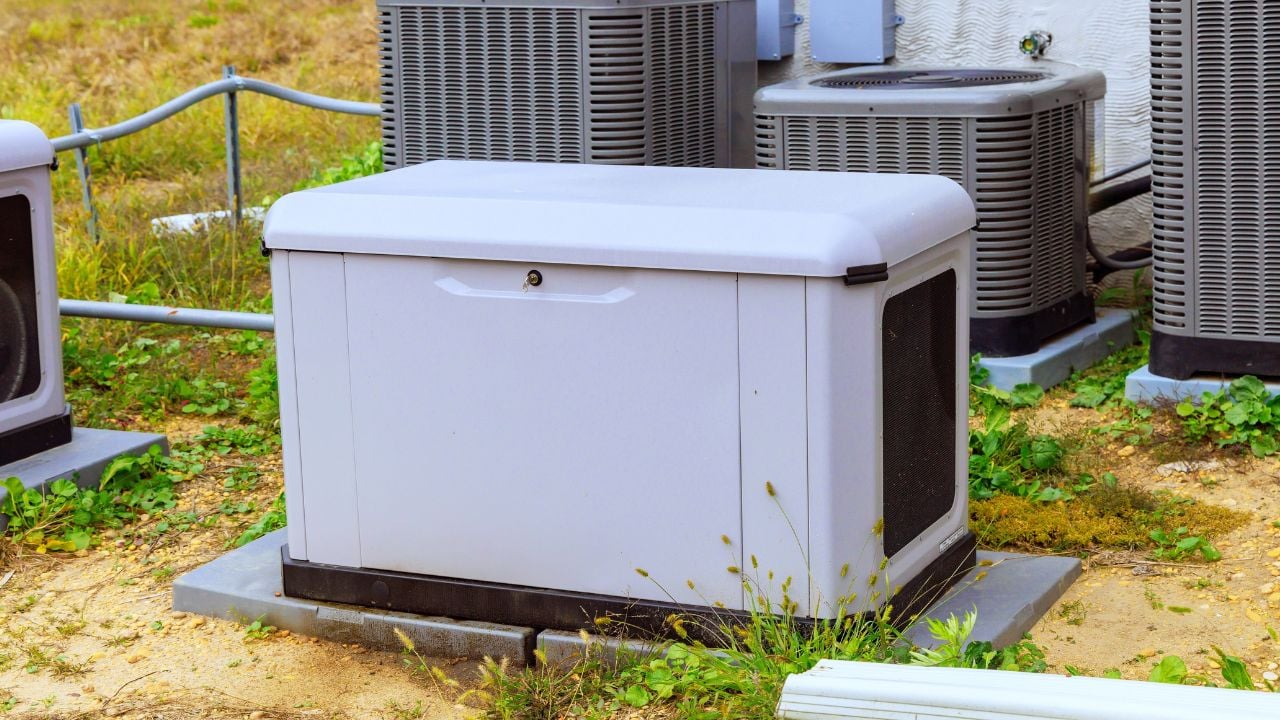
7 New Jersey Rules That Change the Day a Homeowner Installs a Generator

After a long power outage, a generator starts to sound like a smart purchase.
New Jersey homeowners may find that the rules start well before the machine shows up, and they can change from town to town.
Here are the rules that can change the day you install a generator.
Note: This is general information, not legal advice. Permit rules, setbacks and testing hours vary by town and are subject to change.
1. Licensed Contractors
If you hire out the generator hookup, New Jersey’s Uniform Construction Code requires licensed contractors for the plumbing and electrical work, no matter which town you’re in.
As a single-family homeowner, you can do that work on your house without a license.
When you hire contractors, the permit application requires each contractor’s name and license number.
2. A Permit for Each Trade
A licensed plumbing contractor has to sign and seal the plumbing subcode form that Mendham Township requires for a whole-house generator.
In Mendham Township, a licensed electrical contractor signs and seals the electrical subcode form too.
Lambertville requires your permit package for a gas-fired generator to include electric, plumbing and fire subcode forms and a gas riser diagram of the entire gas piping system.
If your generator is an automatic system, Lambertville also requires a load calculation.
Generator Permits and Building Subcodes
In Mendham Township, you submit a building subcode form only when the generator goes on a poured slab.
Florham Park also requires a building subcode if you pour a concrete pad for the generator.
Mahwah Township requires a building permit if you install a slab to support the generator, but not if you use a factory-made support.
3. Zoning Approval First
In Mendham Township, the zoning officer has to approve your generator permit before it goes to plan review.
Mendham Township requires you to submit a survey of the planned spot and a $100 fee with the zoning application, according to its generator requirements sheet.
A separate town, Mendham Borough, charges $30 for its zoning permit application.
Florham Park charges $75 on its zoning application form for a generator.
4. Setbacks From Windows and Lot Lines
Wall Township’s code sets lot-line distances for a generator of 25 kilowatts or less: 7.5 feet in three residential zoning districts and 10 feet in all the others.
Your generator must stay at least 5 feet from any window, door or opening into your house, according to Wall Township’s Standby Generator Allowable Locations handout.
Generators are also banned from the front yard, including both front yards on a corner lot.
In Wall Township, an evergreen buffer has to shield your generator from view.
Fences, pools and sheds don’t count as buffers.
In Pemberton Township, the generator has to sit at least 5 feet from the side or rear lot line and no more than 15 feet from the main structure.
Psst! How much do you know about storms and blackouts? Take our quiz and see if you can ace it.
Quiz
Storm and Blackout Trivia
Answer these questions on blackouts, hurricanes, and outage safety. We bet you can’t get them all right. Prove us wrong?
According to the Consumer Product Safety Commission’s 2022 report, about how many people in the U.S. die each year from carbon monoxide poisoning caused by gasoline-powered portable generators?
5. Size Caps
If you're eyeing a bigger generator, check your town's cap before you pay a deposit.
Pemberton Township allows only one generator, with an output of no more than 24 kilowatts.
In Essex Fells, a permanent generator can't exceed 22 kilowatts.
Pemberton Township also limits the footprint, pad and cover included, to 15 square feet.
The generator can't stand taller than 4 feet under Pemberton Township's code.
6. Approval Before Operation
Installing a generator isn't the last step.
In Pemberton Township, a permanently installed generator can't run until the Department of Community Development inspects and approves it.
North Caldwell and Essex Fells each require their Building Department to inspect and approve a generator before it runs.
In Pemberton Township, that approval also covers routine testing.
If you're convicted of breaking any provision of Pemberton Township's generator chapter, you face a fine of up to $1,250 and up to 90 days of imprisonment.
Pemberton Township treats each day a violation continues as a separate offense.
7. Transfer Switches
In Lambertville, a temporary generator connection needs a permanent transfer switch.
Lambertville says the switch lets you control which circuits in your home get generator power and prevents the possibility of explosion or fire when the main electricity comes back on.
Mahwah Township's generator checklist requires manufacturer specifications for the generator and its transfer switch.
You also have to mark transfer switches, generators and power panels as components of an emergency circuit or system in Mahwah Township.
Testing Hours and Mufflers
You can test a standby generator in Pemberton Township once in any seven-day period, for up to 30 minutes, between 11 a.m. and 3 p.m.
Essex Fells lets you test only Monday through Thursday, from 11 a.m. to noon or from 2 to 3 p.m.
Pemberton Township and Essex Fells exempt a generator from their noise rules only for emergencies, testing or repairs.
In both towns, the generator also needs a working muffler to qualify.
Emergencies can last for days.
After Tropical Storm Isaias struck on August 4, 2020, the Board of Public Utilities says utilities restored all affected customers by August 11.
In Essex Fells, a violation can cost you up to $500, and each day it continues is a separate offense.
Gas Pressure Paperwork
The Public Service Electric and Gas (PSE&G) residential gas application form has a section for generators.
On that form, you list the equipment's make, model and pressure requirement.
You also attach spec sheets showing the generator's pressure.
In Pemberton Township, a gas generator applicant must get a letter from the utility company confirming adequate gas pressure for the generator.
Assembly Bill A4405
Assembly Bill A4405, introduced on February 19, 2026, would let you install an automatic standby generator at certain residences without zoning or planning board approval.
Assemblyman Jay Webber introduced the bill, which means its details could change.
The bill covers natural gas or propane generators permanently connected to a one- or two-family home.
Under the bill's text, you'd have to run a generator in compliance with the Noise Control Act of 1971 and any law or local ordinance regulating noise levels.
Those noise rules wouldn't apply during a state of emergency that the President of the United States or the governor declares.
9 Things That Confuse Everyone Who Moves to New Jersey

Two neighborhoods a mile apart can follow different rulebooks.
That's a lot of rulebooks for a newcomer to keep straight.
9 Things That Confuse Everyone Who Moves to New Jersey
20 Prepper Tips That Sound Paranoid But Actually Work for New Jerseyans

Some prepper habits look paranoid from the outside.
Then a blackout or a storm hits, and a stash of small bills starts to look smart.
20 Prepper Tips That Sound Paranoid But Actually Work for New Jerseyans
