
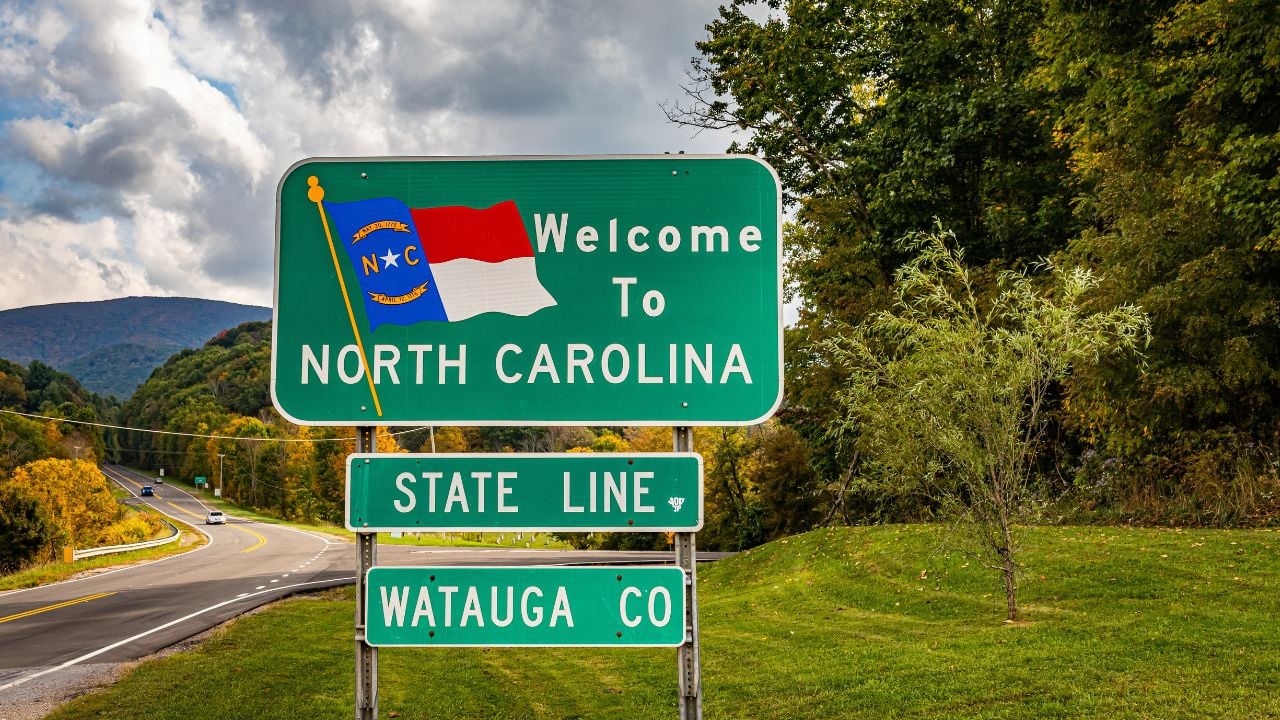
7 Things That Change the Second You Cross From Virginia Into North Carolina

In Virginia, driving 20 mph or more over the speed limit counts as reckless driving.
Virginians who cross into North Carolina and think they’re fine enough driving 15 mph over the speed limit are in for a rude awakening.
Here’s what changes the second you cross from Virginia into North Carolina.
Note: This is general information, not legal or tax advice. Tax rates, wages and traffic laws are subject to change.
1. Grocery Tax
Groceries cost you more in tax the moment you cross into North Carolina.
North Carolina’s rate on qualifying food is 2%, while Virginia’s is 1%.
North Carolina’s Department of Revenue says the state, transit and other local rates don’t apply to qualifying food, so that 2% is the only sales tax you pay on it.
2. Gas Tax
Virginia’s state gas excise tax is 32.6 cents a gallon, the rate you pay for the year that began July 1, 2026.
North Carolina set its gas tax at 41 cents a gallon for 2026.
Lawmakers then passed a suspension bill, and the rate became zero on Oct. 10.
The pause is set to run through Nov. 30, according to the state Department of Revenue.
While it lasts, a 15-gallon fill-up costs you $4.89 in Virginia gas excise tax and nothing in North Carolina’s gas excise tax.
What North Carolina’s Gas Tax Pause Covers
North Carolina’s gas tax pause applies to all motor fuels and alternative fuels, not only gasoline.
A separate state inspection tax on motor fuels still applies during the pause.
3. Cigarette Tax
North Carolina taxes each cigarette at 2.25 cents, so you pay 45 cents in state tax on a pack of 20.
Virginia’s state cigarette tax is 60 cents a pack, which is 15 cents more than North Carolina’s.
On a 10-pack carton, the gap is $1.50.
The Virginia Department of Taxation says several localities levy local cigarette taxes, so the state’s 60 cents may not be the whole tax on your pack.
Psst! How much do you know about North Carolina and Virginia? Take our quiz and see if you can ace it.
Quiz
Carolina and Virginia Trivia
Answer these questions on North Carolina and Virginia landmarks and laws. We bet you can’t get them all right. Prove us wrong?
In 1999, crews moved the Cape Hatteras Lighthouse on steel mats. About how far did it travel?
4. Holding Your Phone
Virginia bars you from holding a handheld phone while you drive a moving vehicle.
A first offense costs you $125.
North Carolina's law covers typing a text and reading a text or email while you drive.
North Carolina's fine is $100 plus court costs.
The law doesn't apply if your vehicle is lawfully parked or stopped.
G.S. 20-137.4A doesn't mention holding the phone or talking on a call, and it exempts voice-operated technology.
If you're under 18, North Carolina also bars you from using a mobile phone while the vehicle is moving.
5. Window Tint
North Carolina requires the front side windows on a passenger car to let through at least 35% of light.
Virginia's floor is 50%, so a tint you can legally run in North Carolina can fail in Virginia.
On a passenger car's rear side windows and rear window, both states set the floor at 35%.
If your car is registered in Virginia, North Carolina exempts a window that meets Virginia's requirements.
6. Speeding Thresholds
In Virginia, driving 20 mph or more over the speed limit counts as reckless driving.
It's the same if you go faster than 85 mph, whatever the limit is.
North Carolina draws its line at more than 15 mph over the limit or over 80 mph, where speeding becomes a Class 3 misdemeanor.
At 82 mph in a 70 mph zone, you're past North Carolina's line but short of Virginia's.
7. Seat Belt Fines
A rear-seat passenger who skips the belt pays a $10 penalty in North Carolina, with no court costs.
A driver or front-seat passenger pays $25.50 plus court costs.
Virginia's law covers the driver and everyone else 18 or older in a seat, and a violation carries a $25 civil penalty.
So if you're an adult riding unbuckled in the back seat, you owe $10 in North Carolina and $25 in Virginia.
In North Carolina, the back seat costs less.
Income Tax
If you file a North Carolina return, you pay one rate: 3.99% for tax years after 2025.
Virginia taxes your income in four brackets.
The first $3,000 is taxed at 2%.
Income from $3,000 to $5,000 is taxed at 3%, and income from $5,000 to $17,000 is taxed at 5%.
Virginia taxes every dollar above $17,000 at 5.75%, against North Carolina's flat 3.99%.
Minimum Wage
If you earn the minimum in Virginia, you make $12.77 an hour.
The U.S. Department of Labor's list, updated July 1, 2026, shows North Carolina at $7.25.
That's $5.52 more an hour in Virginia, or $220.80 more in a 40-hour week before taxes.
Virginia's rate is scheduled to rise to $13.75 on Jan. 1, 2027.
A second step takes it to $15.00 on Jan. 1, 2028, and yearly adjustments begin in 2029.
Vehicle Inspections
Your safety inspection runs on a different clock in North Carolina than in Virginia.
In North Carolina, the inspection has to be done by the last day of the month your registration expires.
You can have it done up to 90 days early.
The state Department of Transportation says a missed inspection due date means North Carolina blocks your registration until the vehicle is inspected.
Virginia requires a reinspection within 12 months of the month of your first inspection.
After that, you need one at least every 12 months.
Virginia's sticker goes in the bottom left corner of the windshield, as seen from inside the car.
Under 19VAC30-70-50, the number on the sticker shows the month it expires.
Registration Changes
Since Oct. 1, 2026, North Carolina no longer issues license plate stickers or automatically provides printed registration cards.
After each registration or renewal, you get a receipt with your vehicle identification number, your plate number and the fees you paid.
According to the state Department of Transportation's release, the receipt also carries a barcode that inspection stations can scan the following year.
If you want a printed registration card, you can print it at a license plate agency or order it online and have it mailed for $5.
Inspections still apply.
Emissions Tests
Virginia requires an emissions inspection only if you garage your vehicle in certain Northern Virginia localities.
Those are the counties of Arlington, Fairfax, Loudoun, Prince William and Stafford, plus the cities of Alexandria, Fairfax, Falls Church, Manassas and Manassas Park.
Each emissions inspection stays valid for two years.
North Carolina adds an emissions test for vehicles registered in some counties, on top of the safety inspection.
Beach People Didn’t Crack North Carolinians’ Top 5 Identities in an Elon Poll

If someone asked you to pick the labels that fit you, which ones would you choose?
A poll this year asked North Carolinians exactly that, and the ranking holds a few surprises.
Beach People Didn’t Crack North Carolinians’ Top 5 Identities in an Elon Poll
7 Things Lowes Foods Employees Wish North Carolinians Knew Before Checkout
You reach the register with a coupon in hand and a deal in mind.
At Lowes Foods, how that deal plays out may depend on a policy you didn't know about.
7 Things Lowes Foods Employees Wish North Carolinians Knew Before Checkout
