
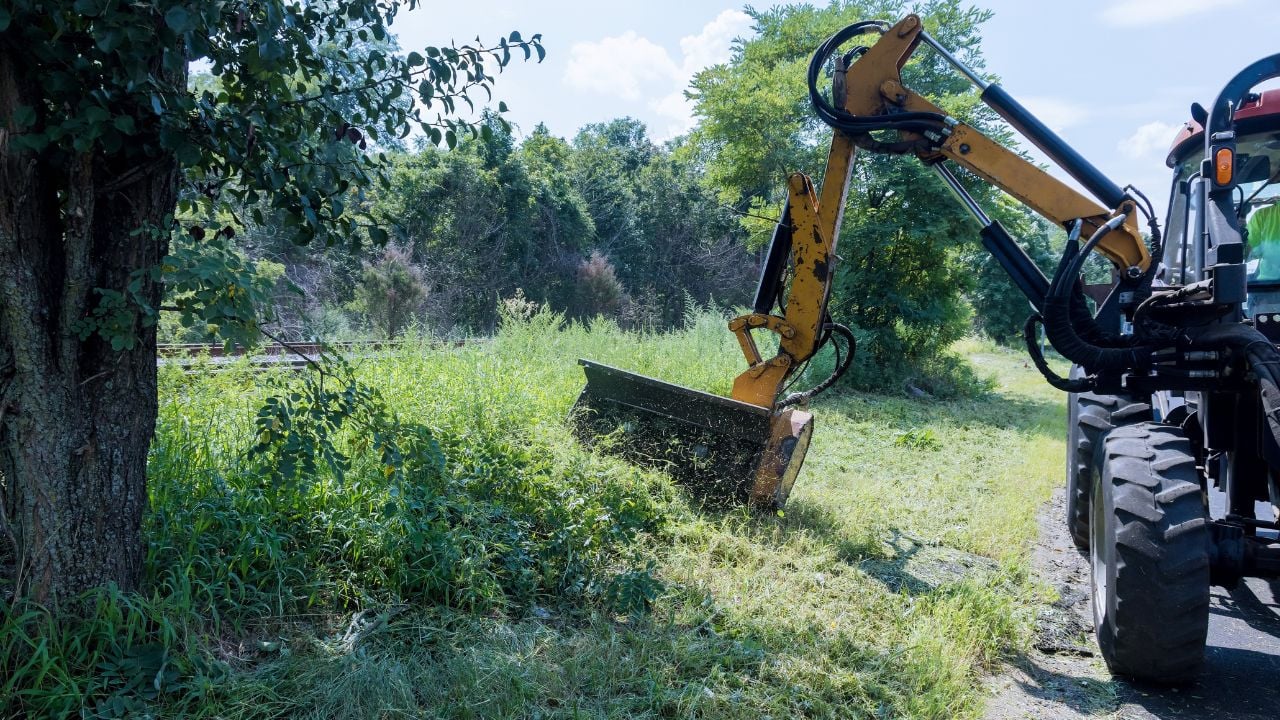
8 Roadside Mowing Rules Kansas Landowners Get Wrong

You fire up the mower along the road and figure you know where your job ends.
Kansas landowners can guess wrong about that, and a wrong guess might cost you.
Here are the roadside mowing rules landowners often get wrong.
Note: This is general information, not legal advice. Roadside mowing, noxious weed, and right-of-way rules vary by county and change over time, so confirm specifics with KDOT or your county’s noxious weed department.
1. Ownership of the Ditch
A ditch along a Kansas section road looks like county land that just happens to sit next to the fence.
It isn’t.
A 1999 opinion from the Kansas Attorney General’s office guides county road engineers on this exact question.
When a road takes a strip for travel, the property beneath it stays with whoever held it before the road existed.
The county only holds an easement, the legal right to keep that strip open for public travel.
That’s exactly why the landowner next to the ditch doesn’t need anyone’s permission to run the brush hog down it.
The dirt is still his to mow.
2. Adverse Possession Trap
A road ditch mowed, farmed, or fenced off for decades can feel like it already belongs to whoever’s been tending it.
It doesn’t settle ownership.
It can’t shut out the public.
A 1908 Kansas Supreme Court ruling, Eble v. State, established that obstructing a public road is a continuing nuisance no county’s silence can excuse.
A more recent case that cites Eble, State v. Deines, still treats that rule as good law today: Long-standing use of a public road creates no private right against it, no matter how long nobody objected.
Push a fence line into the ditch, or plant a crop up to the pavement.
A county can still order it moved, even after years of nobody saying a word.
Long use never converts to a deed.
3. No Duty to Trim the Corner
Overgrown brush at a blind crossroads raises an obvious assumption: That clearing it falls on the landowner nearby.
The Kansas Supreme Court says otherwise.
The corner’s not their job.
The 2018 ruling in Manley v. Hallbauer settled it.
A rural landowner owes no duty to trim or remove trees or other natural vegetation on their property, even along a blind corner.
That’s true even when it blocks a driver’s view.
The case grew out of a fatal crash at an unmarked crossroads where overgrown brush hid oncoming traffic.
The court still declined to put that burden on the landowner.
State law treats a rural landowner differently than a city one, and clearing a blind corner is left to the driver’s judgment.
The safest move is still running the brush hog anyway.
4. Your Ongoing Weed Duty
Mowing the ditch isn’t optional for a landowner, no matter who owns the mower.
Under K.S.A. 2-1314, anyone who owns or supervises land in Kansas has to control weeds the state still lists as noxious today, from field bindweed to Canada thistle.
That duty follows the land, ditch included.
Counties can send a legal notice giving as few as five days to get the weeds under control.
Ignore the notice, and the county can treat the land and bill the owner, with a lien possible if the bill sits unpaid for 30 days.
The alternative is worse.
A county can instead file criminal charges that carry a fine of $100 for every day the violation continues, capped at $1,500.
Five days moves fast in summer.
What Counts as “Controlling” a Weed in Kansas
Kansas’s noxious weed duty doesn’t require a landowner to wipe out every last weed on the place.
Kansas guidance defines “control” as preventing a plant from producing viable seed and stopping its vegetative spread.
A landowner who mows or sprays before seed set has met the legal bar, even with a few stray plants still standing in the ditch.
5. Splitting the Ditch Duty
A Kansas county’s noxious weed department may or may not treat the road ditch as the landowner’s job.
Reno County’s noxious weed division treats every noxious weed found on county right-of-way and county property.
Jefferson County’s weed department describes its job as covering all county road rights-of-way.
Coverage differs by county.
Both counties still send landowners a notice for weeds on the rest of their land.
Reno County even splits the cost of herbicide with landowners fighting weeds on their fields.
What one county’s crew handles, another may leave to the landowner next door.
A phone call to the county noxious weed department settles which rule applies before anyone spends a Saturday mowing ground the county already had scheduled.
6. KDOT’s Wildlife Mowing Window
The mowing schedule along a highway can look like neglect once the grass grows tall past Memorial Day.
It hasn’t.
The Kansas Department of Transportation (KDOT) mows a strip about 15 feet off the pavement on a regular schedule.
But it leaves the outlying right-of-way alone between April 15 and October 1 to protect ground-nesting wildlife.
That outer stretch gets cut to about eight inches on a four-year rotation instead, and it typically skips both sides of the same highway in the same year.
Sight lines still come first.
KDOT keeps intersections, road signs, and curves clear on a separate schedule no matter what the calendar says about wildlife.
7. Mowing Versus Landscaping the Edge
Someone whose yard runs up against a state highway often mows straight through the roadside right-of-way without a second thought.
That part is fine.
KDOT lets an adjacent owner mow the highway right-of-way to match their yard maintenance, with no permit needed for the mower.
Planting a tree, building a fence, or putting in a sign out there’s a different matter.
Any landscape improvement on highway right-of-way needs a permit from the local KDOT office first.
Anything fixed in place can turn into a hazard a car has to hit instead of grass.
The mower gets a pass the shovel doesn’t.
Psst! How much do you know about Kansas roads and highway history? Take our quiz and see if you can ace it.
Quiz
Kansas Roadways IQ
Answer these questions on Kansas roads, speed limits, and highway history. We bet you can’t get them all right. Prove us wrong?
About how many total miles of public roads, streets, and highways does Kansas maintain across all systems combined?
8. Paperwork Before the Baler
A thick stand of roadside grass along a highway can tempt a landowner to just hitch up the baler and go.
That's a mistake.
KDOT requires a permit before anyone cuts hay on a state highway right-of-way, issued through the local KDOT office for a set year or season.
An adjacent landowner keeps first priority on that stretch, but only by applying before March 31.
Landowners who miss that deadline can watch someone else apply for the same stretch of ditch and walk off with hay they assumed was already theirs.
The grass grows every year.
Missing the date costs a landowner priority whether or not they were watching the calendar.
