
9 Bad Driving Habits That Give Away a Florida Transplant

Florida can fine a driver up to $500 for a habit many newcomers don’t even realize is illegal.
Every state teaches its own version of the road, and Florida’s version doesn’t always match the version a transplant learned back home.
These are the driving habits that give away a transplant.
Note: This is general information, not legal advice. Traffic and licensing rules are subject to change, so confirm the current requirements with the Florida Department of Highway Safety and Motor Vehicles.
1. Camping in the Left Lane
New York sends Florida more new residents than any other state, over 50,000 of them in a single recent year.
New York’s traffic law only makes a driver move out of the left lane for being slower than the flow of traffic around them.
Florida’s left lane law doesn’t wait for that.
Once a faster car catches up behind you there, section 316.081 requires you to move over unless you’re about to turn left.
That holds even if you’re already doing the posted limit.
Troopers can write it up as a moving violation.
Longtime Florida drivers make the point with a flash of their lights or a bumper riding close enough to read your plate.
Someone who learned the New York version just holds steady at the speed limit, ignoring the parade forming behind them.
2. Speeding Past a Broken-Down Car
Florida’s Move Over law used to cover just police cars, tow trucks, and utility crews working the shoulder.
That changed.
Since January 2024, the rule extends to any vehicle flashing hazard lights, flares, or emergency signage on the shoulder, disabled cars included.
Drivers are supposed to move over a lane, or slow to 20 mph under the posted limit if changing lanes isn’t safe.
A transplant who only learned to move over for flashing blue lights blows right past a stranded minivan at full speed, with no clue they just broke a Florida law that didn’t exist where they came from.
That exemption for ordinary breakdowns ended in January 2024.
What a Florida Move-Over Ticket Costs
Florida backs its Move Over law with more than a warning.
A cited driver faces a noncriminal moving violation with a fine that can run up to $500 once a court tacks on its own costs and fees.
Every violation also adds three points to your Florida driving record.
Rack up 12 points in a single year, and Florida suspends the license outright.
3. Refusing the Median U-Turn
Divided highways across Florida are built around U-turns, not against them.
Statute 316.1515 lets a driver turn around at many intersections and median openings, as long as no posted sign says otherwise.
Longtime residents use those median cuts like a shortcut, looping back to a missed exit without a second thought.
Habits from a U-turn-restricted state don’t disappear at the state line, and many new arrivals freeze at the opening instead.
Some drive another two miles hunting for a light that lets them turn left the long way around.
That’s two miles, for nothing.
4. Stopping Dead at a Roundabout
With 1,628 roundabouts counted statewide, Florida has more of them than any other state, a full 10.7% of the national total.
New York, which sends Florida more transplants than any other state, counts only 274.
That’s nearly six times fewer.
A roundabout runs on yield, not stop, and any driver already circling has the right of way.
Local coverage out of The Villages has tracked years of fender-benders at its roundabouts, many of them drivers who brake at the entrance like it’s a four-way stop.
Drivers fresh from a place where roundabouts are rare do exactly that.
They lock up the brakes at the yield sign.
Everyone behind them jerks to a stop too.
No one needed to.
5. Leaning on the Horn at Cyclists
A 2021 law lets Florida cyclists ride two abreast and take the whole lane on a road too narrow to share safely.
State law also requires three feet of clearance when passing a cyclist, full stop.
Longtime Florida drivers ease around a pair of cyclists riding side by side without a second thought, since the law is squarely on the cyclists’ side.
A transplant who’s never seen that pattern leans on the horn instead, certain the cyclists are breaking some rule.
They’re not.
Psst! How much do you know about Florida’s driving laws and road history? Take our quiz and see if you can ace it.
Quiz
Sunshine State Road Trivia
Answer these questions on Florida’s driving laws and road history. We bet you can’t get them all right. Prove us wrong?
Florida Highway Patrol swore in its very first troopers in December 1939. How many made up that first graduating class?
6. Blowing Into a SunPass-Only Lane
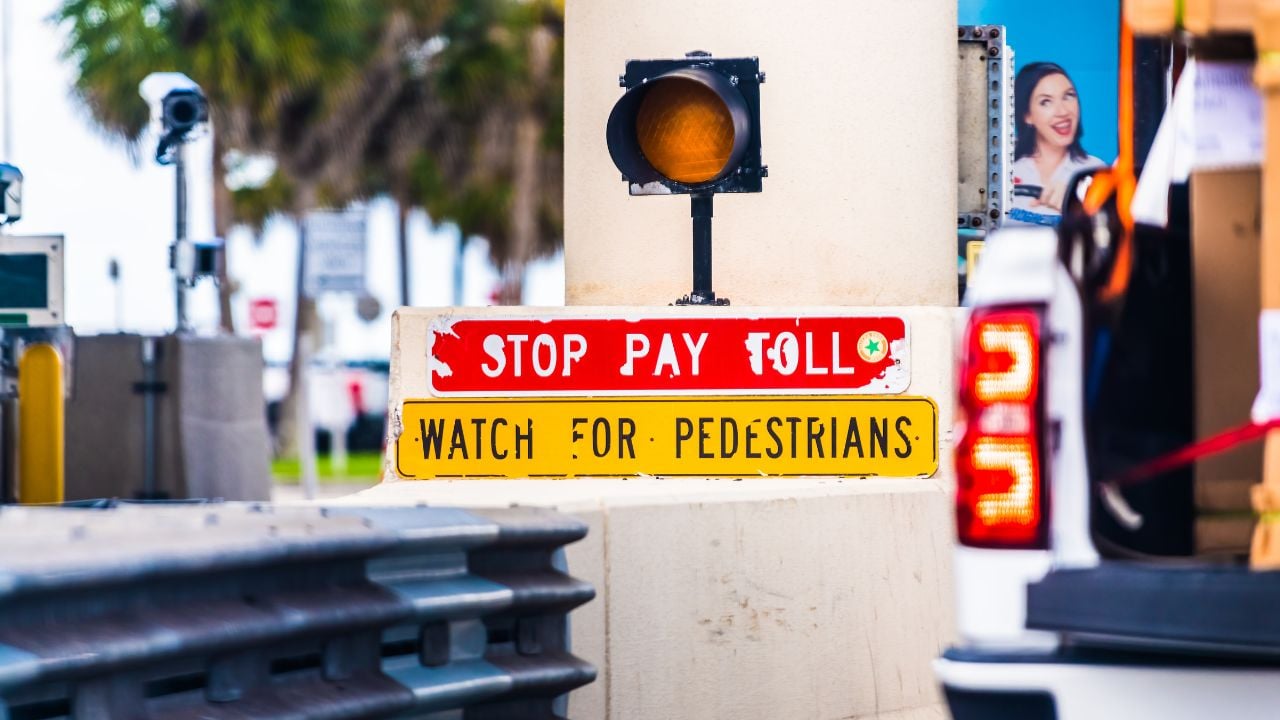
Overhead toll signs mark Florida's Express Lanes on I-95 and I-4, and those lanes run on SunPass transponders and nothing else.
Regular mainline toll roads send a bill in the mail when a transponder is missing.
Express Lanes carry no Toll-By-Plate billing option at all.
Drive through without a transponder, and it turns into a straight citation.
Someone used to a cash booth, or at least a bill showing up later, drives the express lane assuming they'll sort it out afterward.
There's nothing to sort out.
Florida doesn't excuse a missing transponder just because the driver didn't know.
7. Riding a Golf Cart's Bumper
Golf carts share public roads posted 30 mph or less across Florida, crossing faster roads at a light or a stop sign where the crossing is marked for it.
Whole communities, The Villages especially, are built around that rule.
A golf cart in the travel lane carries the same legal standing as any car.
That's the law.
Drivers who've only ever shared the road with other cars tailgate it instead, or swing out to pass blind on a curve, certain the cart doesn't belong there at all.
It belongs there more than they do.
8. Flipping on the Hazards for Rain
Driving with your hazard lights on became legal in Florida back in 2021, but only in a narrow set of conditions.
The rule only covers roads posted 55 mph or higher, and only during heavy rain, fog, or smoke.
Everywhere else, it's still against the letter of the law.
That's the whole exception.
Longtime residents know a Florida downpour blows through fast, so they slow down, flip on their headlights, and wait it out.
A transplant flips on the hazards for any drizzle, on any road, at any speed, a habit hauled down from somewhere the rule never applied in the first place.
Nobody behind them can tell if they're slowing, stopping, or stalled.
9. Waiting Out a Flashing Yellow Arrow
A flashing yellow left-turn arrow means permission to go under Florida's traffic code, as long as you yield to the oncoming traffic that has a green light.
It isn't a warning to stop, the way a steady yellow is.
Go, with caution.
New York, the state that sends Florida the most new residents, only started adding the flashing yellow phase to intersections in the western part of the state this decade.
Just a few dozen have it so far.
Local drivers ease into the intersection and turn the moment there's a gap in traffic.
A driver who's only ever turned on a solid green arrow sits through the flash instead, engine idling, certain the light is broken.
Six cars back up behind them before the cycle even finishes.
Nobody behind them knows Florida changed the signal years ago, only that the car up front clearly never got the memo.
9 Things That Instantly Mark You as a Florida Newcomer

Driving habits aren't the only giveaway.
From beach etiquette to how you order at the counter, Florida runs its own unwritten test for who's stuck around a while.
9 Things That Instantly Mark You as a Florida Newcomer
10 Florida Wildlife Rules People Break Just by “Being Friendly”
Florida's wildlife comes with its own rulebook, and many well-meaning newcomers break it without ever realizing.
A friendly wave at the wrong animal can land you a warning, or worse.
10 Florida Wildlife Rules People Break Just by “Being Friendly”
