
8 Warning Signs Floridians Buying Seafood Shouldn’t Ignore

Red snapper sold at South Florida seafood counters turned out to be a different fish entirely, 86% of the time, in a 2012 Oceana genetic (DNA) testing study.
It’s a sign that not every seafood counter in Florida is honest with shoppers about what’s for sale.
These are the warning signs Floridians shouldn’t ignore at the seafood counter.
Note: This is general information, not medical advice. Seafood-safety guidance and Vibrio vulnificus case counts change through the season, so confirm the current numbers with the Florida Department of Health.
1. Ammonia Smell
Fresh seafood shouldn’t smell like much of anything beyond a clean ocean breeze.
The U.S. Food and Drug Administration (FDA) says fish should smell mild, never fishy, sour, or like ammonia.
Trust your nose.
A strong ammonia edge means the fish or shellfish sat too long before it reached the case.
Florida’s heat speeds up that clock, since bacteria multiply faster on a warm counter than in a cooler climate.
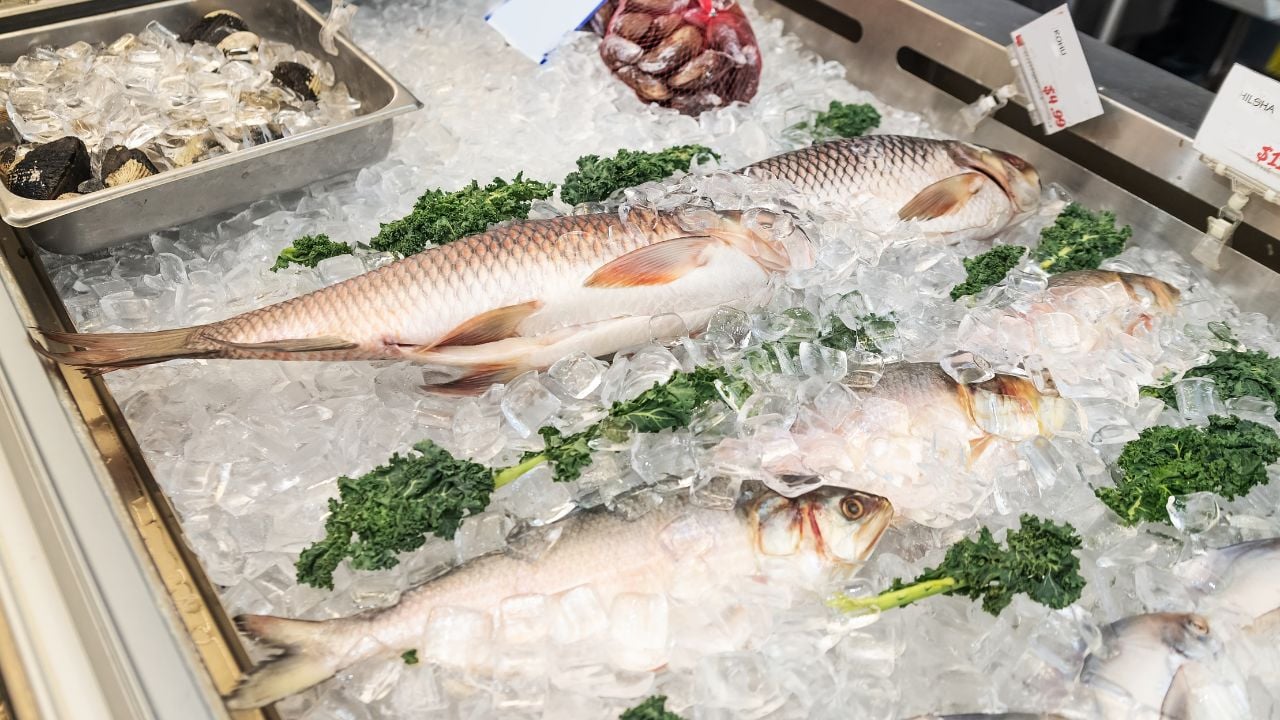
2. No Bed of Ice
Bacteria multiply fastest between 40 and 140 degrees, a range wide enough to cover much of a Florida afternoon.
That’s the danger zone.
FDA guidelines say seafood sitting in melted runoff on a foam tray, instead of a proper bed of ice or a refrigerated case, can drift right into that range.
A full ice bed under proper refrigeration is one of the basics a shopper can check before asking a single question.
3. Cloudy or Sunken Eyes
Grouper, snapper, and mullet often sit whole on Florida ice.
The eyes are one of the more reliable tells before you touch the fish.
Clear, shiny eyes belong on a fresh catch, not a cloudy or sunken look.
That’s the giveaway.
Sunken, cloudy, or filmy eyes mean the fish sat for days, whatever the sell-by sticker claims.
You can tell more about a whole fish’s age from its eyes than from any date printed on the label.
4. Dull, Dry Fillet Edges
Dark, dried, or curling edges are the first thing worth checking on a fillet at a Florida seafood counter.
FDA guidance flags that discoloration and drying around the edges as one of the clearest signs a fillet has been sitting too long.
Edges dry out first when a case’s humidity or turnover slips, a common issue at busy Florida counters during tourist season.
A fillet with dull, browning edges is already past its best day, even if the middle still looks fine.
Check the corners first.
5. No Tag on the Shellfish
A certification tag, not just a price sticker, belongs on every batch of oysters and clams sold at a Florida seafood counter.
Ask to see it.
FDA rules require that tag to show the shellfish was harvested and processed under national safety controls.
No tag means no way to trace where or when that shellfish came out of the water.
Florida’s Gulf and Atlantic waters carry Vibrio vulnificus naturally, which is exactly why that traceability matters.
What Vibrio Vulnificus Means for Florida Seafood Buyers
Florida’s warm, brackish coastal water is home to Vibrio vulnificus, a naturally occurring bacteria and the reason a seafood counter’s other rules matter so much.
Florida shoppers often run into it through raw or undercooked oysters, since the bacteria concentrates inside shellfish as they filter seawater.
People with liver disease, diabetes, cancer, or a weakened immune system face a much higher risk.
A study found they’re about 80 times more likely to develop a bloodstream infection than someone without those conditions.
Cooking shellfish thoroughly kills the bacteria.
Hot sauce or alcohol never will.
Psst! How much do you know about Florida’s commercial fishing history? Take our quiz and see how many you can get right.
Quiz
Florida Seafood IQ
Answer these questions on Florida’s fishing history and Gulf seafood trivia. We bet you can’t get them all right. Prove us wrong?
Shrimpers discovered a massive population of prized pink shrimp near which Florida location in late 1949, sparking a ‘Pink Gold Rush’?
6. Cooked Shrimp Near Raw Fish
Raw fish and shellfish shouldn't share a case with cooked shrimp or other ready-to-eat seafood at a Florida counter.
FDA guidance requires that separation to stop raw juices from reaching food nobody plans to cook again.
A shared case at a busy Florida market is exactly the setup where that cross-contamination happens.
Ask whether the shrimp ring or crab claws came from a case dedicated to cooked seafood before you add it to your cart.
One tray, two problems.
7. No Answer on Sourcing
Many Floridians buy their seafood at a supermarket or grocery counter rather than a dedicated fish market.
Federal rules require those counters to post a country-of-origin label, noting whether a fish is wild-caught or farm-raised.
That same U.S. Department of Agriculture (USDA) rule exempts small fish markets, butcher shops, and other sellers below a certain size, so the label isn't guaranteed everywhere in Florida.
A counter that can't say where a fish came from often can't back up what it's calling it either.
A 2012 Oceana genetic (DNA) testing study of South Florida seafood found red snapper mislabeled 86% of the time, in a sample of just seven fish.
Ask.
A country-of-origin label posted clearly on the case, before a shopper has to ask, is the sign worth looking for.
8. Flesh That Won't Spring Back
Seafood flesh should spring back when you press it, whether it's a fillet, a scallop, or a slab of tuna.
Press gently, not hard.
FDA guidance says shrimp, scallops, and lobster meat should look clear and pearly, never dull or sticky.
A mushy, dented press that stays sunk in is one of the last tells left on a fillet that already smells mild and looks fine.
That one small test at the counter catches what a clean smell and a full ice bed sometimes miss.
Who Inspects Florida's Seafood Counters
Florida's retail seafood markets, supermarkets, and grocery store seafood counters answer to the Florida Department of Agriculture and Consumer Services (FDACS), not just a local health inspector passing through.
FDACS fields complaints about a food product or business, seafood mislabeling included, through its own consumer complaint line.
A shopper who suspects a mislabeled snapper fillet or a shellfish tag that doesn't add up can file a report directly with the state.
Few shoppers know that.
Many never think to look.
FDACS relies on those reports to pull a bad batch before it reaches the next customer in line.
Apalachicola's Oysters Are Back
Apalachicola Bay's oyster fishery collapsed in 2013, and Florida kept the bay closed to harvesting from 2020 through the end of 2025 to let the reefs recover.
That's five years with zero legal harvest from a bay that once produced close to 90% of Florida's oysters.
A long dry spell.
The bay reopened for a limited season this January, its first harvest since the closure began, with the state capping the take at a few thousand bags.
The next harvest window opens October 1 and runs through February, so the oysters on Florida's seafood counters this fall could be some of the first fresh Apalachicola stock in years.
A shopper who spots "Apalachicola" on a shellfish tag this fall is looking at a genuine comeback story, not just a name on a sign.
14 Publix BOGO Buys Florida Shoppers Regret Missing Before the Sale Ends
Florida shoppers know the sting of saying "I'll grab that next time," only to find a Publix BOGO tag gone a few days later.
Some of those deals hurt more than others, especially the pricey cuts of beef and the household staples nobody wants to pay full price for.
14 Publix BOGO Buys Florida Shoppers Regret Missing Before the Sale Ends
11 Things Florida Grocery Cashiers Notice About You Within 10 Seconds

A Florida grocery cashier can read a cart before a shopper says a word, from the storm supplies stacked at checkout to the items rung up out of pure habit.
Some of what they notice comes straight from register training, and the rest comes from Florida rules nobody explains at the door.
11 Things Florida Grocery Cashiers Notice About You Within 10 Seconds
