
5 Utah Funeral Potato Rules Nobody Writes Down

The sign-up sheet taped to a Utah ward’s Relief Society bulletin board says nothing about menus. It asks only for names, oven space, and how many nine-by-thirteen pans of funeral potatoes each volunteer can spare by Thursday.
Out-of-staters take one look and wonder why nobody gets to choose a dish.
The menu isn’t up for debate.
These are the Utah funeral potato rules nobody writes down.
1. The Ward’s Job, Not the Family’s
Funeral potatoes answer to a chain of command that starts with the bishop, not with the family sitting in the front pew.
Under the Church’s General Handbook, the bishop takes charge when a ward member dies, then assigns the ward’s Relief Society and elders quorum presidencies to work out the details.
Family doesn’t run the meal.
Those assignments reach past the kitchen.
The handbook lists notifying relatives, drafting the obituary, arranging with the mortuary, and dressing the body for burial among the tasks a bishop can hand off.
Temple clothing goes on the body where possible, per the handbook’s burial guidance.
The handbook doesn’t spell out a casserole schedule. Wards built that meal tradition on top of the broader assignment over generations, and the potatoes are the part everyone notices.
Nobody circulates a sign-up sheet asking a grieving family what they would like to eat because the ward already decided long before anyone thought to ask.
2. Same Four Parts, Every Time
Funeral potatoes hold to the same four-part build in every ward kitchen, even though no recipe card anywhere enforces it.
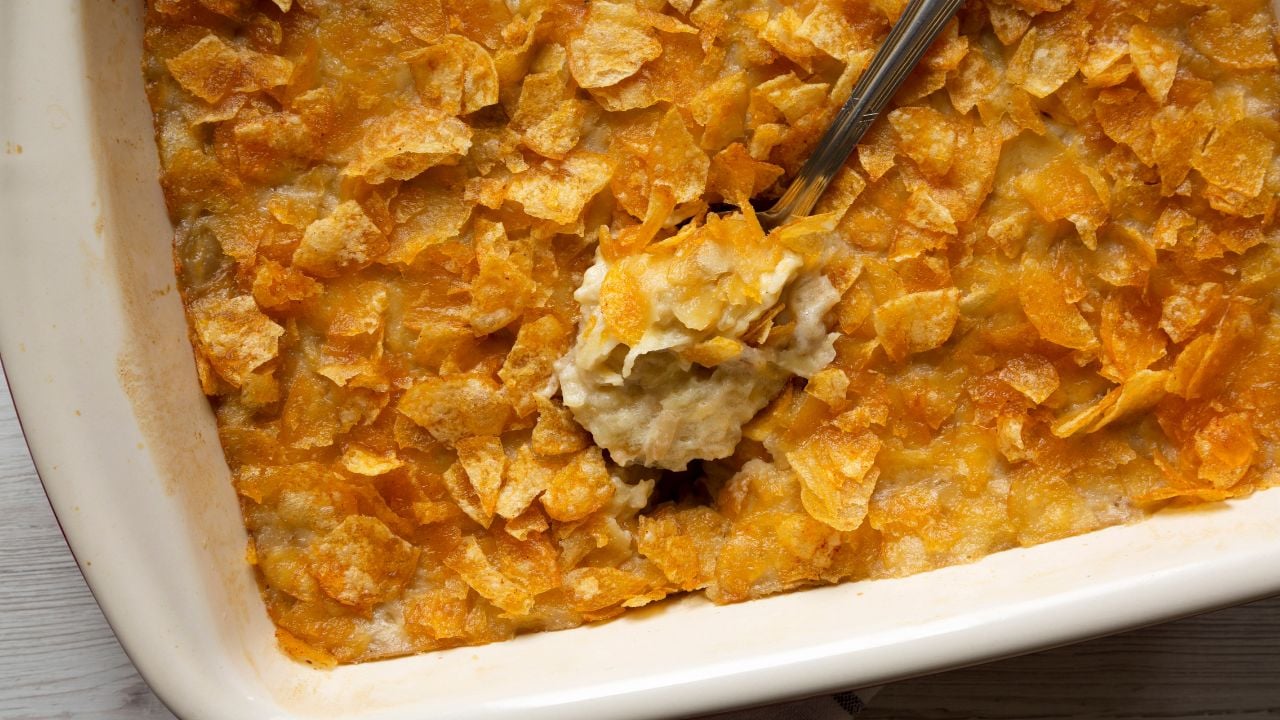
A potato base, a creamy binder of soup and sour cream, a heavy hand of cheese, and a crunchy topping of cornflakes or potato chips make up the structure.
The four parts survive by imitation, not documentation.
Many versions lean on mild cheddar, though a cross with Monterey Jack has become common enough that neither one reads as the wrong choice.
Cheese-type loyalties don’t matter here.
Ward kitchens bake it low and slow, commonly 350 degrees for about an hour, until the top browns and the center turns molten. That skeleton is the one thing every version shares, no matter whose grandmother’s handwriting is on the recipe card.
What Makes It a “Hot Dish”
Food writers place funeral potatoes inside a wider casserole family that Salt Lake Magazine calls the genus Hot Dish, native to the northern plains of the Midwest.
A hot dish, by that definition, is any baked casserole built around a starch, a cream-based binder, and cheese. Utah’s version takes that exact shape, even though it grew up hundreds of miles from where the category started.
Midwestern hot dishes and Utah’s funeral potatoes share the same bones. Both trace back to mid-century pantry cooking, built around a can of cream soup instead of a from-scratch sauce.
3. Life Beyond the Funeral
Funeral potatoes show up at wedding receptions, family reunions, and ordinary ward potlucks with no funeral anywhere on the calendar, and hosts rarely bother renaming the dish for the occasion.
That contradiction became a national punchline in 2018, when Walmart began stocking a boxed mix from Augason Farms, a Utah company, labeled plainly as funeral potatoes.
Shoppers outside Utah, seeing the name on a store shelf for the first time, met it with a mix of confusion and dark humor.
The name stuck anyway.
Nothing about the recipe changed. Only the audience reading the label did.
4. The One Approved Shortcut
Utah’s funeral potatoes allow exactly one shortcut: Starting from a bag of frozen hash browns instead of peeling and dicing potatoes from scratch.
That substitution has become common enough that recipe writers treat it as the default, not the exception.
That leniency exists for a practical reason: Dicing potatoes for a pan large enough to feed a ward’s worth of mourners eats an afternoon nobody grieving has to spare.
Everything else stays scratch-made.
Swapping the cream soup, skipping the cheese, or trading cornflakes for something unrelated marks a version as another family’s take, not a shortcut.
5. Competing Originals
No single, agreed-upon original recipe for funeral potatoes survives on paper, and cookbook historians describe the dish’s true birth as unresolved. Into that gap, every family has planted a flag.
Nobody wins that argument.
A grandmother’s version, passed down with her choice of soup and her topping, becomes the family’s definitive one, not a variation. Gently suggest at a ward potluck that somebody’s topping choice is unconventional, and the friendly argument that follows will settle how seriously the claim is held.
Psst! Think you know Utah food culture past the potatoes? Take the quiz.
Quiz
Utah Food Culture IQ
Local pride is on the line. No peeking at a search engine.
Who is usually credited with inventing Utah’s fry sauce, and where?
The Uncertain Origin Story
Funeral potatoes carry no fixed birth certificate. Food historians agree only that by the mid-1900s, the casserole was already a fixture in Utah kitchens, without pinning down how many years earlier it took hold.
Credit usually lands on the Relief Society, whose early cookbooks hold the first written versions of the recipe, though nobody can name the cook who invented it.
Competing theories point elsewhere. Some food writers trace a similar casserole tradition in the American South, built on the same canned-soup logic and served at potlucks with no funeral attached either. Others suspect the local version descends from a budget stand-in for French potatoes au gratin, built from pantry staples instead of cream and butter.
No one ever settled it.
The clearest evidence that the dish's roots reach past Utah's borders comes from an unlikely place. A 1957 Relief Society cookbook from New Zealand holds it.
That cookbook's recipe, called scalloped potatoes supreme, calls for sliced potatoes, a white sauce, a heavy hand of cheese, and cream of mushroom soup with onion and pepper.
That's the same mid-century pantry logic as Utah's version, minus the funeral name.
9 Utah Foods and Drinks That Confuse Out-of-Staters

Mormon pioneers reached the Salt Lake Valley in 1847 with wagon rations and little else, and Utah's kitchens never fully shook that make-do streak.
These are the Utah foods and drinks that catch out-of-staters off guard, appetite included.
9 Utah Foods and Drinks That Confuse Out-of-Staters
16 Things That Make Utahns Look Cheap Without Realizing It

There's a difference between being smart with money and looking stingy.
Many Utahns cross that line more easily than they'd expect, even when being cheap was never the goal.
