
9 Things That Explain Kansas to Someone Who’s Never Left the Coast

Ocean views are one thing.
Kansas views are another.
A lot about daily life in Kansas will surprise you if you’ve only known the coast.
Here’s a crash course for anyone raised near the water.
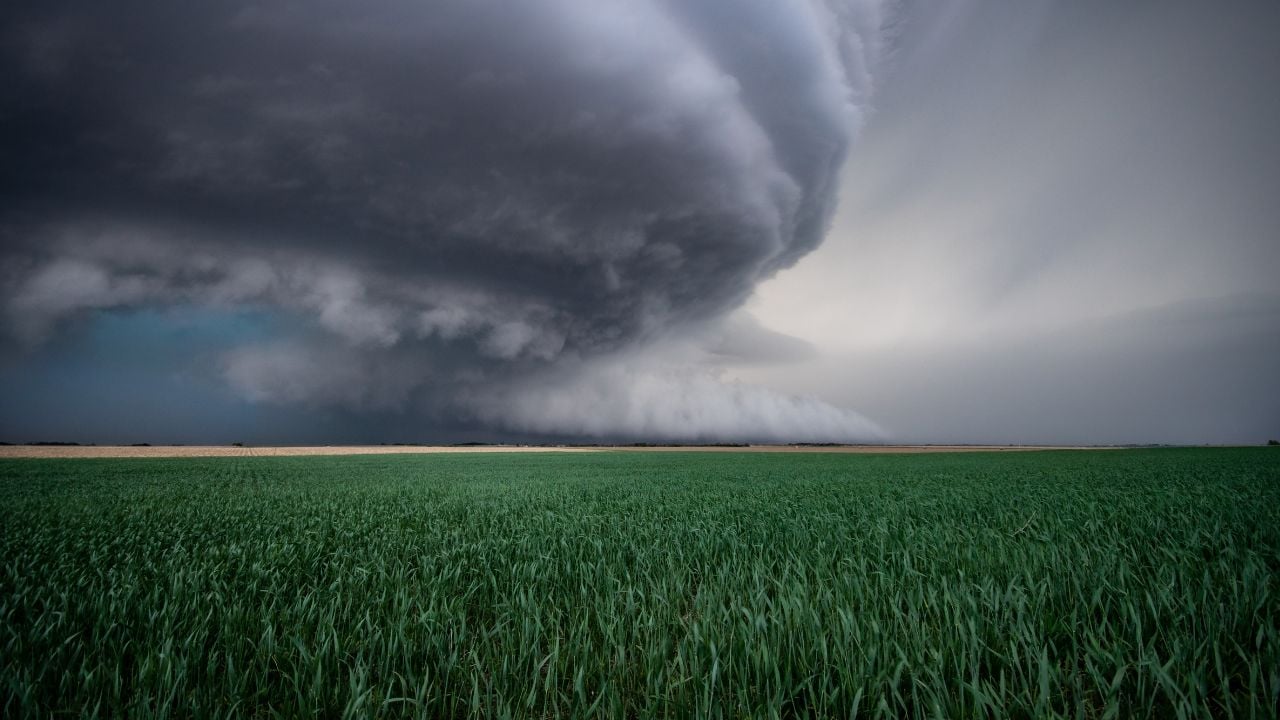
1. Tornado Siren Culture
Tornado sirens are just part of the background noise.
In the ten years through 2012, the state averaged 112 tornadoes a year, according to the National Weather Service.
Nobody flinches.
Sedgwick County alone runs a network of more than 150 outdoor sirens, first tested on April 22, 1952, and the county’s original 13-siren system went live the next year.
These days, Sedgwick County Emergency Management tests them every Monday at noon, unless it’s a holiday or the sky already looks threatening.
Hear one on a calm Monday and you can relax: It’s the test, not a warning.
Stick around long enough, and you’ll stop noticing it too.
2. Flint Hills Burn Season
Ranchers across the Flint Hills set fire to their pasture on purpose.
The burning is why it still looks like prairie instead of scrub forest, according to the U.S. Environmental Protection Agency (EPA).
Fire clears out eastern red cedar and other woody growth that would otherwise choke out the native tallgrass.
If you drive through in early spring, you might catch it happening: Ranchers burn an average of 2.1 million acres across the Flint Hills every spring.
Grassland wins.
The burn keeps the Flint Hills able to support more than a million head of cattle through the grazing season.
Many ranchers build their spring calendar around it, the same way other farmers build one around a harvest.
How Big Is Kansas’s Spring Fire?
Kansas’s Flint Hills burn covers roughly 3,280 square miles once you convert the 2.1 million acres into square miles.
That burning happens in March and April, according to the Kansas Department of Health and Environment.
The EPA’s guidance asks ranchers to shift some burning to late summer or early fall instead.
So much smoke landing in those same spring weeks drags down regional air quality, and if you live downwind, you’ll smell it before you see the haze on the horizon.
3. State Motto’s Origin
Kansas’s state motto wasn’t chosen for comfort, and the history behind it explains why.
About 56 people were killed in the guerrilla fighting known as Bleeding Kansas, the violence over whether the territory would enter the Union free or enslaved.
Kansas entered the Union as a free state on January 29, 1861, becoming the 34th state.
Four months later, on May 25, 1861, the new legislature adopted “Ad Astra per Aspera,” to the stars through difficulties, as the state motto.
Lawmakers put it on the state seal that same year.
Atchison state senator John J. Ingalls gets the credit for the phrase.
One senator wrote it.
You can still see the wording on the state seal today, ringed by 34 stars for the state Kansas was when it joined.
You can still feel that intent behind the phrase today.
Kansas Tourism, the state’s tourism office, still calls the motto a reminder that adversity is the path to strength, not the end of the road.
Lawmakers adopted the motto nearly 165 years ago.
4. Two Counties on Mountain Time
Central time covers almost all of Kansas, except for two far-southwestern counties.
Federal regulation draws the Central-Mountain time line east and north of Sherman, Wallace, and Wichita counties.
It then cuts south along the edge of Greeley and Hamilton counties before it reaches Colorado.
Only Greeley and Hamilton land on the Mountain side of that line.
Two counties break the pattern.
So if you’re calling ahead to a business in the far southwest corner of the state, check which county you’re dialing before you assume the time.
5. Long Wait for a Drink
Kansas banned alcohol early.
Letting go of that ban took decades.
Voters ratified a constitutional prohibition amendment in November 1880, and it took effect on May 1, 1881.
The statewide ban lasted until 1948, when voters repealed it by a vote of 422,294 to 358,485.
Even under the rules that followed repeal, a bar still couldn’t sell you a mixed drink over the counter.
You couldn’t even get it by the glass, either.
Kansas voters didn’t approve liquor by the drink until 1986, according to state legislative records.
Even that vote, which passed 60 percent to 40 percent, left the decision to each county rather than settling it statewide.
As of 2026, some Kansas counties still vote to stay dry, so what you can order can depend on which side of a county line you’re sitting on.
Psst! Kansas has more myths attached to it than you’d guess. See how many you can call before you flip.
6. Brown v. Board
Brown v. Board of Education, which the National Park Service calls one of the most significant Supreme Court rulings ever delivered, traces straight back to a school in Topeka, Kansas.
Monroe Elementary was one of four segregated schools for Black children in Topeka, which the National Park Service now preserves.
The case built around that school reached the U.S. Supreme Court, and the 1954 ruling struck down school segregation nationwide.
The Supreme Court combined the Topeka case with four similar lawsuits from Delaware, South Carolina, Virginia, and Washington, D.C.
The National Association for the Advancement of Colored People (NAACP) organized the lawsuits.
You know the whole ruling by its Kansas name because NAACP lawyers put Topeka father Oliver Brown’s name at the top on purpose.
You can walk through Monroe Elementary today, and it runs as a visitor center.
The building is the exhibit.
7. Border War’s Roots
The Border War nickname for the Kansas-Missouri rivalry started out as an actual war, not just something you’d hear about at a tailgate.
William Quantrill led a band of pro-Confederate raiders across the state line and into Lawrence on August 21, 1863, according to the Kansas Historical Society.
The raiders killed around 150 men and burned more than 200 homes and businesses.
It happened in one morning.
Historians count it among the deadliest single strikes of the border fighting that spilled out of Bleeding Kansas and into the Civil War.
You can still hear the echo of it whenever Kansas and Missouri fans argue over who owns the name.
8. Map Full of Counties
Kansas splits its local government into 105 separate counties, according to the University of Kansas’s Institute for Policy and Social Research.
Many of them run a full sheriff’s office, courthouse, and set of elected commissioners.
Add up 105 courthouses.
You get a lot of local government to keep straight.
You can cross three or four county lines on a single errand and never notice.
Nothing changes but a road sign and a new set of local officials technically in charge.
That means 105 separate county governments to keep track of instead of a handful of big counties.
Psst! How much do you know about Kansas trivia? Take our quiz and see if you can ace it.
Quiz
Kansas Trivia IQ
Answer nine questions on Kansas symbols, landmarks, and firsts. We bet you can’t get them all right. Prove us wrong?
Kansas has an official state flying fossil. What kind of creature is it?
9. Farming on Ancient Water
Western Kansas farms on water that fell as rain thousands of years ago, and that water isn't coming back at the same rate it's being used.
The High Plains Aquifer supplies 70 to 80 percent of the water Kansans use every day, much of it drawn up for irrigation, according to the Kansas Geological Survey.
You can see the strain clearly in the numbers.
Corn and wheat irrigation in southwest Kansas alone added more than $900 million to the state's economy in 2013.
That's the trade-off.
Water levels in parts of southwest Kansas have already dropped more than 100 feet since farmers first tapped the aquifer.
A cluster of west-central counties, Greeley, Wichita, Scott, and northern Finney, now has less than 30 feet of water left in many spots.
Kansas pulled more than 3 million acre-feet of groundwater from the aquifer between 2012 and 2021, while natural rainfall puts back only about 0.75 million acre-feet a year.
If you fly over western Kansas, the circles of green center-pivot irrigation stand out against the dry-looking ground around them.
Those green circles are pulling from the same aquifer that lost more than 3 million acre-feet in just nine years, while nature feeds back only 0.75 million a year in return.
5 Mistakes Kansans Make When Taking Pets on a Road Trip

Leaving a pet in a parked car during a Kansas summer can turn dangerous fast, even with the windows cracked.
That's one of several mistakes Kansans make when they bring a pet along on a road trip.
5 Mistakes Kansans Make When Taking Pets on a Road Trip
6 Kansas Foods That Out-of-Staters Try Cautiously

German-Russian Mennonites carried a bread roll stuffed with beef and cabbage into central Kansas when they settled Marion, Harvey, and McPherson counties starting in 1874.
You can still find it, called a bierock, in bakeries across those same counties today.
