

Why Does Michigan Car Registration Cost So Much More on a Newer Car?

Buy a newer car in Michigan, and your registration bill can come as a shock.
The tax starts from your car’s list price, not what it’s worth today.
Here’s why Michigan car registration costs so much more on a newer car, and when the bill starts to drop.
Note: This is general information, not legal or tax advice. Registration rules and fees are subject to change, so confirm the current figures with the Michigan Secretary of State.
Why Michigan Car Registration Is Expensive
Michigan car registration on a newer car starts with a price table written into state law.
The Secretary of State says the fee follows a formula built on your vehicle’s list price from the year it was made.
The first bracket is $36 for a vehicle that listed at $6,000 or less.
For nearly every extra $1,000 of list price, you pay $6 more.
A vehicle that listed at $30,000 owes $178.
Past $30,000, any fraction of $1,000 counts as a full $1,000 step.
Go over $30,000 by a single dollar, and you owe $6 more.
Registration Tax by List Price
Michigan car registration tax on a vehicle listed at $20,000 is $118 in its first year.
Step up to $25,000, and the bill is $148.
At $35,000, five more $1,000 steps add $30 to the $178, for $208.
If your vehicle listed at $45,000, you owe $268.
A $60,000 list price brings $358, roughly triple the $118 at $20,000.
Those figures leave out the plate and add-on fees, so your total runs higher.
How Michigan Defines List Price
Michigan car registration tax is based on list price, which state law defines as the manufacturer’s suggested base list price published by the Secretary of State.
If the state hasn’t published a price for your vehicle by the time of sale, the price on the vehicle’s required sticker label applies.
If neither price exists, the state uses what you paid for the vehicle.
For 2014 and newer vehicles, the state’s registration page points you to J.D. Power for the price.
Why Older Vehicles Pay Less
If your newer car is in its first model year, Michigan car registration gets cheaper at each of your next three renewals.
Each of those renewals is billed at 90% of the year before.
On the $35,000 example, the tax falls from $208 to about $150 by the fourth year.
After that, the state provides no further reduction.
Buying used doesn’t restart the clock since the tax counts from the vehicle’s model year.
If you register a 2023 model in 2026, you pay the lowest rate in the schedule.
A 2026 or 2027 model registered in 2026 pays the first-year rate.
If you’re buying from a private seller, our guide to a private car sale covers the paperwork.
Psst! How well do you know the road firsts Michigan can claim? Take our quiz and see if you can ace it.
Quiz
Michigan Road Firsts IQ
Answer nine questions on the road firsts Michigan can claim. We bet you can’t get them all right. Prove us wrong?
Michigan built the nation’s first mile of concrete highway. In which year did the Wayne County Road Commission finish it?
Higher Rates Since 2017
Lawmakers raised Michigan car registration taxes for passenger vehicles 20% on January 1, 2017, under a 2015 law.
The increase covered passenger vehicles manufactured after 1984, not only new ones.
A percentage increase adds the most dollars to the highest brackets, so if your newer car sits in one, you feel the increase most.
That law also added new fees for electric and plug-in hybrid vehicles.
Electric and Plug-In Hybrid Fees
Michigan car registration costs an extra $267 if your vehicle runs only on electricity.
A plug-in hybrid adds $113 instead.
Trucks and buses pay $367 for an electric vehicle and $183 for a plug-in hybrid.
If your newer electric vehicle listed at $45,000, you owe $268 in price-based tax plus the $267 fee, or $535 before the plate and add-on fees.
For vehicles weighing 8,000 pounds or less, the 2015 law set the add-ons at $100 for an electric vehicle and $30 for a plug-in hybrid.
Both fees are also tied to the gas tax.
The electric vehicle fee goes up $5, and the plug-in hybrid fee $2.50, for every cent the gas tax goes above 19 cents a gallon.
A fall 2025 road funding deal reset Michigan's fuel tax from 31 cents to 52.4 cents a gallon, while ending the 6% sales tax on gas.
Bridge Michigan reported in January 2026 that the deal raised the electric vehicle fee on light-duty vehicles from $160 to $267.
The plug-in hybrid fee went from $60 to $113.
At that point, Michigan's electric vehicle fee was the highest among the 40 states that charge one.
Psst! How much do you know about Michigan's roads? Take our quiz and see how many you can get right.
Quiz
Michigan Road Facts IQ
Answer nine questions on the numbers behind Michigan's roads. We bet you can't get them all right. Prove us wrong?
Michigan's first road map, with only three roads, came out in 1826. Who published it?
Plate Fees and Sales Tax
A newer car's first Michigan registration comes with a few fixed charges on top of the price-based tax.
A standard plate costs $5.
State law also adds a $2.25 regulatory fee and a $5.75 administration fee to the price-based tax until October 1, 2027.
That puts first-year registration on a $35,000 vehicle at $221 with a standard plate.
When you transfer a title into your name and register the vehicle, the state also collects 6% sales tax.
That tax isn't part of registration, but you pay it at the same visit.
Six percent of $35,000 is $2,100, about ten times the $208 registration tax.
A Recreation Passport or personalized plate adds more, but both are optional.
The state's Registration Fee Calculator lets you calculate registration fees for your vehicle.
FAQ
Here are short answers on registering a newer car.
Why is Michigan car registration so expensive?
Michigan sets the tax from the vehicle's list price, so a pricier vehicle pays more.
A newer vehicle also pays a higher rate, since the tax steps down 10% a year only through the third year after its model year.
How much does it cost to register a $35,000 car in Michigan?
A vehicle that listed at $35,000 owes $208 in price-based tax in its first year.
With a $5 standard plate and $8 in state add-on fees, the total comes to $221.
Does Michigan registration go down every year?
Yes, if your vehicle is in its first model year when you register it, the tax drops 10% at each of your next three renewals.
Used vehicles follow the model year, not your purchase date.
How much is the electric vehicle fee in Michigan?
Michigan charges $267 for an electric vehicle and $113 for a plug-in hybrid, on top of the regular registration fees.
Trucks and buses pay $367 for an electric vehicle and $183 for a plug-in hybrid.
Where can I find my vehicle's list price?
The Secretary of State points to J.D. Power for the price of vehicles 2014 and newer.
The state's Registration Fee Calculator then calculates the fee for your vehicle.
9 Signs Someone Was Raised in Michigan No Matter Where They Live Now
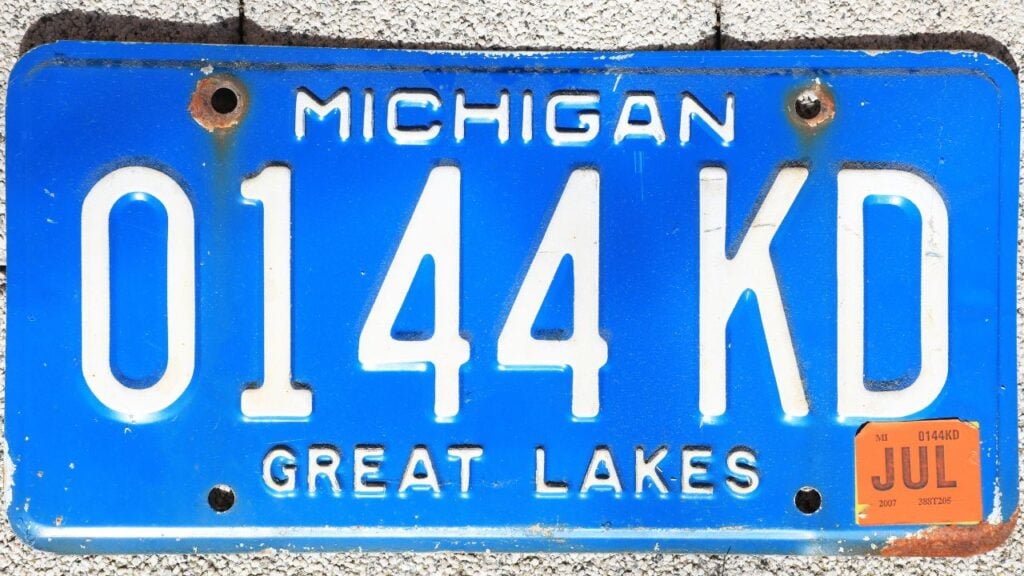
A Michigan childhood leaves a few habits that never wear off.
See how many of these signs still give you away.
9 Signs Someone Was Raised in Michigan No Matter Where They Live Now
10 Ways One Side of Michigan Feels Like a Different State From the Other

Michigan stretches far enough that its two halves barely feel like one state.
Find out where the line between them falls.
10 Ways One Side of Michigan Feels Like a Different State From the Other
