
You Could Save Over $3,000 a Year by Switching Grocery Stores in Minnesota

Where you shop can matter as much as what you buy.
A price check of stores around the Twin Cities found big gaps between grocery chains, and those gaps add up big over a year.
Here’s how much Minnesotans could save by switching grocery stores.
What Checkbook Measured
Consumers’ Checkbook compared grocery prices at stores across the Twin Cities area. Its page on the results was last updated in November 2025.
It priced a 150-item list of common items.
It then measured each store against the average price at all the stores.
A store 21% below average charges you about $79 for what costs $100 at the average store.
An example turns that gap into dollars.
A family that spends $300 a week at the supermarket would save $3,276 a year.
Customers were also asked about quality. The “superior” ratings in this piece come from those answers.
It only looked at Twin Cities-area stores. So these figures describe that market, not prices in Duluth or Rochester.
These are the stores found cheaper than average, starting with the biggest gap.
ALDI’s 41% Edge
ALDI posted the widest gap on the list. Its prices ran about 41% below the all-store average.
Brands differ so much at ALDI and Trader Joe’s that Checkbook built a modified market basket for those two.
So their numbers rest on that adjusted list.
The examples on that page include $3,276 and $2,028 a year. The yearly ALDI figures here come from simple multiplication.
Say you’d spend $300 a week at an average store. At ALDI, you’d save about $123 a week.
That’s $6,396 over 52 weeks, more than double the $3,000 mark.
Walmart’s 21% Edge
Walmart’s gap is the same 21% that the $3,276 example uses.
Walmart was measured against the average at all the other stores. That’s not quite the same yardstick as ALDI’s.
On a $300 weekly budget, that’s $63 saved a week. That’s enough to put Walmart over $3,000 a year.
Quality is the trade-off.
Only 14% of Walmart’s customers rated it “superior” for overall quality in Checkbook’s survey.
That’s your call.
What Checkbook’s $3,276 Grocery Savings Assume
The $3,276 example rests on a $15,600 yearly grocery bill. That’s $300 a week for 52 weeks.
21% of $15,600 is $3,276.
The $300 is the budget picked for the example, not a figure you have to match.
If you spend $200 a week, 21% comes to $2,184 a year.
Trader Joe’s and Target
Trader Joe’s sits about 17% under the all-store average in Checkbook’s survey.
Target sits about 13% under.
At $300 a week, Trader Joe’s 17% saves you $2,652 a year.
Target’s 13% matches the gap in the other example, which totals $2,028 a year.
Neither gets you to $3,000.
Quality is where the two part ways.
82% of customers rated Trader Joe’s “superior” for quality, against 36% for Target.
So the cheaper store of the two also drew the higher rating.
So the cheaper store of the two also drew the higher rating.
Stores Priced Above Average
On Checkbook’s page, four stores cost more than the all-store average. They are Fresh Thyme, Whole Foods, Lunds & Byerlys and Kowalski’s.
Kowalski’s was the priciest.
Its prices ran about 19% above the average.
On a $300 weekly budget, that adds up to $2,964 a year more than you’d pay at an average store.
Fresh Thyme, Whole Foods and Lunds & Byerlys cost more too.
On the same $300 budget, that’s $624 a year more at Fresh Thyme (about 4% higher), $1,404 more at Whole Foods (about 9%) and $1,716 more at Lunds & Byerlys (about 11%).
Customers rated both Kowalski’s and Lunds & Byerlys well overall. They also rated their produce and meat well.
Smaller Weekly Budgets
Savings shrink with your budget.
At $150 a week, ALDI’s 41% gap still comes to $3,198 a year.
Walmart’s 21% comes to $1,638.
Drop to $100 a week, and the savings fall to $2,132 a year at ALDI and $1,092 at Walmart.
Spend about $141 a week at an average store, and ALDI’s 41% tops $3,000 a year.
Hy-Vee Versus Cub
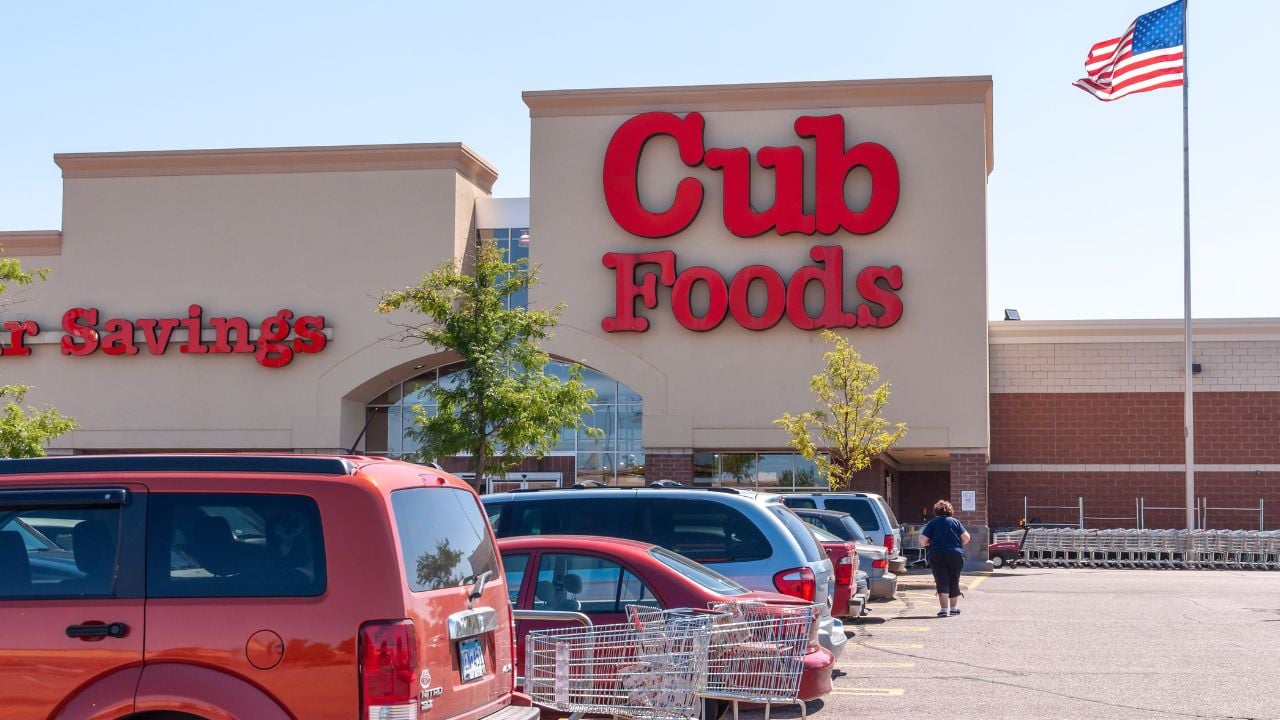
Hy-Vee’s grocery prices averaged about 8% lower than Cub’s in Checkbook’s survey.
That gap was measured against Cub, not the all-store average. So you can’t add it to the other percentages here.
If you spend $300 a week at Cub, 8% works out to $24 a week, or $1,248 a year.
At $200 a week, that 8% comes to $832 a year.
Customers rated Hy-Vee “superior” overall at 56%, against 38% for Cub. So the cheaper store also drew the higher rating.
Psst! Where does your grocery store land? Sort Checkbook’s figures and see how much you’d save or spend.
A 22-Item Grocery Basket Check
Bring Me The News priced 22 items at 12 Twin Cities grocery stores.
It published the comparison in April 2025.
If you’d bought that basket at ALDI, you’d have paid $65.59.
At Walmart it was $66.37.
At Kowalski’s it was $136.80, about double ALDI.
It’s a separate test, so you can’t blend those totals with Checkbook’s percentages.
Prices had moved since 2024, too.
Fresh Thyme was the only store on the list that was cheaper than the year before, down 3%.
ALDI’s basket rose 14%, the steepest jump, though it was still the cheapest basket.
7 Lake Access Rules That Cost Minnesota Property Owners Their Frontage

Owning shoreline on a Minnesota lake doesn’t always mean you control the water in front of it.
Lake access rules can leave you stuck with a neighbor’s dock.
7 Lake Access Rules That Cost Minnesota Property Owners Their Frontage
7 Signs the First Frost Is Close in a Minnesota Backyard

A frost advisory buzzing on your phone is the easy warning to spot.
Your backyard gives you other hints before the forecast does.
